
“Books are a uniquely portable magic.”
― Stephen King
“Books are a uniquely portable magic.”
― Stephen King
 This is Doris Lessing’s first novel, published in 1950. She has another three on the 1001 List.
The setting is 1940s rural Rhodesia. The opening lines are:
Murder Mystery
by Special CorrespondentMary Turner, wife of Richard Turner, a farmer at Ngesi, was found murdered on the front verandah of their homestead yesterday morning. The houseboy, who has been arrested, has confessed to the crime. No motive has been discovered.
It is thought he was in search of valuables.
And from there we join the story of Mary and Dick Turner starting, at the end of things, with Mary’s death and the arrest of Moses, the houseboy.
Mary is from a poor white family, where her mother struggled to look after them and her father was overly fond of alcohol. Her childhood leaving a huge psychological scar on her. As she grows up she finds success as a single woman, working happily in a good job and enjoying an active social life with her many friends and acquaintances. One day she overhears an insulting comment from people she thought of as friends, and determines then and there to marry.
Along comes Dick Turner, a poor farmer who is on his annual town visit, taken by chance to the movies where he sees Mary and then pursues her only to be absent for months before returning. They marry in short order, and it is the first sign that things are now set in train that will end in Mary’s death.
Dick takes her to his farm, which he mishandles. Mary believes she will adapt but the circumstances of their poverty-stricken existence, coupled with the pride that both of them cling to, means that they set themselves apart from the surrounding white community. Dick is entranced by the land and Mary comes to hate it.
The underlying commentary of the novel is that of the mindset of white Rhodesians towards their native workers, and how their community holds itself together. Mary is an overt and cruel racist. She is an intolerable mistress to her houseboys and fires them for the most trivial things. Dick, also holds similar views, but is less vocal and cruel with them. At one point Mary starts to feel he is almost like one of the field labourers. The story displays all the nastiness of the colour bar mentality.
A passage in the second half of the book expresses something of this.
What had happened was that the formal pattern of black-and-white, mistress-and-servant, had been broken by the personal relation; and when a white man in Africa by accident looks into the eyes of a native and sees the human being (which it is his chief preoccupation to avoid), his sense of guilt, which he denies, fumes up in resentment and he brings down the whip.
Yet, despite that repulsive attitude, there is still something of pity to be had for Mary. She is clearly a broken person from her childhood and marrying in haste to a man who takes her back into the poverty from which she had escaped opens up all of her earlier experiences once again. She becomes her mother, only on a farm. Her personal disintegration is painful to watch, as is her attitude and behaviour towards the native workers.
The same can be said for Dick Turner. Over the course of the novel, he too begins to unravel. His inability to complete tasks and take a pragmatic view of his farm keeps them in continuous penury. His inability to understand Mary, and her distance from him, especially after she sees his mismanagement first hand, eats at him also. To me it seems like the title was made for him…the grass sings for him… he is obsessed with the farm and this becomes his undoing.
The book is full of easy language, appropriate for it’s time and expressing the values of the people described. The subject matter is harsh and Lessing doesn’t hold back in her prose.
It is a small book, coming in at just over 200 pages, but it is a challenging one. Watching people self-destruct and misuse other humans is never going to be light reading, but it is well worth your effort to expand your understanding of life in Southern Africa in mid-century, in order to begin to understand the Southern Africa of today.
Happy reading.
 Steppenwolf is the story of Harry Haller, a man who is miserably struggling to deal with two very different aspects of his personality – one of these he views as a man and the other as a wolf. He finds his ‘man self’ excited by the trappings of the bourgeois lifestyle he more or less leads, but his ‘wolf self’ hates it and finds it ridiculous. He is only really happy in the moments where he can feel completely man, or completely wolf. These moments are few and far between.
Soon Haller meets Hermine, a woman who tells him she is just like him, and spends an unforgettable night in a theatre “for madmen only.” The bulk of the novel is Haller’s experiences in the theatre and their impact on the condition of his dual soul.
I was surprised at how accessible and digestible this novel was, based on what I’ve heard and read about Hesse in general. Though I will admit it did give me a few nights of very intense dreams, especially the night I put the book up and went to sleep in the middle of Harry’s theatre visit.
While I know very little about philosophy, Eastern or Western, and have just a basic understanding of Jung’s work, it’s easy to see their influence here.
The multiplicity of the soul:
“In reality, however, every ego, so far from being a unity is in the highest degree a manifold world, a constellated heaven, a chaos of forms, of states and stages, of inheritances and potentialities.”
Humans as a grand experiment:
Man is “nothing else than the narrow and perilous bridge between nature and spirit. His innermost destiny drives him on to the spirit and to God. His innermost longing draws him back to nature, the mother.”
The unimportance of physical objects:
Experiences are our “life’s possession and all its worth.”
And the fluidity of the soul:
“My personality was dissolved in the intoxication of the festivity like salt in water.”
I was very impressed with Harry as a character. His struggles, while extreme, make a lot of sense and express what I know that I certainly feel occasionally – that life can lack a sense of progress or greater purpose, leaving dissatisfaction and lack of motivation. In the end, and I don’t think this is a spoiler, Hesse’s answer for Harry is this:
Just like the radio spoils and beslimes music “and yet cannot altogether destroy its spirit, just so does life, the so-called reality, deal with the sublime picture-play of the world and make a hurley-burley of it…All life is so, my child, and we must let it be so; and, if we are not asses, laugh at it.”
Easier said than done, and difficult to wrap the mind around, of course. Seeing as how we’re alive, living life and have been as long as we’ve had consciousness, we can’t really get an outside perspective on this the way we can on music. But it is helpful as a reminder to relax and remember that not everything is rational, nor does it need to be.
My favorite part of the book was the surreal, bizarre culminating scene (the last third of the book, really) because I was very intrigued and impressed with how Hesse took the conscious thoughts and actions of Harry and developed a fitting subconscious dream-world that served as both a source of and an outlet for who Harry is and what he believes. It’s an impressive feat of writing.
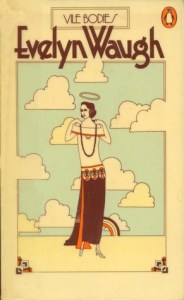 I first laid eyes on Vile Bodies back in 1989 while travelling through Europe on my OE with a friend from university. It was my first time reading the very English wit of one of the Waugh family and I remember absolutely loving it. It fit in with my penchant (then and now) for stories written or set between the two world wars.
This was all brought back to me when I pulled my copy off the bookshelf in order to revisit it this year. As I opened the page, out fell two tiny pieces of paper. One was for the Casa del Libro in Madrid and the other for the Paperback Exchange in Florence. After so many years, I am unsure which was the supplier of my Waugh but I am grateful to whichever it was.
This satirical look at the era and goings-on of The Bright Young Things was first published in 1930. It is the story of two young lovers, Adam Fenwick-Symes and Nina Blount. They are part of the crazy, hedonistic set of young aristocrats known as the Bright Young People. It is raw satire, with seemingly ridiculous goings-on and brilliantly silly character names. I mean, you can’t go wrong with names like Miles Malpractice, Fanny Throbbing, Lottie Crump and Mrs Melrose Ape, can you?
At the very start of the novel we find Adam aboard the Channel ferry during a rough crossing and it is here that Waugh begins introducing us to some of the colourful characters he has created,
Other prominent people were embarking, all very unhappy about the weather; to avert the terrors of sea-sickness they had indulged in every kind of civilized witchcraft, but they were lacking in faith.
Miss Runcible was there, and Miles Malpractice, and all the Younger Set. They had spent a jolly morning strapping each other’s tummies with sticking plaster (how Miss Runcible had wriggled).
The Right Honourable Walter Outrage, M.P., last week’s Prime Minister, was there. Before breakfast that morning (which had suffered in consequence) Mr Outrage had taken twice the maximum dose of a patent preparation of chloral, and losing heart later had finished the bottle in the train.
Throughout the work there are passages of wonderfully expressive writing and the crossing of the Channel is one of them. Waugh describes it thus,
Sometimes the ship pitched and sometimes she rolled and sometimes she stood quite still and shivered all over, poised above an abyss of dark water; then she would go swooping down like a scenic railway train into a windless hollow and up again with a rush into the gale; sometimes she would burrow her path, with convulsive nosings and scramblings like a terrier in a rabbit hole; and sometimes she would drop dead like a lift. It was this last movement that caused the most havoc among the passengers.
The main line of the story follows the ups and downs of Adam’s attempts to wed Nina. As a writer he is hoping to get published until the customs men decide to confiscate and burn the one and only copy of his manuscript. His great intention of being able to support a wife evaporates in that instant. We then chase along behind him as he gains employment and then loses employment, approaches his future father-law for assistance and gets embroiled in all sorts of unexpected adventures. All the while he and Nina are ‘on’ and ‘off’ again, before he faces the ultimate challenge of a rival in the form of Ginger Littlejohn.
It is at once cutting and full of caricatures. The behaviour is over the top, the reckless abandonment of several of the characters and the whimsical choices made are both ridiculous and poignant. It is as though the aftermath of World War I seemed to imbue a spirit of living totally in the moment with little regard for the outcome. As a young woman I certainly thought it was extremely funny and crazy, but as an older adult I can now see a huge depth of poignance in the behaviour of the Bright Young Things. I can now see the underlying sadness and the carelessness with life, as well as the humour.
At 220 pages, it is a snip of a read. If you are a fan of writing about or during the Interwar period, then you will most probably appreciate this. If you are not, you may still enjoy it as a somewhat exaggerated view of a time of past glories and excess. The huge dose of humour will help it go down, but don’t be expecting a Wodehouse-style read, as it is nowhere near as gentle.
Happy reading.

“I have seen no book of chivalry that creates a complete tale, a body with all its members intact, so that the middle corresponds to the beginning, and the end to the beginning and the middle; instead, they are composed with so many members that the intention seems to be to shape a chimera or a monster rather than to create a well-proportioned figure. Furthermore, the style is fatiguing, the action incredible, the love lascivious, the courtesies clumsy, the battles long, the language foolish, the journeys nonsensical, and, finally, since they are totally lacking in intelligent artifice, they deserve to be banished, like unproductive people, from Christian nations.”
As this long quotation from Don Quixote makes clear, romantic books of chivalry are terrible. So author Cervantes wrote Don Quixote in 1605 to satirize the form. And he does it well, taking each negative about books of chivalry he lists and, through comedy and wordplay, turning it into a positive. The result is a long, epic novel in two parts that is about chivalry but anything but terrible. After all, “The benefit caused by the sanity of Don Quixote cannot be as great as the pleasure produced by his madness?”
While very over the top, Don Quixote is a wonderful reading experience. Don Quixote is a fantastic character, with a stubborn streak that lets him truly believe in his own inventions. He even manages to convince one other person, his squire Sancho Panza: “Sancho Panza is one of the most amusing squires who ever served a knight errant; at times his simpleness is so clever that deciding if he is simple or clever is a cause of no small pleasure.”
Sancho was my favorite character. He waxes and wanes between knowing his master is crazy and utterly believing in his inventions and adventures. Sancho is somewhat prone to malapropism, but not to the extent of, say, Mrs. Slipslop in Henry Fielding’s Joseph Andrews. His more extensive verbal tendency is using endless proverbs, some more apt than others in any given situation. Here’s an example of Sancho’s speech: “Because in a well-stocked house, supper is soon cooked; and if you cut the cards, you don’t deal; and the man who sounds the alarm is safe; and for giving and keeping, you need some sense.”
Sancho keeps things moving, adding humor to situations where Don Quixote’s ridiculousness might just seem sad. Above all, I loved the scenes where Sancho carried out his duties as ‘governor.’
I did feel that the novel could have been shorter – some of Don Quixote’s adventures are a bit repetitive. He basically attacks anyone and anything, demanding they admit his beloved Dulcinea is the most beautiful woman in the world – there are only so many ways to make this amusing. I also found the ending a bit of a let-down; it was clear that Cervantes just wanted to make certain no one else would ever write about Don Quixote. That said, this is a 400-year-old novel – it’s literally exemplary.
 1001 Books to Read Before You Die