Fugitive Pieces – Anne Michaels

Review #104

Reviewer: Beth, of Beth’s List Love (first published June 2012)


I have read a lot of Holocaust books in the course of my journey through the 1001 Books list. Each book has moved me, has added to my understanding of the time and place, of the experience of those whose lives were torn asunder by the large and small horrors. This book may be the best, though it comes at the subject more obliquely than many. The language, the psychological depth, the complexity together left me breathless. Below you will find my Goodreads review of Fugitive Pieces which begins with the book’s opening passage.

My rating: 5 of 5 stars

“Time is a blind guide.
Bog boy, I surfaced into the miry streets of the drowned city. For over a thousand years, only fish wandered Biskupin’s wooden sidewalks. Houses, built to face the sun, were flooded by the silty gloom of the Gasawka River. Gardens grew luxurious in subaqueous silence; lilies, rushes, stinkweed.
No one is born just once. If you’re lucky, you’ll emerge again in someone’s arms; or unlucky, wake when the long tail of terror brushes the inside of your skull.”

Let me begin by saying that whatever I type here, I will not do this book justice. You should read this book. I do not give 5 stars lightly, and this volume, which won the Orange Prize in 1997, had earned 5 stars in my mind by just a chapter or two in. In reading farther, I never felt the urge to revise my assessment. This book eases into your soul and takes up residence.

Let me start simply with what it is about. The book captures the experiences primarily of two men. The first, Jakob Beer, is found as a child hiding buried in mud at an archaeological site after fleeing the Nazis who have killed his parents. Only after he escapes does he realize that he does not know what became of his older sister. The Greek archaeologist who finds him takes him back to Greece, hides him, and then builds a new life with him as his godfather. The second man, Ben, takes up the story at the point of Jakob’s death. He is a scholar inspired by Beer’s work, and the Canadian child of two concentration camp survivors.

The book powerfully chronicles the physical and psychological impact that the Nazis had on individuals and on the territories they occupied, but it does so in gemlike fragments–images, moments, dreams, the reflexive responses of individuals wounded in devastating ways by the horrors inflicted by men on their fellow creatures. Beer is a poet; one gift that the archaeologist gives him is the tradition of using of using language to meet the deepest human experience. As he hides in the house on a Greek hillside, he reads and absorbs the literary traditions of Europe’s great ancient cultures. But he is given more. The archaeologist loves him deeply, teaches him to trust and to connect with people, and shares his own love of the earth and its records of truth.

Geology is present throughout the book, and in the later sections meteorology is, as well, since Ben’s scholarship looks at the impact of meteorology on historic events. And finally, romantic love and both its capacity and failure to transform and transcend the wounds of past experience is gorgeously explored in the lives of both men.

The language of this book is remarkable, the themes complex and expertly wrought. There are times it is hard to breathe while reading it. This book deserves to be read and reread, as were many volumes on the shelves of Beer’s home in Greece which Ben searches through after Jakob’s death, seeking journals to take back to Canada to a mutual friend. It is too beautiful and too powerful to leave behind after a single reading.

The Life and Adventures of Nicholas Nickleby – Charles Dickens

Book #917

Reviewer: Beth, of Beth’s List Love (first published March 2012)

Dickens had a genius for revealing the social ills of the England in which he lived through poignant tales of worthy characters who battle and suffer from those ills. In the process, he lightens the reading experience with his marvelous wit, his gift for characterization, and his clear compassion for the protagonists he creates.

In this tale, the protagonist, Nicholas Nickleby, is the son of a widow, well-meaning but amazingly circumstantial and self-involved, and his namesake, who was a respectable landowner until an unwise investment at the urging of his wife lead him to financial ruin. At the opening of the tale, Nicholas, his beautiful sister Kate, and their mother have traveled to London to throw themselves on the mercy of Nickleby Sr.’s brother Ralph who is wealthy. Ralph is as nasty as he is rich, and this leads the family to experience a number of the country’s ills which they might otherwise have been spared. Nicholas is packed of to the Yorkshire countryside to work under Mr. Squeers, a horrible schoolmaster who takes in vulnerable boys and starves and beats rather than educates them in exchange for their tuition. Kate is consigned to work in a seamstress’s shop, and she and her mother are lodged in a tiny unkempt property of Ralph’s. In the course of the tale Kate is placed at the mercy of lecherous gentry, Nicholas escapes, rescuing a runaway boy, and joins a theater company, and various other adventures ensue. Eventually joins forces with various other reputable and kind hearted folk to battle back against the various evil schemes of his uncle.

This book is VERY long, but it is an enjoyable, if not gripping read. At times it reminded me of A Christmas Carol, but Ralph is not so easily influenced as was old Ebeneezer Scrooge, despite being at one point visited by a Marley-like figure from his past (not yet dead, and not yet fully repentant, but nonetheless offering a chance to make reparations for one of his early evil deeds). I’m glad to have hung in there through this lengthy read, although at times I thought I might never get to the end.

Schindler’s Ark – Thomas Keneally

Book #275

Reviewer: Beth, of Beth’s List Love (first published March 2012)

In 1980, Thomas Keneally was in LA looking for a briefcase. A Holocaust survivor named Leopold Pfefferberg, may or may not have actually sold him one, but he gave him something much more valuable, a tale of holocaust heroism of which he had been one of thousands of fortunate participants. Pfefferberg introduced Keneally to others who had been a part of the story, and took him to the locations critical to the tale. The result was this novel, Schindler’s Ark also known as Schindler’s List, and the movie which we have probably all seen (and should see, if we haven’t).

Most books on the 1001 Books You Must Read Before You Die list aren’t there for the plot. They are there for the amazing prose, the literary innovation, the depth of psychological insight. This one, while its prose is fine, is there for the plot. So if you know the plot, since you’ve seen the movie, do you really need to read the book? Yes. Definitely, yes. The book contains the level of documentation and detail, in novel form, but not fictionalized, that helps a reader begin to fully grasp the immensity of what Schindler’s miraculous acts of heroism involved. The book does not paint a saint. Among other things, Schindler was an unapologetic philanderer. According to Keneally, “sexual shame was, to him, a concept like Existentialism, very worthy but hard to grasp.” But Schindler committed years and immense sums of money to protect over a thousand Jews from starvation, abuse, and death, all via an absurd con–a munitions factory that never produced a useful shell.

Schindler walked a high wire, using bribes, charm, and an incredible instinctive ability to read the characters of others, all to protect the Jews in his care and even to rescue his women workers from the bowels of Auschwitz when they were waylaid there on the way to his factory in Moravia. The question you have to ask yourself in reading this book is “Could I have had the courage to act in this way? Faced with Schindler’s choices and risks, could I have been a Righteous Person?” I wish I could confidently answer yes. I am certain of this: reading this book can only make that “yes” more likely.

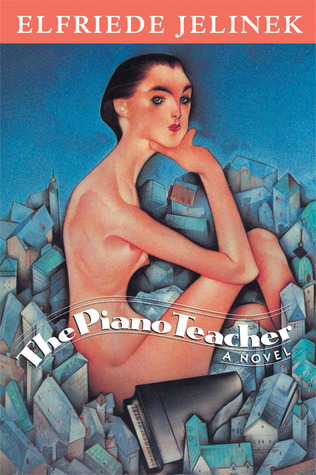
The Piano Teacher – Elfriede Jelinek

Book # 268

Reviewer: Beth, of Beth’s List Love  (FIRST PUBLISHED FEB 2012)

This book is a bizarre combination of beautiful, compelling, and incredibly disturbing. To say that the relationships in this book are unhealthy is a profound understatement. Yet the author captures her characters and their worlds with evocative prose that carries you along, and keeps you looking, wide-eyed, horrified at what you see.

To give a basic summary: Erika is a middle aged piano teacher in Vienna whose mother has pushed her all her life to be a star. The mother has tightly controlled every detail of Erika’s life, or so the mother believes. The result is a very repressed and grandiose personality in what otherwise might have been a fairly talented normal girl. Erika’s father has been taken off to a mental institution and is largely out of the picture, but he is definitely the least toxic member of the family.

As we get to know Erika, we learn that secretly she has become a voyeur, lurking at peep shows or in the bushes of a public park when she tells her mother she is attending chamber music concerts. She also slices away at her own flesh in front of mirrors behind closed doors. When Keller, one of her male students, develops an interest in her, the relationship plays out in unpleasant of ways which make a monster of an otherwise simply self-involved young man.

To give you a taste of the author’s style, at least in translation, here is a selection:

It’s no use, Erika is stronger. She winds around Mother like ivy around an old house, but this Mother is definitely not a cozy old house. Erika sucks and gnaws on this big body as if she wanted to crawl back in and hide inside it. Erika confesses her love to her mother and Mother gasps out the opposite, namely that she too loves her child, but her child should stop immediately! Now! Mother cannot defend herself against this tempest of emotions, but she feels flattered. She suddenly feels courted. It is a premise of love that we feel validated because someone else makes us a top priority. Erika sinks her teeth into Mother.“

Or this:

Erika’s will shall be the lamb that nestles down with the lion of maternal will. This gesture of humility will prevent the maternal will from shredding the soft, unformed filial will and munching on its bloody limbs.“

To say that I liked this book would be odd, but reading it was a riveting experience. I think if the content were something other than mutual psychic destruction, I would be giving it a 5. I’m definitely interested in reading more of Elfriede Jelinek‘s work.

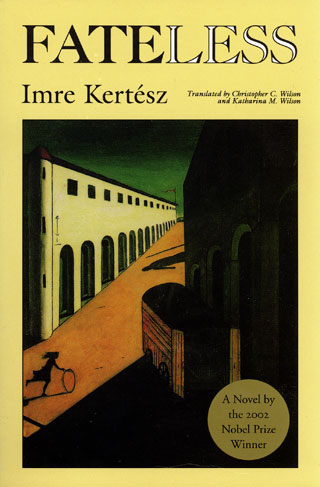
Fateless – Imre Kertész

Book # 329

Reviewer: Beth, of Beth’s List Love  (FIRST PUBLISHED FEB 2012)

***Spoilers follow, but no more than you would get from the cover of the book.

I haven’t given a lot of 5 star ratings, but this one definitely earned all 5. It started with the pitch-perfect narrative voice of Gyorgy, a Hungarian Jewish teen, as he faced the deportation of his father to a labor camp during WWII.

I have an 18-year-old step-son, and it was easy to place the words of Kertesz’s protagonist directly into my step-son’s head. Given where this book was clearly headed from chapter 1, it became incredibly poignant right away for me.

As events unfold, our protagonist remains an essentially naive, unworldly, teenage boy. He is embarrassed by the emotions that events he can’t fully understand are evoking in his elders. When all the Jewish teen workers at the oil plant are taken off their bus during the commute to work one morning and held pending further instructions, he is happy to play games with his fellow workers. While he is unaware of where events are leading, and lives very much in the moment, the reader is painfully aware of what the boxcars and the word Auschwitz on the gate of a camp to which he is transported portend.

My uncle was among the American troops who liberated one of the death camps. As a child, I heard my father tell of the bar of soap-shaped clay he brought home to tell the tale of the ways people were seduced into death chambers. Hearing that story was my first experience of horror, and waves of that same horror washed over me as I continued to read this tale.

The contrast between the protagonist’s innocence and that horror are part of the power Kertesz, himself a survivor of Auschwitz, wields as he weaves this tale. Fortunately, the tale soon moves to Buchenwald and then to a more rural labor camp, but not before Gyorgy comes to understand what the horrible smell coming from the chimneys of a number of buildings in the distance signify. Despite what he slowly learns about his situation, Gyorgy continues to find ways to make the experience manageable physically and emotionally. His is a powerful lesson in mindfulness, resilience, and the ultimate complexity of human experience. When he eventually returns to Hungary and is told to put the whole experience of the horrors of his last year behind him, he tries to explain that he doesn’t want to, can’t, forget the things he has experienced.

In the end, he is unwilling to dismiss them, not out of a desire for revenge, or to preserve a record of atrocity, but because he is unwilling to relinquish the memories of the moments of happiness he was able to distill as he worked to create meaning in his ordeal.