BOOK #769
Reviewer: Tall, Short, Tiny & a Pickle
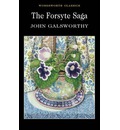 The Forsyte Saga is a trilogy about money, class, and morals at the end of the Victorian/start of the Edwardian era. It focuses on a large upper-middle class family who are very conscious of their wealth being “new money”. The story focuses on two branches of the family (the Jolyon Forsytes and the James Forsytes), and it is their interactions that form the main plot of this saga. It is a series about the expansion of wealth and the price of beauty and love.
It isn’t a story I would rush to recommend, and I did breathe a sigh of relief to have finished. Indeed, there were moments where I put it aside to read something more interesting; I felt that it dragged and wasn’t nearly as exciting or intriguing as I’d been led to believe. To me, it read like a soap opera, and while I’m aware that this would have heightened its appeal to the filmmakers who made it into a miniseries not too long ago, it didn’t really appeal to me as I thought it would.
The style of Galsworthy reminds me of my perennial favourite, Charles Dickens, but he seemed to write with less flair. Perhaps comparing him to Mr Dickens isn’t fair, but it is hard not to when the similarities are so obvious; personally, I found Galsworthy’s prose a bit pompous.
One of the main character is Soames Forsyte (son of James), who is a solicitor and “a man of property.” This refers to his physical possessions as well as his relationships with other characters in the book. Soames’ journey throughout the book is complicated; he struggles with the concept that he can not “own” other people. His wife, Irene, is a beautiful woman, but she is also quite aloof and distant; we learn early on that her relationship with Soames is strained, to say the least. Irene is a character we never fully understand or know, and she remains somewhat of an enigma right to the end. Neither of them are particularly endearing, and by the end of the novel, I had very little feeling about either of them.
Another character who takes on a main role, and the only character I actually really liked, was “young” Jolyon, an impoverished artist who has been long estranged from the rest of the Forsyte clan. His attitude to possession is the complete opposite to Soames’, his cousin; he appreciates beauty and people, and is not interested in materialistic possessions. I liked him partly due to his attitude, but also because he made his own share of mistakes; he was the most realistic of the characters, for me.
The rest of the family are all described in great detail, and we learn a little about each one at various stages. Galsworthy is very skilled at describing his characters – big and small – without letting it take over the story. I particularly liked this early description of the family’s patriach, which says so much about the old man’s character in so few words:
He held himself extremely upright and his shrewd, steady eyes had lost none of their clear shining, thus he gave an impression of superiority to the doubts and dislikes of smaller men. Having had his own way for innumerable years, he had earned a prescriptive right to it. It would never have occurred to old Jolyon that it was necessary to wear a look of doubt or defiance.
Galsworthy also goes on to describe more of the Forsyte men:
Through the varying features and expression of those five faces [the Forsyte brothers] could be marked a certain steadfastness of chin, underlying surface distinctions, marking a racial stamp, too prehistoric to trace, too remote and permanent to discuss – the very hallmark and guarantee of the family fortunes. Among the younger generations, in the tall, bull-like George, in pallid, strenuous Archibald, in young Nicholas with his sweet and tentative obstinacy, in the grave and foppishly-determined Eustace, there was this same stamp – less meaningful perhaps, but unmistakeable – a sign of something ineradicable in the family soul.
There are, as with many stories of this era, a number of little subplots that add to the drama of the story; if I’m to be truly honest, I often found myself wishing that Galsworthy would just get on with the main story.
I can see why some would enjoy this saga, and therefore why it earned its place on this list, but it wasn’t for me.

 1001 Books to Read Before You Die