The Master and Margarita – Mikhail Bulgakov

Book #400
Reviewer: Tall, Short, Tiny & a Pickle

The Master and MargaritaThe Master and Margarita appears on numerous “must read” lists, and having recently inhaled it, I believe it is deserving of all the kudos. I had no prior knowledge of the story, and simply had the recommendation of a friend to go by; suffice to say I will be listening to any further book suggestions she makes!

The Master and Margarita is set mainly in Moscow, and begins with a meeting between two literary figures and a mysterious foreign gentleman – a professor of black magic. The conversation turns to one of the literary figures dismissing the idea of the existence of the devil; the foreign gent takes offense at this, and unfortunately for the former, things don’t turn out for the best. As the story unfolds, it becomes clear that the foreign gentleman is none other than Satan himself, calling to wreak havoc upon the predominantly-atheist, bureaucratic, materialistic society. He has brought with him a handful of weird and wonderful servants, who are essentially his go-betweens.

There is a host of interesting characters, with numerous crossing-of-paths moments. A few of the characters end up in an asylum, and as the story goes on, the reader wonders who else might be admitted. One such character is known as The Master; he has admitted himself to the asylum following a devastating review of his first literary piece, leaving behind a devastated lover by the name of Margarita, who has an interesting meeting with the Devil in the second part of the story.

It did get a little confusing at times, with Russian naming conventions and the use of diminutives as well as full names, and some of the characters had similar names. However, Bulgakov always added in a small descriptor which made it easier to track who was who.

This was an exciting, intriguing, beguiling read. I read at every opportunity, staying up way past my bedtime on numerous occasions, simply because I couldn’t put the book down. It was beautifully written; evocative and fascinating in both subject matter and style, poetic and sumptuous in characterisation and location.

Frozen to the spot in terror, Margarita somehow made all this out in the treacherous shadows from the candles. Her gaze was drawn to the bed, on which sat the one whom poor Ivan had been trying to convince, still very recently at Patriach’s, that the Devil did not exist. It was this non-existent one that sat on the bed.

The subject matter was intriguing, and the telling of the story was magical and quirky. At times, it was quite dark, but there was always an undercurrent of humour. I enjoyed the way the story continued to build impossible layer on top of impossible layer, adding to the element of sheer frivolity. I also liked that many of the characters spoke lines such as,

“He’ll get up to the devil knows what…” and “…it’s time to let everything go to the devil…”

The Master and Margarita was a surprising treat and I won’t hesitate to recommend it to you all.
Quote of the Week

“We don’t need a list of rights and wrongs, tables of dos and don’ts: we need books, time, and silence. Thou shalt not is soon forgotten, but Once upon a time lasts forever.”

Philip Pullman

The Man Who Loved Children – Christina Stead

Book #599
Reviewer: Beth’s List Love (first published February 21, 2012)

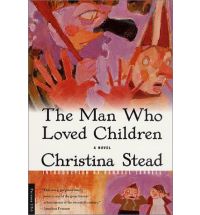
The Man Who Loved ChildrenSam and Henny Pollit have too many children, too little money, and too much loathing for each other. As Sam uses the children’s adoration to feed his own voracious ego, Henny watches in bleak despair, knowing the bitter reality that lies just below his mad visions. A chilling novel of family life, the relations between parents and children, husbands and wives, The Man Who Loved Children, is acknowledged as a contemporary classic.

This novel is the dysfunctional family writ large. Dad is a civil servant naturalist with superficially benevolent ideas about the world and mankind, but with a heavy dose of sexism, a leaning toward eugenics, a disdain for literature, and most importantly a massive dose of narcissism hidden beneath the superficial shell. He looks initially like a fun dad, ring-master of “family fun day” on Sundays, and seemingly the younger kids enjoy him, but he contributes to the impoverishment of the family, belittles the children in various ways (including speaking a nauseating baby-talk to them), and has a major war going on with their mother.

“Mothering” (a nickname he coined, that she hates) is a former heiress who is less self-involved than she appears in some ways, but who speaks hatefully to the kids, especially the eldest who is a step-daughter, spends much of the time withdrawn or absent, and seems incapable of a kind word about anyone.

The eldest daughter Louie is the child who gets the most attention in the novel, but I had a soft spot for Ernie, the eldest boy, who is the only one in the family with financial sense. We watch the family unravel from a marginally middle-class existence in Georgetown to abject poverty and emotional chaos in Annapolis after the father becomes unemployed. The emotional toll of family life on the kids, particularly Louie and Ernie, gets clearer and clearer and leads them to desperate acts.

I found this an oddly enjoyable, but nonetheless bleak, read. My rating: 4 out of 5 stars

Quote of the Week

“It has often been said
there’s so much to be read,
you never can cram
all those words in your head.

So the writer who breeds
more words than he needs
is making a chore
for the reader who reads.

That’s why my belief is
the briefer the brief is,
the greater the sigh
of the reader’s relief is.

And that’s why your books
have such power and strength.
You publish with shorth!
(Shorth is better than length.)”

― Dr. Seuss

The Name of the Rose – Umberto Eco

Book #293
Reviewer: Tall, Short, Tiny & a Pickle

The Name of the RoseThe Name of the Rose tells the story of William, a Franciscan monk who travels to a monastery in Northern Italy with his apprentince, Adso, to attend a theological conference of sorts. Just before their arrival, it appears that one of the monks has either been murdered or committed suicide. As the story continues, a number of other monks mysteriously die, and William is asked by the abbey to use his superior skills of observation and curiousity to investigate the deaths.

Sounds exciting, right? Well, let me start by telling you that this review almost never eventuated. I stopped reading The Name of the Rose twice, and it almost didn’t make it back off my bookshelf. However, I was determined to finish it for a personal reading goal, and when I realised it was on the 1001 Books list…well, that made me even more determined to get to the end.

It will come as no surprise that I didn’t like this book at all; in fact, I found it incredibly boring and have nicknamed it The Book of Snore. To be fair, I imagine Eco didn’t have a sleep-deprived mother in mind when he wrote his novel, but I still think I wouldn’t have enjoyed it if I was getting a solid eight hours sleep each night. His method of telling a story within a story did nothing to endear me to his style of writing.

The length of the sentences, paragraphs and chapters was excessive; in some stories, this style works, but here, it simply didn’t. I waited for the pace to pick up…and I waited, and waited, and waited. It simply took too long to read; I wasn’t expecting instant gratification, but I was expecting to be entertained in some way, and I wasn’t.

The narrator was an insipid character, and his insights didn’t add anything to the story. Eco’s descriptive passages also missed the mark for me, which is saying a lot when I’m a big fan of Dickensian over-descriptions. I was disappointed, too, because the cover of my copy was so pretty and held such promise which the contents really didn’t deliver!

I didn’t like the use of Latin phrases when there were no translations or footnotes. It was frustrating to feel as thought I may have missed something important because of this; indeed, when I’d finished, I actually did wonder if I’d missed something and that’s why I didn’t “get” it? Because it bored and frustrated me so, I found that I didn’t retain a lot of what I read from one evening to the next, but wasn’t inclined to go back and refresh my memory. I am aware that this linguistic ambiguity is a special technique, but it’s not one I enjoyed reading.

There’s obviously a reason The Name of the Rose earned a place on the list, but I am at a loss to figure it out. If someone can convince me otherwise, I am eager to hear your glowing reviews of this book.