The Big Sleep – Raymond Chandler

Book # 599

Reviewer: Ms Oh Waily
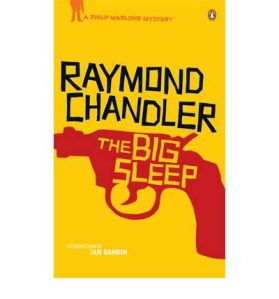

TBS A little while ago I reviewed one of the other Raymond Chandler entries on the 1001 list, Farewell, My Lovely as did Beth.  We both agreed that it was well worth reading.  As a result I thought I would work my way through the other two – The Big Sleep and The Long Goodbye.

Today we will visit Philip Marlowe on his very first outing.

In this story we meet Marlowe when he is hired by a General Sternwood to deal with a case of blackmail.  The General is father to two wild daughters, Vivian and Carmen.  The elder being married to an ex-bootlegger and the younger prone to drugs and men.  In this case it is the younger who is causing her father to hire Marlowe, but at the same time the General hints at another need – to find the missing husband of his eldest daughter.

This seemingly straightforward case of warning off a blackmailer takes Marlowe through the dark underbelly of Los Angeles.  Along the way we have illicit pornography, drugs, murder, and various forms of racketeering.  All of this by a wide-ranging cast of characters.  It is a complex plot, but easy enough to follow as you read.  The language is gritty and ‘hard-boiled’, as you would expect.  Having read the books out of order, I can clearly see this as a softer version of Marlowe both linguistically and as a character, but all the essential elements are there just waiting for firming up.

Here he is, in his own words to General Sternwood.

‘Sure, but there’s very little to tell. I’m thirty-three years old, went to college once and can still speak English if there’s any demand for it.  There isn’t much in my trade.  I worked for Mr Wilde, the District Attorney, as an investigator once.  His chief investigator, a man named Bernie Ohls, called me and told me you wanted to see me.  I’m unmarried because I don’t like policemen’s wives.’
‘And a little bit of a cynic,’ the old man smiled. ‘You didn’t like working for Wilde?’
‘I was fired.  For insubordination.  I test very high on insubordination, General.’

Yes he does.  Very high.  And once again we get another set of insights in his first conversation with Vivian Regan, the elder Sternwood daughter.

‘I didn’t ask to see you.  You sent for me.  I don’t mind your ritzing me or drinking your lunch out of a Scotch bottle.  I don’t mind your showing me your legs.  They’re swell legs and it’s a pleasure to make their acquaintance.  I don’t mind if you don’t like my manners.  They’re pretty bad.  I grieve over them during the long winter evenings.  But don’t waste your time trying to cross-examine me.’

And how can you pass up the option to read a book that contains one liners like this.

Neither of the two people in the room paid any attention to the way I came in, although only one of them was dead.

Or, better yet, this.

‘A little weak,’ I said. ‘But pass it. You’re broke, eh?’
‘I been shaking two nickels together for a month, trying to get them to mate.’

Oh yes, very vivid imagery.

Once again I can recommend you take a spin around 1940s Los Angeles with Raymond Chandler and his tough-talking private detective.  A great book for a quick and enjoyable read.  Perfect holiday reading.  Well deserved place on the list.

Now I’m off to find a copy of The Long Goodbye.

Breakfast at Tiffany’s – Truman Capote

Book #467

Reviewer: Tall, Short & Tiny


Breakfast at Tiffany's

It is impossible to read, or indeed review, Breakfast at Tiffany’s without conjuring up that famous image of Audrey Hepburn in her black gown and jewelled headdress, standing outside Tiffany’s in New York City, coffee in hand. In fact, I’m the first to admit that for a long time, I had no idea that one of my favourite films was in fact based on Truman Capote’s novella.

Sometimes, having seen the film first can ruin the subsequent reading of the book. However, there are so many points of difference between the two that there’s no possible cause for true comparison. Both, in my opinion, are fantastic…but that’s not much of a review now, is it?

The novella is narrated by a writer living in the same apartment building as one Holly Golightly, a mysterious, outwardly sophisticated but inwardly lonely and scared young woman with a penchant for rich suitors and expensive drink. She is the object of desire for virtually every man she meets, and while she often benefits from the attention, it is apparent that she is uncomfortable with her own beauty and attractiveness. She decides, on their first meeting, to call the narrator ‘Fred’, as he reminds her of his brother. It is hinted at that the writer is gay and that Holly is an escort, but these remain speculations.

Holly has many admirers, and throws many parties frequented by many men, yet she seems to be perpetually alone. She has a cat for company, but even then, she doesn’t wish for any sense of belonging to exist between the two. In the early part of the novel, Holly comes across as flighty, and the reader almost expects to find her vanished at the turn of the next page, but when she does disappear, it is a disappointment and the reader – along with our friendly narrator – is left hoping that she is all right.

I enjoy Capote’s style of writing. It is elegant and flowing, warm and enthralling. In Breakfast at Tiffany’s, he relies heavily on dialogue rather than description to tell the story, and that appeals to me immensely (I am the sort who will skim through a tedious book until I reach the dialogue; the relationships between characters is always my favourite part). This is a short story (94 pages in my copy), and a very easy, enjoyable read, earning 4/5 stars from me.

Quote of the Week

“Lock up your libraries if you like; but there is no gate, no lock, no bolt that you can set upon the freedom of my mind.”
Virginia Woolf, A Room of One’s Own


Saturday – Ian McEwan

Book #2

Reviewer: Jon Day 


Well, would you look at this… both Book #1 and now Book #2 from the original list have been reviewed. In doing so we would like to introduce you to our newest reviewer Jon, who blogs over at The Mirror Man, views from a hospital bed. If you like poetry, then you should definitely visit with him. Thanks for joining us Jon.


S

The books which Ian McEwan writes seem to share two features. The first is about how single moments can change things for ever, and the second is about the morality of choices. His novel, Saturday, is no exception. The events in the novel concern a single day and its consequences and there is more than one moral lesson approached in the text.
The protagonist is a man named Henry Perowne, a neurosurgeon. Don’t be fooled into thinking such a man has little to do with your life for his thoughts and conversations address issues which affect all of us. And that is the magic of this novel. Everything is relevant to the reader’s life. The plot, great though it is, is secondary, to the soul of the book. McEwan’s use of language is exemplary. Ease of readability runs concurrent with intelligent prose. The book is set in London, one Saturday shortly before the second Gulf war and the invasion of Iraq. McEwan is able to capture both the anti-war feeling and the fear of terrorism prevalent in the public at the time. Throughout the novel he also illustrates the motives behind young people’s apparent disinterest in the bigger issues of the day. As one character notes;

“When we go on about the big things, the political situation, global warming, world poverty, it all looks really terrible, with nothing getting better, nothing to look forward to. But when I think small, closer in—you know, a girl I’ve just met, or this song we’re going to do with Chas, or snowboarding next month, then it looks great. So this is going to be my motto—think small.”

The novel is full of small incidents which build tension and drama, fast and thick observation of all sorts of things. Perowne reveals himself an intelligent man, who counts his blessings over and over. And on this innocuous Saturday we know all is not as it should be. There are portents of doom and we are led to a finale in which the protagonist’s level headedness is tested against the fickleness of life. Our comfort is challenged as McEwan asks us how far civilised men will go to protect what they hold dear. This is a thoughtful and well considered book and I am glad I read it.

April Update

7 books reviewed
138 books in total
863 books to go

April saw the review of Book #1 on the list: Never Let Me Go. This means we now have reviewed the very first book on the list, and the very last (Aesop’s Fables)…as well as a few in between.

Reviews for An Artist of the Floating World, Smiley’s People, The Little Prince, Absalom, Absalom, The 39 Steps and The Tree of Man mean we have reviewed 92 books from the 1900s. Given that this is the section with the largest number of entries, we do have a way to go, but this seems to be our most popular century to review!

Never Let Me Go is the only book from the 2000s that we reviewed in April (although it is the second Kazuo Ishiguro novel reviewed this month, along with An Artist of the Floating World), bringing the number of books reviewed from the 2000s to 18.

We have reviewed 20 books from the 1800s, three from the 1700s, and five from pre-1700s.

I wonder – is it the age of these entries that put us off, or their accessibility (both physically and literary)? Or is it more that we are simply attracted to the more recent works? Something to ponder, as eventually, we won’t be able to hide from the 1800s and earlier any longer!