Reblogging

We have recently been “reblogged” for the first time here at 1001 Books.
Three posts have been taken.  No request to reproduce them was received before the arrival of the comment telling me that they were up on another blog.

Now, I’m of the opinion that you should ask before you take.  But I’m old, and funny about basic etiquette and good manners.  I imagine that my viewpoint is not the only one to be had out here on the world wide web.  So, before I go put on my stomping boots and ask that the site removes the book reviews in question, I would like to canvas the opinions of our readers and reviewers.

I will also be leaving the final decision regarding what approach to take to the reviewers affected by the reblogging.  I will contact you shortly.

In the meantime, as this is a collaborative blogging effort here, I want to get a feeling about how you all view this new trend in the blogging world and how you would like us to handle any future occurrences.

Thanks for taking the time to leave a comment with your opinions.

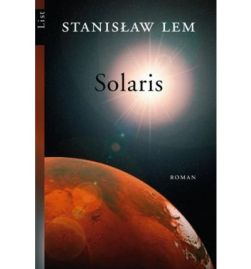
Solaris – Stanislaw Lem

Book #448

Reviewer: Ms Oh Waily

Solaris is the 1961 science fiction classic by Polish author, Stanislaw Lem.

Let me start with the fact that I didn’t actually enjoy reading this story.  I didn’t relate to the way it was told; found it very dry and the writing frequently obfuscating. Lem, apparently, read fluent English and was disappointed in the translation.  Perhaps that  accounts for some of the issues I had, which is a shame as the ideas Lem puts forward were clouded somewhat by the way the story reads.

The setting is a research space station orbiting the planet Solaris.
The protagonist, Kris Kelvin, arrives after a long space trip to the research station. He is expecting a welcome from an old teacher, Gibarian, when he arrives.  This doesn’t happen, instead he is met with silence and a feeling of dread.  Eventually he locates one of the crew, Snow, and in a manner no more fun to read than to have teeth pulled, he extracts the information that Gibarian is just recently dead.  Snow hints of dreadful things while telling Kelvin nothing at all of the circumstances on the station.

This entire section of the book feels extremely odd and unreal, with strange reactions and behaviour from both Kelvin and Snow.  We learn that there is a third person on the station, Sartorius, who has more or less become a hermit in his research laboratory.  No explanation is forthcoming from the slightly less reclusive Snow.  Soon, however, we are given insight into the unusual happenings, with Kelvin’s sighting of a “giant Negress” in Gibarian’s room and by his body.  This is followed by Kelvin’s own ghostly, yet real, visitor – his deceased wife, Rheya.

Are you with me so far?  If so, well done.  You are doing better than I was at this point in the book.

The story continues to unfold, especially around the indestructible “visitors” that each man has.  We are only ever given extensive information about Kelvin’s.   While Kelvin tries to work out what is happening on the station there is ample opportunity for Lem to include a lot of description about the history of the study of Solaris and it’s planet-wide ocean.  This is not carried out in an overly subtle way.  At this point the themes Lem seems to want to explore start to take shape.  After generations of study, mankind has named just about every phenomena going on Solaris, but is none the wiser about the Ocean for having done so.  There is one section of researchers who believe the Ocean to be sentient, but no one has ever managed to establish any sort of connection or communication with it.  The visitations start after a particularly aggressive, and unauthorised, experiment is carried out on the Ocean. Here we are confronted with the idea that the Ocean is, in its turn, experimenting on the researchers.  Yet we have no idea why it is doing so.   This is no fuzzy E.T. and it is no anthropomorphised life form either.  Perhaps that is why I found this novel to be so unenjoyable.

Having just recently read this interesting post* regarding the difference between genre fiction and literary fiction, I am having to take another look at Solaris.  And myself as a reader, along with my responses to various novels.  Solaris clearly is not science fiction “genre” writing if you come at it with the idea that genre reinforces current ideology.  Lem is definitely challenging the normal human-centric view of our likely future contact with sentient entities.  He is poking at our self-centredness, as though we will be unencumbered in our ability to communicate and understand what we may find in the universe one day.
It is thought provoking and the ideas are interesting.  I just wish they had been wrapped up in easier, more flowing prose.

* I highly recommend Tales from the Reading Room if you have a bookish leaning.  I find I learn or am provoked to think about  something from most posts, as well as her very interesting commenting public.

Favourite 1001 Book

I was sitting here at home today, doing my usual catch-up blogging, and I began to think about which book from the list should be the next to come home from the library with me.  It is quite a daunting prospect, choosing one book out of 1200+.  But one book it must be.  Mostly because I have a terrible habit of trying to read multiple books at once and never quite finishing some of them, but also because I seem to have reduced reading time for myself at the moment.

While I was pondering this problem my mind wandered away from me, as it frequently does, and ended up in the vicinity of our reviewers and readers here at 1001 Books.  I began to wonder which book from the list you would absolutely recommend in a heartbeat.  A book that spoke to you, that you loved to read and that you think of fondly even days, weeks, months or years after having finished reading it.

Then I thought to myself, “Well, why not ask them?  Someone is bound to be reading the blog at some point, and they are bound to have read at least one book from the list.  Go on.  See what happens.”

So here I am.  Asking you.

Which book from the 1001 Lists would you unreservedly say “you really should read this“?

Feel free to argue amongst yourselves in the comments below.  A curious reader would like to hear your opinion.  Oh, and if you can include your reason for loving the book – that would help me choose too.

Kristin Lavransdatter – Sigrid Undset

Book #722a

Reviewer: Arukiyomi (First published April 2012)

Please welcome our latest reviewer, Arukiyomi.  You may notice his button in our sidebar; this links through to a rather nicely put together spreadsheet of all the 1001 Books To Read Before You Die lists.  Enjoy, both the review and the spreadsheet.

This is an epic in the great tradition of Scandinavian literature. A trilogy which helped to win her the Nobel Prize, Undset’s masterly portrayal of the life of a 13th century nobleman’s daughter is a classic work and should be more widely known.

Kristin is a headstrong beauty who spends most of her life torn between her urges (love, guilt, loyalty) and her obligations (family, religion, gender). There’s plenty here that occurs in many other great novels but what makes the difference to this work is not only the richness of Undset’s exploration of Kristin’s character, what makes this novel stand out is the setting.

I doubt many are familiar with 14th century Norway. Exploring it through Undset’s prose is a very rewarding experience. Granted, there are brief stretches in the second book where the medieval Scandinavian political scene dragged a bit. But these are brief and you’re soon back into the countryside, or houses, or food or clothing or religion and these are all richly described. For me, the blend of superstition and Christianity was fascinating. Why so? Well, it mirrored almost perfectly that of the 21st century Papua New Guinea I’m living in. Made me wonder if the present day church in Norway is what PNG’s will look like in 2800.

There are plenty of events along the way that keep you occupied while you get to know the setting and Kristin herself. She has 7 sons and, as they grow up, she finds herself facing somewhat similar issues to those her father faced with her. She deals with these in various ways, always haunted by what she put her parents through.

And there are plenty of other characters to keep you busy if you’re not taken with Kristin herself. Her father features a great deal in the first book and he’s something of a hero, both on the domestic and national fronts. Simon is also a key figure in the narrative and his love for Kristin is an entire story in itself.

So, if you want to immerse yourself in the past for a while and see both how life has changed while humanity has stayed the same over the last 800 years, get yourself a copy of this. For portability though, I suggest you get the e-book. Alternatively, at 1100 pages, use it to build your biceps on your daily commute.