The White Tiger – Aravind Adiga

Book #6b

Reviewer: Ms Oh Waily (first published August 2011)


The White Tiger
is the winner of the 2008 Man Booker Prize, and was easily the most enjoyable Booker that I have read to date.  It is also the third Booker set in India or about Indians which I have read; the other two being In A Free State which has a story about an Indian manservant in the US, and The Siege of Krishnapur which is set during the Indian Mutiny.
This book is set in modern India, starting out in Laxmangarh, moving briefly to Dhanbad  then through to Delhi and finally resolving in Bangalore.  It follows the life of Balram Halwai, also known as the white tiger.  Balram is the son of a rickshaw puller, whose father wants him to be the first in the family to get an education.  Sadly for Balram he does not get to remain in school, and considers himself to be half-baked because of it.

The story is told in the form of a conversational letter written by Balram to the soon to be visiting Premier of China, Wen Jiabao.  Balram recounts his life from Laxmangarh to Bangalore and how he is a great example of an Indian entrepreneur.    The humour is all pervasive.  All the way through the book the descriptions and language are full of it.  But it isn’t straightforward humour, it is the sort that is full of very large porcupine quills.  From a distance it looks sleek, but get too close and it will poke you firmly in your soft bits.

It is crammed full of social observations, and shows the dichotomy of country and city, rich and poor, and traditional ways versus technology driven modernisation.   It was highly entertaining while being quite enlightening about the life of the crushingly poor of India. Social commentary in humorous form.

So, here are a few examples of Adiga’s writing, the first is about the way elections are bought from the illiterate and the poor by coercion:

“It’s the way it always is.” my father told me that night.  “I’ve seen twelve elections – five general, five state, two local – and someone else has voted for me twelve times.  I’ve heard that people in the other India get to vote for themselves – isn’t that something?”

The “other India” is a reference to those who do not dwell in the Darkness – the poor, rural communities where the landlords are rulers of all and decide just about everything.

Then, a tongue in cheek commentary on the life of a city driver, which Balram becomes.

You can develop the chauffeur’s habit – it’s a kind of yoga, really – of putting a finger in your nose and letting your mind go blank for hours (they should call it the ‘bored driver’s asana‘).

And some irony to finish.

The dreams of the rich, and the dreams of the poor – they never overlap, do they?
See, the poor dream all their lives of getting enough to eat and looking like the rich.  And what do the rich dream of?
Losing weight and looking like the poor.

Part of me feels badly about enjoying this so much.  There is so much injustice, mistreatment and general dishonesty and nastiness described in this story that you really feel that you shouldn’t be enjoying it at all.  You should be feeling some sort of ire, anger or horror.  But you don’t.  Maybe it’s the irrepressible way that Balram looks at life that allows you to read his story without wallowing in the misery of the lifestyle he describes.

I really loved reading this.  If you want to read a Booker this year, then choose this one.  I don’t think you’ll be disappointed.

Wise Children – Angela Carter

Book #173

Reviewer: Inspirationalreads

Twin sisters Dora and Nora Chance have lived an exciting life. The illegitimate and unwanted daughters of famous thespian Melchior Hazard, they followed in their performing father’s footsteps and became celebrated “song and dance” girls in their own right.  As their father’s 100th birthday approaches, along with their own 75th birthday, Dora narrates the story of their life.  This includes the story of their father and his twin brother, their various offspring and the madcap lifestyle that comes with living in infamy,with talent and little to reign in the compulsiveness and dysfunction that comes with both.

Angela Carter has long been on my radar for the fantastical elements her stories seem to contain.  She appears to fearlessly tackle darker story lines and/or thread them with an ominously fanciful tone.  And like her contemporaries Joyce Carol Oates and Margaret Atwood, she has written a lot.  I stand in awe of these ladies as they appear to eat, breathe and sleep writing (Carter sadly passed away in 1992, this being her last novel).  All to my benefit thankfully.  As for Carter, this is my first and while not disappointed it was not quite what I expected either.

This is a flashy, interesting read.  The characters are larger than life as are a lot of the situations that arise. There is an enormous cast of characters, all related in some way or another to the Hazard family, be it through birth or marriage. Perhaps in keeping with our 75 year old narrator, the story seems to dither a bit, jumping here and there and there is a ludicrous feel; I kept thinking that some of the situations seemed so absurd that the old dear was maybe hamming it up.  This is in part to the almost conversational tone of the book, as if Dora is sitting there chatting away with a cuppa in one hand and a biscuit in the other.  In hindsight, it is more in keeping with a theatrical performance, the novel as a whole being some kind of homage to theatre in particular pantomime.

I was not quite savy enough to pick up on the Shakespearian nods either, never having studied the Bard in any great capacity.  There are five acts and direct references to his plays (of which I was oblivious).  Learning of this layer added some depth to a novel that comes off as a bit frothy, particularly as the end comes together to create a neat tie off to a bit of a jumbled mess of the middle.  The big birthday celebration allows for some more grandiose developments such as people back from the dead, abandoned babies requiring carers and an icky geriatric chandelier-moving romp which would have been a tad sweet if there wasn’t a familial connection in there *blergh*.

Before tackling some more of Carter’s work, I am going to do more research into the author herself and what she hoped to bring to her writing as there seems to be a lot thematically that passed over my head.  Wise Children seems to touch on a number of things around family, particularly legitimacy a sense of belonging even if that comes not from a direct blood line.  In finding that this was written after Carter was diagnosed with what proved to be terminal cancer, there is also an emphasis on fun and happiness, a kind of legacy she wished to leave to her husband and son.  All of this I could see after reading it, but while in the middle of it, I couldn’t see past the frivolity and seedy silliness of this family.

So, an interesting introduction to a highly lauded writer.  I was left a little cold by the book itself, but after a bit of applied thought I realise it offered me more than just a few hours of easy reading entertainment.  A solid 3 out of 5 and an expectation of a more enjoyable Carter read in the future.

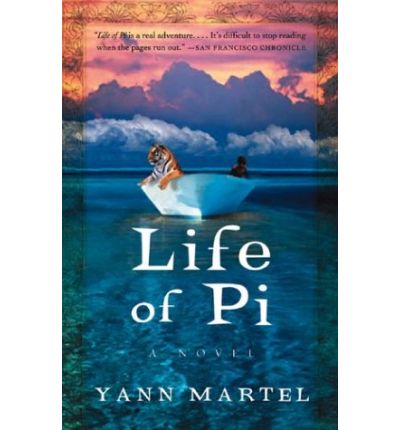
The Life of Pi – Yann Martel

Book #49

Reviewer: Naomi, of Create-Believe-Dream

Please welcome our newest reviewer, Naomi from Create-Believe-Dream.

Having just finished Martel’s somewhat harrowing book Beatrice and Virgil I wasn’t sure what I was getting into when a neighbour loaned me The Life of Pi. One thing I did know for sure is that it would be exceptionally well written; it was, and also, I think, deserving of a place on the 1001 books list.

The Life of Pi is the story of an Indian boy named Piscine Molitor Patel (Pi), who has an unusual interest in religion and whose father is a zoo-keeper. Pi enjoys an idyllic childhood in India, living on the grounds of a zoo and exploring Islam, Christianity and the Hindu faith before cultural and political unrest prompt his family to immigrate to Canada, selling all their animals and setting sail as the only passengers in a Japanese freight ship loaded with cargo bound for American zoos.

The ship sinks while at sea and Pi finds himself on a lifeboat with no-one but a Bengal tiger as company for 227 days. What follows is an extraordinary tale of survival, made all the more amazing by the prefix from the author that tells the reader the book is based on a true story.

The voice of the narrator Pi is beautifully written. His love of animals and God in all his manifest forms weaves in and out of the narrative giving it a fantastical almost mythical element. The relationship between Pi and the tiger is moving and heartfelt, full of pathos, fear, sympathy and humanity. His relationship with the tiger proves to be the saving grace for Pi, giving him the wherewithal, the motivation and the strength to deal with the despair of his situation.

Despite the bulk of the book being set on the lifeboat with not a lot of plot to move it forward, I was totally engrossed and finished the book in two days (admittedly I am a fast reader). The character of Pi is a times wise and innocent, brave and foolish, and almost accidentally resourceful. But always enchanting, imaginative and believable.

In the prefix a character tells the author that this story “will make you believe in God” and ultimately Pi’s unwavering faith in the face of his hopelessness and despair is what the book most palpably left me with.

Martel has written a story in the best tradition, juxtaposing the everyday with the divine, the magical with the horrifying and joy with tragedy. I would unreservedly recommend this book to any reader. It was an entertaining, illuminating and inspiring read.

Things Fall Apart – Chinua Achebe

Book #472

Reviewer: Kara

Things Fall Apart is a simple little novel with a fable-like voice that packs a real punch. The main character is Okonwo, a leader in the fictional Nigerian village of Umuofia. He is extremely industrious and strong, but also brusque and ambitious to point of harboring a lot of anger to those who don’t fit into his vision. The first half of the novel is a fascinating background about Okonkwo, his family, his village, and their indigenous cultural and religious beliefs and practices. The second half shows just how “things fall apart” (Chinua Achebe took the title from Yeats’ poem “The Second Coming”).

Achebe touches on many themes in just 180 pages. Umuofia’s culture is described in detail and it’s rituals and beliefs are connected throughout to the larger themes of gender, religion, history, and mythology. While all of this is fascinating and serves the novelistic purpose of building believable and interesting characters, for me Achebe’s crowning achievement comes in the second half of the book.

Achebe takes a situation that could easily be oversimplified in a novel (that of the destruction of African culture due to the influence of white men, specifically Christian missionaries) and allows it to have its inherent complexity and truth. For example, Okonkwo is no romanticized version of a native African man – he is overbearing, angry, and completely inflexible and all of these qualities contribute to his downfall as much as the influence of Christianity. In turn, the two white men who spend time in Umuofia are not stereotypical villains, but have distinct personalities: Mr. Brown is benevolent and aims to convert many people to Christianity by letting them dabble in its teachings; Mr. Smith is hard-edged and sends away anyone who does not bend completely to the will of God as he lays it out.

Things Fall Apart is a stern warning about the destruction that can happen when two cultures come into contact. It’s clear in the novel (and in Africa’s history over the past 100 years) that the influence of white culture has been forceful and destructive, but Achebe very interestingly points out that no one is perfect and Okonkwo himself could destroy the life he built for himself. In other words, the individuality that we as humans each have plays an important role in strengthening our societies – perhaps an even more important one than culture itself.
Things Fall Apart is a great gateway into African literature, and absolutely belongs on the list of books to read before you die.