There are three rules for writing a novel. Unfortunately, no one knows what they are.
– W. Somerset Maugham
Kim – Rudyard Kipling
Book #783
Reviewer: Ms Oh Waily
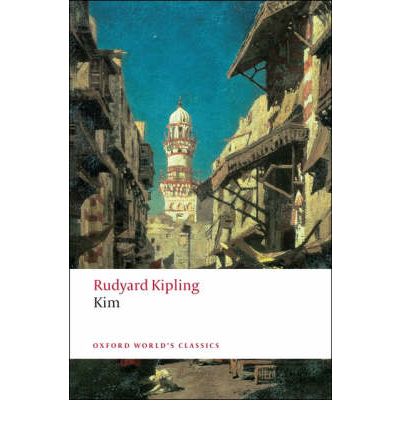
Before we begin on the review proper, I must confess to being an unabashed lover of the Just So Stories, with a lovely copy sitting on my bookshelves. Kim is the first full length work by Kipling that I have read.
Kim is a young orphan when we meet him at the start of the story. Born Kimball O’Hara, his father is an Irish soldier stationed in India and his mother a nursery maid. Both die when he is young and he is brought up by a half-caste Indian woman in the bazaar of Lahore. He is known as ‘little friend of all the world’ to those in the bazaar. He is much more a native than the Sahib he was born to be, more comfortable with the trappings and behaviours of various Indian castes and religions than he is with his own heritage.
He leaves his happy bazaar roots when he meets Teshoo Lama, a Tibetan lama in search of a mystical Buddhist “River of the Arrow”. They meet by Zam-Zammah, outside of the House of Wonders in Lahore, where Kim decides to become his disciple or chela. This is how the novel opens,
He sat, in defiance of municipal orders, astride the gun Zam-Zammah, on her brick platform opposite the old Ajaib-Gher – the Wonder House, as the natives call the Lahore Museum.
They set off on an adventurous journey that takes in the vast sub-continent, it’s varying peoples and cultures and eventually leads to his induction into The Great Game through his friendship with the Pathan horse trader, Mahbub Ali. He ends up getting caught by members of his father’s regiment and is reintroduced to his Sahib roots by way of an English education at St Xavier’s, a top school in Lucknow, much to his initial disgust. There he starts his training to become a surveyor (or spy).
When his formal education comes to an end he cannot wait to reunite with his lama, and he takes his first steps in to the real world of espionage with a trip into the Himalayas in search of two Russian surveyors. The ending of the novel is sufficiently vague as to his future, however. Does he continue down the espionage road, or does he take to the spiritual endeavours of the Buddhist Way?
This is a rather wonderful picaresque novel that combines the story of a friendship, a coming-of-age and a bit of boy’s own romping spy fiction on the side. Kipling rolled it all together into one glorious book. I enjoyed this immensely, even with all the thees and thous throughout. Not to mention the OOS generated by flicking between the text and the references at the back of my copy of the novel.
Kipling is often reviled for his views on imperialism. Personally I didn’t find this work particularly condescending or oppressively rah-rah. Instead I found it extremely evocative of British India and the variety of its peoples. It was touching, funny, beautifully written and took me right in to the life and times of a young street rascal turned spy. The characters are sympathetic and you feel that you want to follow them to their fates. Kipling clearly loved India and its people. I think it is obvious in every part of this book.
If you have enjoyed any of Kipling’s short stories, then I can highly recommend Kim as your first venture into his novels. For a little more background once you have read the novel you may find this article interesting, especially with regards to the mixing of fiction and reality.
The Book of Illusions – Paul Auster
Book #37
Reviewer: Inspirationalreads
 After his wife and two young sons die in a air plane crash, David Zimmer descends into a crippling grief. Suicidal and using alcohol as a way to numb his pain, one night he catches a silent movie and it makes him laugh, something he thought he was incapable of doing. With his interest piqued, Zimmer, who is also a teacher and a professor, researches the star of the film Hector Mann. He discovers that in 1929, Mann disappeared and was never heard from again. To add to the mystery, Mann only made less than a dozen movies, all of which also disappeared and then years later were slowly given one by one to various film institutes for posterity. Zimmer then goes on to write a biography about the actor and his work. Forward to 18 months after publication and Zimmer receives a letter advising him that Mann is still alive and wishes to meet him.
The mystery of Herman Mann is an interesting one and kept me wanting to read more to find out what happened to our silent film star. And Auster did not fail to meet expectations, keeping the twists and turns unpredictable. In Zimmer, he created a character who from the start elicits sympathy and as a result places the reader in a empathetic role which extends beyond the tragedy of his loss. We continue on beyond his grief into firstly the intrigue of the vanishing Mann and then the need to know what happened. There are a few moments where the need to suspend your disbelief is pushed to their limits. These instances are where I felt you could see the strings so to speak, parts that didn’t feel like a natural occurrence but were there just to move the story along.
However, there is a question in here that is more than what happened to Mann. The theme of the book is around art – Why do you create? Who do you create for? When we learn of what did eventuate with Mann, we are told that he is punishing himself, that he has to make movies but he stops his creations being viewed by anyone to prevent them becoming more real. Can an idea become more tangible, take on meaning only through others experiencing it? Is the appreciation of an audience the ultimate goal of any artist? It is an intriguing thought and one that Auster didn’t really approach in a subtle manner; the forced nature I wrote of above was really evident for me in the second half of the novel where this theme of art and its audience is raised. I’m appreciative because I’m not fully up with the play thematically with a lot of the novels I read, especially ones from the 1001 list, but this one was clearly obvious. I’m not saying heavy handed, but… well, yes I am actually. Heavy handed.
I enjoyed the actual story in this book and in putting in more thought into it for this review, the theme was an interesting one to mull over . I particularly relished the way Auster was able to render a movie from a moving picture into word form; he is obviously a fan of this art form and the technical aspects of it. And yet for all this, if I didn’t have to write this review I probably wouldn’t remember what it was about a few months down the track. This is probably more revealing of my ageing brain than anything else, but for want of a better clichè, I am going to have to damn it with faint praise. It was ok but not great and certainly not memorable. So a miserly 2.5 out of 5 from me.
Quote of the Week
“You have to write the book that wants to be written. And if the book will be too difficult for grown-ups, then you write it for children.”
― Madeleine L’Engle
Les Misérables – Victor Hugo
Book #873
Reviewer: Tall, Short & Tiny
 When I first saw the musical – probably close to 20 years ago – I had no idea that it was based on a classic novel, and all I can really remember is that it was dark and gloomy, and seemed to be all about the French Revolution.
So it was with some trepidation that I picked up a copy of the book; the font was small and I envisaged a novel full of dreary tales and chapters made up entirely of the phrase, “Vive la Révolution!” However, it transpires that the backdrop for Hugo’s novel is not the French Revolution as most people believe, which means my pre-judgement of it was waaaaaay off base!
From the very first page, I was hooked – this was a novel I could not put down. It was one of the best classics I’ve read in a long time; it was powerful and poignant and very poetic, despite the often gruelling nature of its subject matter.
Hugo writes in a beautifully evocative way. I often found myself shivering with cold, experiencing numb feet and a gnawing hunger in my belly, along with the main characters. I was drawn in, and my imagination was in overdrive as I pictured the dark cobbled streets of Paris, run-down old buildings, and a vast contrast between the rich and the poor.
It is very difficult to summarise the plot without ruining the story. The characters and events are so cleverly intertwined, and each adds another layer to an already fascinating tale, that I feel I would spoil it for you if I tried. The main plot is the story of ex-convict, Jean Valjean, and his journey to becoming a good person; he is unable to escape his dark past, but various characters along the way help him to create a better life for himself and those he comes in contact with. He draws on each experience to benefit others, and pay forward the forgiveness and love that was shown to him at the beginning of the story.
Essentially, Les Misérables is a story about the power of love, social injustice, and right versus wrong (or perhaps legality versus morality). These themes run strongly through each sub-plot, adding to the complexity and intrigue.
I can’t recommend Les Misérables enough! Go to your local library or better yet, treat yourself to a copy – this is a book that every book lover should own. It exceeded all expectations, and was a beautifully harrowing tale of struggle, morality and humanity. Well-written, and well-deserving of being considered one of the best novels of the nineteenth-century.
 1001 Books to Read Before You Die