The Piano Teacher – Elfriede Jelinek

Book # 268

Reviewer: Beth, of Beth’s List Love  (FIRST PUBLISHED FEB 2012)
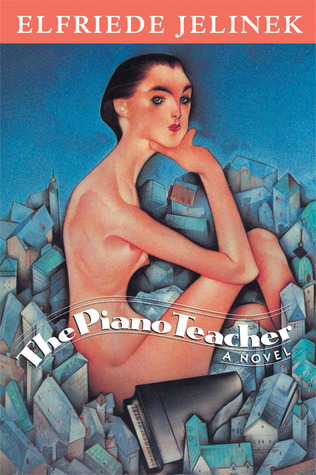
This book is a bizarre combination of beautiful, compelling, and incredibly disturbing. To say that the relationships in this book are unhealthy is a profound understatement. Yet the author captures her characters and their worlds with evocative prose that carries you along, and keeps you looking, wide-eyed, horrified at what you see.

To give a basic summary: Erika is a middle aged piano teacher in Vienna whose mother has pushed her all her life to be a star. The mother has tightly controlled every detail of Erika’s life, or so the mother believes. The result is a very repressed and grandiose personality in what otherwise might have been a fairly talented normal girl. Erika’s father has been taken off to a mental institution and is largely out of the picture, but he is definitely the least toxic member of the family.

As we get to know Erika, we learn that secretly she has become a voyeur, lurking at peep shows or in the bushes of a public park when she tells her mother she is attending chamber music concerts. She also slices away at her own flesh in front of mirrors behind closed doors. When Keller, one of her male students, develops an interest in her, the relationship plays out in unpleasant of ways which make a monster of an otherwise simply self-involved young man.

To give you a taste of the author’s style, at least in translation, here is a selection:

It’s no use, Erika is stronger. She winds around Mother like ivy around an old house, but this Mother is definitely not a cozy old house. Erika sucks and gnaws on this big body as if she wanted to crawl back in and hide inside it. Erika confesses her love to her mother and Mother gasps out the opposite, namely that she too loves her child, but her child should stop immediately! Now! Mother cannot defend herself against this tempest of emotions, but she feels flattered. She suddenly feels courted. It is a premise of love that we feel validated because someone else makes us a top priority. Erika sinks her teeth into Mother.“

Or this:

Erika’s will shall be the lamb that nestles down with the lion of maternal will. This gesture of humility will prevent the maternal will from shredding the soft, unformed filial will and munching on its bloody limbs.“

To say that I liked this book would be odd, but reading it was a riveting experience. I think if the content were something other than mutual psychic destruction, I would be giving it a 5. I’m definitely interested in reading more of Elfriede Jelinek‘s work.
A Small Change

Hello from the 1001 Books to Read Before You Die editorial team.

This is just a short message to let you all know about a small change we have made to the blog.
For those of you who visit the blog regularly you may have noticed that we have a couple of buttons in the sidebar under the recent comments you may have made.  For those reading in a feed reader, how about coming and visiting us to take a look?
The rather lonely figure of the Kiwi Mummy Blogs button has recently been joined by a link to the online book retailer, Book Depository.

We thought it was important to let you know that we have decided to become an affiliate for this retailer.  Just to be clear, we’re not a money-making enterprise, just a couple of book-loving Kiwi Mums who like to hear what other people think of their reading.  So nothing will be changing with respect to the content and format of the reviews.
We do, however, have something in the works that we hope you will like and Book Depository will be playing a part in that.
My lovely co-editor will reveal all about that before the end of this month, so keep your eyes open for another administration email.

In the meantime, if you already use Book Depository’s service (like I do), you might want to take advantage of the further 10% discount they are currently offering and while you do help us out with the costs involved in paying for a dot com address and a yet-to-be-announced event by clicking through from our small banner.

Never heard of Book Depository?  If you don’t like paying for shipping and are willing to wait a bit, then they are a great option if you use online retailers*.

* Please note:

This is my (Ms Oh Waily) personal opinion and experience to date.  For New Zealanders, you can often buy books at approximately half the price of local “bricks and mortar” stores, and find books that may take as long as 6 weeks to “place a special order for” but will arrive within 2 weeks or so if in available at Book Depository.  Can you tell I’m a convert?  One hard to find book was all it took to convince me that this was the way of my future book purchases.  I would just like to share the love of a happy customer.

The Long Dark Tea-Time of the Soul – Douglas Adams

Book # 209

Reviewer: t, of as long as i’m singing

“I may not have gone where I intended to go, but I think I have ended up where I intended to be.”

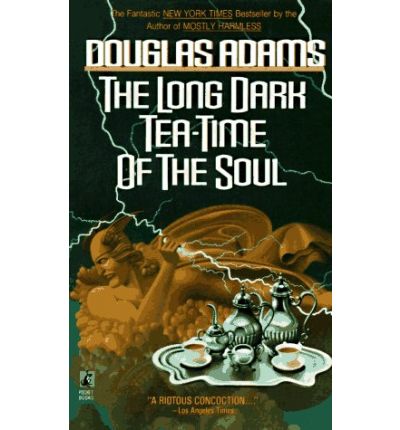
This is a line not at all from the book being reviewed today – “The Long Dark Tea-Time Of The Soul” – but rather it’s predecessor which was, to the cultured fan at least, a much better read. It’s unsure if this novel would’ve also been surpassed by the third installment planned, entitled “Salmon Of Doubt,” as the author had to go and screw the whole thing up by dying, after wading only several chapters in.

I’ll be reviewing the first book as well, but thought I would address this one first, as I’m a bigger fan of saving the best for last. Not that this one was bad, mind you. No, not at all. Unless of course you’re very religious (about Thor and Odin that is), and easily offended by conjecture in their regards. There’s nothing blasphemous in the book. Or at least I don’t think there is. But there’s hardly anything complimentary either.

In this novel, and assuming you’ve already read the other book that I’ve yet to review, we once again meet up with Dirk Gently, Holistic Detective. And much like other main characters created by Douglas Adams (I would assume that by the third paragraph in, the author’s name should be noted at least once, yes?), they are nice to have around, but hardly required to keep the story moving along. A story that can be quite confusing at times, what with errant and seemingly intelligent eagles fighting gods with short tempers and big hammers. A story that also involves people walking sideways into heaven, only after walking the Earth looking much like hell. A story that shows us a god who is much more concerned about crisp white sheets than he is eternal life. An adventure full of Coca Cola Vending machines, refrigerator thugs and horoscope writers who use their position in life only to secretly insult others whom they don’t care for. In short, another jolly romp from the man who taught us that the art of flying is simply forgetting that you’re falling.

As with my other reviews, I really don’t want to give too much of the plot away, assuming I haven’t just now. But I can tell you this. Adams once again creates a female character – this one by the name of Kate – that seems to be the only person of strength and sanity in an otherwise mad world. A world where Gently’s actual client ends up dead, his head lazily sitting atop a revolving recording of the smash hit “Hot Potato,” in the very first chapter. A world where the Thunder God himself is forced by his father to count all the stones in Wales – only to think that he “may have lost count somewhere in Mid-Glamorgan.” Amongst it all, Kate shows herself to be the bravest, most intelligent and the most “grounded” of any and all the people – or gods for that matter – that populate this novel. It’s something I hadn’t realized till just recently, but upon second thought, a running theme with most of Adams’ work. Amongst all the insanity, the nonsense and the sheer lunacy, there always seems to be a strong woman in the center of it all. Made stronger still by the fact that she responds so coolly to all the idiocy that abounds.

I will tell you another thing as well. Like most of Adams’ other material, this too required a second reading to fully “get it.” A second breeze through to simply enjoy the scenery, as it were. Not because the language is alien or clunky, but rather because the nuances are too bountiful and subtle to catch them all in the first go ’round. There are parts within this novel where you can almost see Adams struggle with his boredom over it all. But he rebounds from these moments quite quickly, and in a total of thirty-five chapters covering three hundred and seven pages, ends the story in a fashion very satisfactory. An ending I won’t blurt out here, but an ending that wouldn’t suffer terribly even if I did.

As mentioned before, this would prove to be the last full book that Douglas Adams ever wrote. While it wasn’t his best work, it is a testament to the man’s talent, wit and charm. It’s also another glowing example of how he could twist words into a delicious concoction that makes your mind almost – well, I want to say “orgasm over” – but I’m not sure if this is a “family friendly” site or not, so we’ll just leave that last bit out. I suppose what I’m trying to say about this book has already been said about this book. It occurred when The Houston Post said this: “Nobody else writes like this, nobody else could…” Snag a copy from your local library or used bookstore. You’ll be glad you did. But unlike the flip-flopped nature of my reviews, DON’T read it until you’ve read “Dirk Gently’s Holistic Detective Agency” first!

Of Mice and Men – John Steinbeck

Book # 608

Reviewer: Ms Oh Waily

This novella was first published in 1937.  It is the story of two friends, George Milton and Lennie Small.  They are migrant farm workers, or bindlestiffs, going from ranch to ranch in order to earn money.  They are complete opposites, with George a small, intelligent, sharp featured man.  Lennie is a large, exceptionally strong man, but mentally deficient.

On the way to a new ranch the pair are dropped, deliberately, by the bus driver many miles away from their final destination.  They stop by a pool of water and camp overnight.  It is during this passage that we learn about George and Lennie’s past experiences and why they are coming to this ranch.  Lennie idolizes and relies heavily on George, this is clear from the start when he mimics all of George’s actions at the waterhole.  But we also are shown here what George takes from an otherwise troublesome friendship with Lennie.

The following morning they arrive at the ranch and the other key characters are introduced.  Slim is the jerkline skinner, a wise man and clearly the leader of the workers on the ranch.  Candy is an old ranch worker who lost a hand in an accident but is kept on as a swamper.  Candy’s old and decrepit dog, whom he has had since he was a pup.  Carlson, another ranch hand.  Crooks the coloured stable buck*, so named due to his crooked back.  Curley, the boss’ son and Curley’s brand new wife.

Curley is a small man who likes to fight.  And he likes to have good odds on his side, so he picks on big men in order to be “the big man” should he win, and the recipient of sympathy that a man that big “should have picked on someone his own size”.  Lennie is like a red rag to a bull for Curley.  Curley’s wife is a flirt and appears to the ranch hands “looking for Curley” in order to “give them the eye”. George is disturbed by the feeling of the ranch, he can see that Curley is a danger to Lennie and that Curley’s wife is a danger to all.  Lennie can feel this too, and begs to move on.  But George knows that they need the money to raise their stake.

It isn’t really possible to go into too much more of the plot without giving away the ending. Suffice it to say that both Curley and, in the end, Curley’s wife destroy the “best laid schemes o’ mice an’ men”.**

The minute I began to read I felt a great sense of foreboding.  A big, strong, simple man in the 1930s who has some sort of impulse control issues is not leading down a promising path.  Not only did I feel foreboding, but I began to feel sad at the sort of life these men had to lead, especially the need to “hide” Lennie’s deficiency and because of the clear bond the two men share.
Unlike many of the bindlestiffs, these men are travelling together and giving each other support and encouragement.  This is rare and brings many comments on their arrival at the ranch.  It is this bond that makes this story so poignant as this quote from Lennie shows.

Because…because I got you to look after me, and you got me to look after you, and that’s why.

George and Lennie share a dream of gaining a stake and having their own land.  It is this dream and story that binds them and keeps them upbeat in the face of what could be a dead-end cycle of work, cathouses and whisky.  Candy joins them in the venture mid-way through the story, and George relaxes his vigilance around leaving Lennie on his own.  While George is in town Lennie is too rough with the puppy that Slim has offered him, and Curley’s wife finds him sitting alone, lamenting his roughness.  Unfortunately Curley’s wife is lonely, despises her husband and is rueing her lost future.  It is while she is telling Lennie all of this that she makes a fatal mistake that not only ends her future but also that of Lennie and George.

I found the whole story to be heartbreaking.  Even a week after finishing the story it is still with me.  The sense of meaningless loss.  Loss of friends, loss of a future, loss of a dream.  The despair that brings.

It is truly a tragic story, yet beautifully told.  I am taken by the simplicity of the writing, yet there are patches of beautiful imagery.

At about ten o’clock in the morning the sun threw a bright dust-laden bar through one of the side windows, and in and out of the beam flies shot like rushing stars.

Or the very evocative slang of the era,

What the hell kind of bed you giving us, anyways. We don’t want no pants rabbits.

And describing Curley’s wife as she lays in the barn,

And the meanness and the plannings and the discontent and the ache for attention were all gone from her face.  She was very pretty and simple, and her face was sweet and young.

I can highly recommend spending the time to read this.  It is evocative, heart-warming and tragic all wrapped up in one very well written package.  So, off you go… the library catalogue is waiting for you… don’t put it off, you won’t regret it.

And yes, Candy’s dog’s demise does have significance.  And so does Candy’s comment to George afterwards.

Happy reading.

* again this is a novella using the language of it’s time.
** taken from Robert Burns’ To A Mouse, from which the title of this novella is believed to have come.