“A mind needs books as a sword needs a whetstone, if it is to keep its edge.”
― George R.R. Martin, A Game of Thrones
The Death of Ivan Ilyich – Leo Tolstoy
Book #829
Reviewer: Ms Oh Waily
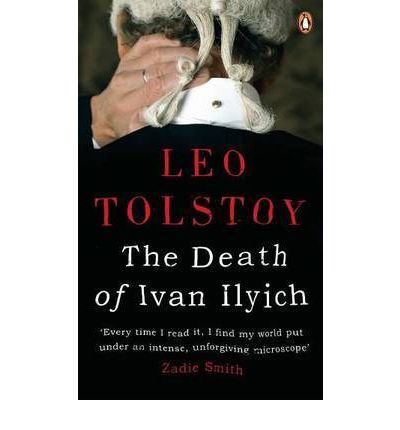 For such a very short story, around the 50 to 60 page mark, this has been very hard for me to write a review. Perhaps because it is a deceptively simple story.
First let me say that this is my first venture into reading Russian literature, and therefore, the formidable Leo Tolstoy of War and Peace renown. I must say that I felt a great deal of trepidation at tackling a work by such a literary giant. In the end I should not have been so concerned. My translation was by Hugh Aplin and the language flowed simply and elegantly.
The novella begins at the end, with the death of Ivan Ilyich, and his colleagues visiting to pay their respects. We are then transported back through the years to follow Ivan from his youth, through his education in the law and on through the life experiences of gaining better positions, a wife and children and eventually a good position as a judge in the city.
At the point where he gains this exulted position, he takes a grand house and sets about furnishing it to reflect his new social status. While involving himself in a hands-on way, he falls and hurts his side. Thinking nothing of this, he continues on with his life. Unfortunately for Ivan, the incident has life-changing impact. His health deteriorates and he suffers considerable pain. The doctors he consults contradict each other, but continue with an upbeat prognosis should he follow their advice. Sadly for Ivan, he declines steadily until eventually he succumbs to death at the youthful age of forty-five.
There are a number of themes running throughout. The most obvious one to me was the way in which Tolstoy brings into question all of the worldly trappings and accepted “striving” for position and status amongst the upper-middle classes. It is all for naught in Ivan’s case. He may have worked his way up the hierarchy, subsuming himself to whatever the norms of that class are, but in the end his mortality will not be avoided by accumulation of things or position.
His family and colleagues show this avoidance of reality in their dealings with him once he becomes ill. Death is not something they consider with regards to themselves, and are frankly glad it is happening to someone else. It makes them uncomfortable.
In fact, the only person in the story who is comfortable with death is Gerasim, Ivan’s peasant servant. He is able and willing to give of himself and his kindness at the very end of Ivan’s life, when the pain is so excruciating that Ivan screams for days on end. He gives this aid freely and willingly as he hopes someone will do for him when his time comes.
In the end, after much internal turmoil, Ivan comes to look back over his life and accept that his death is inevitable. In the process, he stops feeling irritated and angry with his family for their inability to see his death as imminent, and begins to pity them and their self-induced delusions.
My translation was very easy reading. The story was told in enough detail to build up a picture of Ivan and his life, but no aspect seemed to be overindulged. Tolstoy truly is a master of conveying meaning with brevity. The language is not flowery or effusive, but simple and straightforward. I found that the story was told with remarkable clarity and even I could see some of the themes he was incorporating without the need for external references to guide me. Recognition of other themes would require more knowledge of the author and his particular interests and outlook than I have, but can be readily accessed in the many other online reviews of his work.
If a near 1500 pages of War and Peace is too intimidating, then it is well worth reading this deceptively simple work. I can highly recommend this as an entry point to Tolstoy.
Silk – Alessandro Baricco
Book # 101
Reviewer: Inspirationalreads
 Translated from Italian and told over a scant 91 pages, Silk is the tale of 19th century French silk merchant Hervé Joncour. When a blight threatens the European and African silk worms, Joncour is sent further afield to source new worms to sustain not only his livelihood but that of his home town. Leaving behind a loving wife, it is to Japan that he travels; a country mysterious through it’s policy of self-isolation but renowned for their quality of silk. On this first trip he successfully negotiates and obtains silk cocoons from a Japanese baron amidst much secrecy; Joncour is led blindfolded to the village. It is on this first trip that he first encounters the Baron’s concubine and a mutual fascination develops.
Joncour returns to Japan less than a handful of times. On all these occasions, time spent with this woman is no less fleeting but the emotions at play are also no less intense or passionate but remain unfulfilled. After each trip, he returns to a wife not completely unaware of the change Japan has wrought on her husband. When civil war in Japan destroys the village and any chance at a more permanent and ongoing relationship with the concubine, Joncour’s tale becomes that of longing “…to die of nostalgia for something you will never live.”
Silk is physically brief – if 91 pages is not short enough, most of the pages were only half filled. I mention this only because I am still amazed at how much of a complete story is told, how much emotion is conveyed, how much there is to take a away from this novella.
There are historical facts here; a little about the silk worm industry; Japan and their self-imposed isolation; Joncour’s journey is mapped quite thoroughly and is able to traced. But alongside the historical aspects, there is a complete and satisfying story. I’m not against books that leave things a bit open ended, allowing the reader to draw conclusions or imagine how they would like the characters to move on after the written part of their journey ends. In some circumstances I actually prefer it and with novellas I expect it. However, Baricco tells the full story of Joncour, his trips to Japan, his enthrallment with the concubine and the effects on his life in France particularly his marriage. The characters are not able to be fully fleshed out but this does not affect the readers understanding of the motivations or actions of the characters involved. The instant attraction leading to the ongoing obsession, the reasons behind the Joncour’s enduring marriage in the face of this, what both Hélene and Hervé do as individuals to see it out.
Which leads me to the thing that I enjoyed most about Silk – the writing. Lyrical in feel, Baricco renders this brief tale through the lens of strong imagery and such beautiful prose that it actually felt like I was consuming it; if I could only use one word to describe it, the word would be delicious. The only way to do Baricco any justice would be to provide a quote that struck me;
“He had once held between his fingers a veil woven out of Japanese silk thread. It was like grasping in your fingers… nothing.” pg. 14
When I first rated this, I gave it a 4/5, Goodreads not allowing me to give it that extra half a star I felt it deserved at the time. After giving it the necessary musings in writing this review, I’m re-thinking my rating. For all the reasons listed above, I thoroughly enjoyed this quick read. But the amount of times that it has popped back into my thoughts since reading it means it really has resonated with me. It is beautiful, sensual, desperate and heart-breakingly sad. And so I’m bumping it up to 5/5. Another reader commented that the length of this story allows you to read it one sitting and this is how I am recommending it. Read it once in one sitting to appreciate the story. Read it again, slowly, to appreciate the writing.
Quote of the Week
“No book is really worth reading at the age of ten which is not equally – and often far more – worth reading at the age of fifty and beyond.”
― C.S. Lewis
A Confederacy of Dunces – John Kennedy Toole
Book #291
Reviewer: Ms Oh Waily
 This is the 1981 Pulitzer Prize winner, sadly awarded twelve years after the author’s death. Toole set his novel in 1960s New Orleans and the tone of the language and commentary reflect this. He created a cast of bizarre and colourful characters. They are:
Ignatius J. Reilly, the protagonist, medievalist, crazy man; Irene Reilly, Ignatius’ mother with bottle red hair and a muscatel in the oven; Angelo Mancuso, policeman and master of many, ludicrous, disguises; Santa Battaglia, Mancuso’s aunt and Irene’s new found best friend; Myrna Minkoff, Reilly’s offbeat adversary and “girlfriend”, mostly seen from a distance; Gus Levy, owner of Levy Pants and downtrodden husband; Lana Lee, owner of Night of Joy and part-time purveyor of photographic articles; Jones, the coloured “vagran” and janitor at Night of Joy; Mr Clyde, owner of Paradise Vendors (hotdog vendors) and a large pointed metal fork; Dorian Greene, rake about town (gay) and buyer of Irene’s hat; Claude Robichaux, an old man arrested by Mancuso and later to become the beau of Irene. Claude is also ever so slightly obsessed with “comuniss”. George, a juvenile delinquent and partner in crime with Lana Lee; Darlene, an erstwhile dancer at Night of Joy and owner of a parrot; Miss Trixie, the bewildered, ancient accountant at Levy Pants, personal project of Mrs Levy and the fall-guy. That is quite a few people to keep track of as their stories weave together.
The whole sorry, messy and funny story begins when Patrolman Mancuso tries to arrest Ignatius while he is waiting outside a department store for his mother. This is not unsurprising when you read the description of Ignatius as he waits.
A green hunting cap squeezed the top of the fleshy balloon of a head. The green earflaps, full of large ears and uncut hair and the fine bristles that grew in the ears themselves, stuck out on either side like turn signals indicating two directions at once. Full, pursed lips protruded beneath the bushy black moustache and, at their corners, sank into little folds filled with disapproval and potato chip crumbs.
Ignatius himself was dressed comfortably and sensibly. The hunting cap prevented head colds. The voluminous tweed trousers were durable and permitted unusually free locomotion. Their pleats and nooks contained pockets of warm stale air that soothed Ignatius. The plaid flannel shirt made a jacket unnecessary while the muffler guarded exposed Reilly skin between earflap and collar. The outfit was acceptable by any theological and geometrical standards, however abstruse, and suggested a rich inner life.
Mother and son bamboozle Mancuso with the help of the crowd and especially Mr Robichaux (as we find out later in the book).
They escape and hide for some time in the Night of Joy club in the French Quarter where they meet Dorian, Darlene and Lana. Irene gets tipsy & crashes the car when they try to return home. The accident, where she knocks down a wrought iron balcony, is the catalyst for the ensuing farce of Ignatius finding work and systematically destroying his employers.
Ignatius is both laughable and pitiable. I found myself wanting to hit him and laugh at him, alternately. He is such an appalling character that it isn’t possible to actually like him. Yet he is so appallingly naïve and stupid that you cannot truly dislike him either.
He is perhaps an advertisement for the old saying, “a little knowledge is a dangerous thing”, for that seems to be his problem. He lives his own “rich inner life” guided by his Mediaeval scholarship, which naturally has very little to do with the real world in the middle of the twentieth century. He is critical of everyone and everything, and he has a psychological skin as thick as a rhinoceros. In no way does he accept his ineptitude and poor behavior as being responsible for any of the calamities that befall those around him or himself.
We follow him through his first job, at Levy Pants, where instead of attending to the filing as requested, he tries to instigate an uprising of the coloured factory workers against the “office”. There is never any question of success.
He then scrapes the bottom of the barrel when he takes on the job of street vendor of weenies. He is excessively lazy and skives off at every opportunity, mostly to watch matinee movies. In this he is aided and abetted by George, in exchange for the use of his bun compartment as storage for dubious photographs. He eats as much of his product as he sells and brings home an ever-decreasing amount of money to help out his “momma”.
The final straw for his exasperated mother comes when he tries to organise a political party around Dorian, the “deviant”, and his cohort. He is so grotesque that all hell breaks loose at the kickoff rally (party) and he is tossed out by three rather butch and brutal women. This leads him to the Night of Joy where the final indignity of fainting in front of an oncoming car occurs. While lying in a heap on the ground he is photographed and the ensuing image is published in the newspaper. His mother finally hits bottom.
Without fail I enjoyed this book. It got a little hard towards the last third, simply because I knew that he was going to repeat the arrogant mistakes of earlier cycles, and I was simply marking time waiting to find out the ultimate outcome of all Ignatius’ ridiculous behaviour.
I can quite easily see how this work won a Pulitzer, even without the cultural knowledge of New Orleans society and the US of the early 1960s. There will have been jokes that sailed right across my head, but equally my knowledge is sufficient to get many others. Then, of course, there was all of the very international slapstick bungling that cannot be missed unless you prefer your humour to be highbrow. Personally I view myself as uni-brow – high or low, I’m happy as long as it is funny or witty or clever. A mix suits me just fine.
By way of example, I have chosen a passage to help give you a flavour of some of the pointy commentary and the pompous character of Ignatius.
He remembers his first meeting with Myrna, and recounts it thus,
While I was desultorily attending graduate school, I met in the coffee shop one day a Miss Myrna Minkoff, a young undergraduate, a loud, offensive maiden from the Bronx. This expert from the universe of the Grand Concourse was attracted to my table at which I was holding court by the singularity and magnetism of my being. As the magnificence and originality of my worldview became explicit through conversation, the Minkoff minx began attacking me on all levels, even kicking me under the table rather vigorously at one point. I both fascinated and confused her; in short, I was too much for her. The parochialism of the ghettoes of Gotham had not prepared her for the uniqueness of Your Working Boy. Myrna, you see, believed that all humans living south and west of the Hudson River were illiterate cowboys or – even worse – White Protestants, a class of humans who as a group specialized in ignorance, cruelty, and torture. (I don’t wish to especially defend White Protestants; I am not too fond of them myself.)
As you can see he is completely delusional about himself. Fortunately he is well matched in Myrna. Their swordplay through letter is the key trigger for his ridiculous schemes and constant undoing.
I recommend this if you want a laugh with a lot of barbs attached. If you are not sensitive about issues around books still published when black Americans are referred to as “colored” or “Negroes” or occasionally “jig”; and can see it for what it is, then I think you will enjoy this. The same applies to anyone with sensitivities around the gay community, where terms like “deviant” are used.
I don’t believe that the author is intending to slur communities; he is representing the way of thought and speech of a particular place and time. I did not find it offensive, but others may. In fact, the “white” folk of this story come off as the intended targets of the humour more than anyone. They are poked fun at in myriad ways. If you have read or choose to read this, I’d like to hear what you think about it.
A solid four stars from me.
 1001 Books to Read Before You Die