A Clockwork Orange – Anthony Burgess

Book #437

Reviewer: t, of as long as i’m singing.
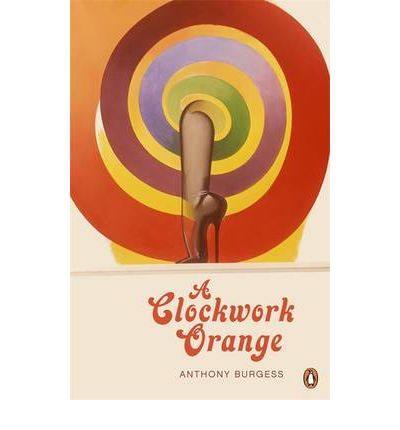
I’ll admit it. I saw the movie first. Look, it was the eighties, and I was a punk kid. And in my circle, it was almost expected that you would understand the references, and know the quotes. So I saw it. And I hated it. I just didn’t get what all the fuss was about. I mean, wasn’t this supposed to be some sort of fictional masterpiece? A book well worth reading, to the point where it could actually be life altering? It made no sense. So much so that I went and picked up the actual book to see what I had missed. And am I ever glad I did.

Now, up until that point, reading was much more of a task for me than a joy. So jumping into a book that includes it’s own dictionary may not have been a wise choice. But “A Clockwork Orange” proved that theory very wrong. The idea behind the dictionary is that since the story takes place in the future, the language is slightly different than our own. It was a daring yet beneficial move on the part of Anthony Burgess, who wrote this bleak novella back in 1962. By using phrases like “horrorshow” and “droog”, he helps to keep the reader actively attentive. “Ultra-violence” also made its first appearance in this book as did, what many in my circle thought was quite funny to say excessively, “the old in-out, in-out.” Reading the story with these phrases strewn throughout, the virgin reader is forced to continually flip forwards and back, between story and dictionary in order to follow along. It made the story portion a bit choppy, but so riveting was it that a second read was imminent after the new phrases were learnt from the first.

The story itself involves a young man by the name of Alex and his gang of four. As young teenagers in a near-future Britain, these characters are thugs and vandals. People with little respect for anything or anyone, up to the point of murder and rape being quite all right, if not in fact hoped for. Alex does have a strange love of Beethoven, which appears to be an island of tranquility, dozily resting upon his sea of turmoil. But only until you realize that he uses it to help him better visualize acts of cruelty. Besides that I don’t want to give away too much of the plot, because much like “Hitchhikers”, this is a story much better discovered than recapped. Much better experienced than reviewed. I will tell you however, that Alex is eventually caught and punished for his deeds. And I will tell you that that is not where the story ends. Also, it should be noted that every single rock video showing a person strapped into a chair with their eyes forcibly opened while watching films, is an ode to that punishment.

Should you decide that there’s enough here to get you to bounce down to your local library or book store and obtain a copy for yourself, please keep several things in mind. First, make sure the version you get has the dictionary included. You’ll be lost without it. Unless you come from a near-future Britain, of course. And if you’re in the U.S., make sure you obtain the version with twenty-one chapters, versus twenty. For some reason, when Burgess brought his book over, U.S. publishers felt that the American audience wouldn’t “go for” the twenty first chapter, and they opted to publish a version including only the first twenty instead. Doing this did a great disservice to the story itself, and to all who read it in this fashion. This was supposedly the version Stanley Kubrick read before making his ill-fated movie, and this may help to explain why he so poorly missed the point.

In short, “A Clockwork Orange” is to books what “Saving Private Ryan” was to movies. You need to read it, even if you can only muster the strength to do so once. It shows a near-future world that is much closer than we’d probably care to admit. All while helping to illuminate the idea that how you perceive the world to be is the world that you will in turn create. And if it were left up to the twenty-first chapter Alex to wrap up this review, I suppose he would most likely say that the book is important, because one should always “viddy well, little brother, viddy well.”

The Siege of Krishnapur – J.G. Farrell

Book #343

Reviewer: Ms Oh Waily (first published 2008)


This is the 1973 Booker Prize winner by J.G.Farrell.

The setting is the 1857 Indian Mutiny.  The story is told from the perspective of a number of British residents in Krishnapur.  The central characters are Mr Hopkins, the Collector; Fleury, a recent arrival to India and his widowed sister, Miriam; the Dunstaple family – father, the local physician – son, a young military man and daughter Louise, the season’s beauty; Mr Willoughby, the Magistrate; and the Padre.

I felt that the story started off very slowly and I was dreading another reading trial like The Poisonwood Bible.  Fortunately as I went further through the book and when the siege finally began it all started to flow for me.  In the end I was fascinated by the characters and the way the author grew them and altered their views through the trials and deprivations of living through a siege situation.

And for the first time in an absolute age, I actually felt like I picked up on some of the themes.  Admittedly they came to me one morning in the half-dozing state that occurs when you are on the cusp of waking up.

The political & philosophical themes were primarily voiced in the observations of each main character given page time by Farrell, although behaviour was also used, especially by the minor players.

One aspect that this novel shared with The Poisonwood Bible is the theme of people under stress and what that brings out of their character.  Are character and world view interlinked and changeable?  The Poisonwood Bible seemed to suggest a strengthening of existing character traits and views, while The Siege of Krishnapur seems to suggest a person could go either way with an extreme strengthening of convictions or a complete weakening of convictions, even to the point of altering them diametrically.

Briefly the themes I identified were:

  • Materialism and Advancement through Invention of things versus the importance of Advancement of the human spirit.

This was primarily played out by Mr Hopkins and Fleury.  Hopkins has fitted out the Residence at Krishnapur with items he believes represent advancement, especially items from The Great Exhibition.  He is reverential about the Exhibition, almost to the point of worship.
Fleury, on the other hand, views the advancement of the spirit to be the most important thing that humans can aspire to.  Certainly materialism and objects are not worthy of the reverence he sees Mr Hopkins display.

  • The Established View versus Scientific Observation and Rationalism

This pits the two Doctors against each other.  Dunstaple is ‘old school’ and is frequently found to be criticising the methods of his colleague, McNab, as experimental and cold.  Dunstaple views the ‘establishment’ as the source of information and direction, while McNab views his own observations (as well as alternatives to the prevailing treatments) as valid guides to patient treatment.  This comes to a head over the treatment of a cholera outbreak.  While the Dunstaple cholera episode should be sad, it is actually completely, gut-bustingly and ironically funny.

  • Scientific observation

The Magistrate also showcases the duality of science that prevailed during this time.  On the one hand he views scientific rationalism very highly, as seen in his support of McNab’s use of statistics to back up his arguments on the treatment of cholera.  On the other hand is his interest and wholehearted believe in the “science” of frenology.

  • Sin

Farrell also touches on themes like “sin” as well.  This is displayed through the Padre’s progressively vigorous pursuit of sin, and the expunging of it from the congregation.  The women also feature here, with a “fallen” woman, Lucy, brought into the enclave.  She is socially shunned with the exception of Miriam and Louise who feel it their duty to be kind to her until she begins to make herself cosy with their brothers.

Through the latter half of the book, and the siege, the writing gets progressively more double-edged.  You can’t help laughing at the characters.  I am sure that Farrell intended to almost caricature certain aspects of British India, Victorian science and the intensity with which people hang on to, or shed their beliefs.

I thought that the “voice” of the book was reasonably authentic.  Apparently a lot of material was taken from diaries of events and there is even a note by Farrell that indicates some sections were almost completely lifted from his research.  Presumably this is why it felt ‘of it’s time’.

I can highly recommend this novel.  After the first, slower part of the book, it picks itself up and becomes at once entertaining, sad and thought-provoking.

The Week Ahead

Books 343 and 437 are the reviews for the coming week.

On Monday we will be making our first literary visit to India.  Set during the Indian Mutiny of 1857, it is the 1973 Booker Prize winning The Siege of Krishnapur by J.G. Farrell.
Follow the interesting cast of characters as they face imminent danger.
J.G.Farrell has two other books on the 1001 list, Troubles and The Singapore Grip.

Then in the middle of the week we will have our usual quote break.

And finally on Friday we will be enjoying another review from our newest Review Crew member, t of as long as i’m singing.  This one is the dystopian novella, A Clockwork Orange by Anthony Burgess.
It is set in near-future Britain, and follows a gang of teenage thugs and their leader, Alex.  It should be an interesting review.

Have a great week reading everyone.

Enduring Love – Ian McEwan

Book #95

Reviewer: Inspirational Reads

Joe and his wife are on a romantic picnic when a hot air balloon becomes untethered with a lone boy in it. Joe and a number of other onlookers rush to assist; the boy lives but one of the rescuers does not. It is at this event that Joe meets Jed Parry, one of the other rescuers and with one shared glance Jed begins an obsession with Joe that dramatically alters both their lives.

The story is told from Joe’s perspective, recalling the events set off by the ballooning tragedy. And from the outset Joe makes us aware of this impending “something”, that this event is where everything spirals out from. The tension is there from the beginning. We become aware of Jed Parry’s obsession almost immediately as Joe receives a phone call from him that very night. And McEwan only ups the ante from there.

Joe views himself as a scientist, his profession as a science writer only came about through self-perceived failure. It is this analytical nature that Joe brings to bear on Parry’s obsession. His own compulsion to know why this is happening, what he can do to stop it, what he needs to do to keep himself and his wife safe, becomes manic in its intensity, mirroring Parry’s lovesick madness. Joe’s own crazed behaviour impacts his marriage and soon the reader too begins to doubt that everything is right with Joe himself.

This is my first Ian McEwan read, and it’s a fantastic introduction to a great writer. There is a lot going on here story wise. There are a number of sub-plots circulating around this one event other than the stalking of Joe by Parry. The second half of the book meanders a bit in trying to draw all these together. What doesn’t suffer is the writing. McEwan uses Joe’s all-consuming scrutiny to put forth outstanding passages, such as:

Our misery in the aftermath was proof that we knew we had failed ourselves. But letting go was in our nature too. Selfishness is also written on our hearts. This is our mammalian conflict – what to give to the others, and what to keep for yourself. Treading that line, keeping the others in check, and being kept in check by them, is what we call morality.

Although this was my first McEwan, it was the third in a line of contemporary writers that had a similar feel; an intelligent person suffers a major event, usually tragic and the story goes on to show the impact of this event with the protagonist introspectively analysing their actions, the actions of those around them and the associated emotions. Usually some form of violence is needed to bring about the climax. Enduring Love did not suffer in comparison, this was the best of the bunch and to be fair I enjoyed every one and the writing was impeccable for all, (just for interest’s sake the other two are Siri Hustvedt’s What I Loved, and her husband Paul Auster’s Invisible), it just suffered for it’s similarity. And it also sounds like a majority of McEwan’s work is along these lines. This will in no way stop me from reading more, I just won’t be going through all of his (or Hustvedt’s or Auster’s) one after the other.

This is a cracking story with excellent writing. There is also a movie adaptation staring Daniel Craig and Rhys Ifans which will be interesting to check out despite it’s 6.4/10 rating on IMDB. But for the book itself, I recommend it and rate it 4/5.