Don’t cry because it’s over, smile because it happened.”
– Dr. Seuss
Captain Corelli’s Mandolin – Louis de Bernières
Book #129
Reviewer: Ms Oh Waily (first published 2008)
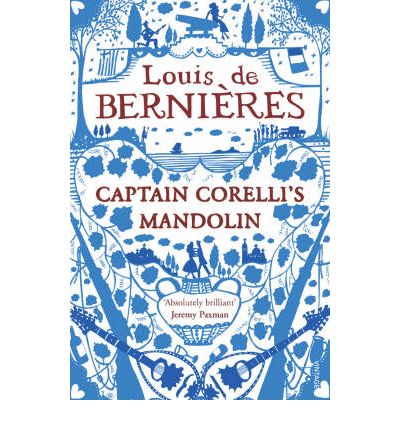
I have already made comment regarding one thing that annoyed me about this book, and that was the feeling that the author had fallen into the Oxford Not-So-Concise Dictionary printing press. This annoying feature lasted roughly for the first third to half of the book. After that point Mr de Bernières seems to have calmed down somewhat.
Don’t get me wrong. It’s not that I don’t like to have my vocabulary stretched – I do. It’s just a case of feeling that it was written in a manner that almost suggested the literary equivalent of name-dropping. You know the sort of thing – “See who I know and just how smart I am?” When in fact a more judicious use of unusual words would have indeed suggested the author was very smart, but not attempting to rub our noses in his erudite language skills. Okay, that’s my first gripe over with.
The basic storyline follows Carlo Guercio, Antonio Corelli, Doctor Iannis and his daughter, Pelagia. There is also a wonderful set of supporting characters to back up and give the texture to the story. The setting is predominantly Greece, but moves through the war in Albania briefly before settling back into Cephallonia . The majority of the book is devoted to the complicated relationship that builds between Pelagia and Corelli whilst the Italians occupy Greece during the war.
The novel moves from cynical to dark to gory to funny to heartwarming to horror to disbelief very easily. You are not always sure what the next chapter will be bringing. The tone and language also changes throughout. Some chapters are crammed full of a variety of uncommon words, while others are full of easy, smoothly readable descriptions of places, people and their personalities. There is no shortage of commentary on the nature of man during wars, and the infliction of pain on soldiers and civilians alike. There is also a good dose of some absolutely hilarious, acid and brutal political commentary. To illustrate this, I have taken two extracts from near the end of the book. The first extract is in the context of Greek liberation from the German occupation, only to be overrun by the communist andartes.
In all this there was both an irony and a tragedy. The irony was that if the Communists had continued their wartime policy of doing absolutely nothing, they would undoubtedly have become the first freely elected Communist government in the world. Whereas in France the Communists had earned themselves a rightful and respected place in political life, the Greek Communists made themselves permanently unelectable because even Communists could not bring themselves to vote for them. The tragedy was that this was yet another step along the fated path by which Communism was growing into the Greatest and Most Humane Ideology Never to Have Been Implemented Even When it Was in Power, or perhaps The Most Noble Cause Ever to Attract the Highest Proportion of Hooligans and Opportunists.
The second extract is a commentary on Britain and it’s position in the world.
In those days Great Britain was less wealthy than it is now, but it was also less complacent, and considerably less useless. It had a sense of humanitarian responsibility and a myth of its own importance that was quixotically true and universally accepted merely because it believed in it, and said so in a voice loud enough for foreigners to understand. It had not yet acquired the schoolboy habit of waiting for months for permission from Washington before it clambered out of its post-imperial bed, put on its boots, made a sugary cup of tea, and ventured through the door.
There are more moments like this. If you particularly would like to poke fun at Mussolini, then you will love reading the chapters entitled The Duce and A Pamphlet Distributed on the Island, Entitled with the Fascist Slogan ‘Believe, Fight and Obey’.
My only other major complaint, without giving the ending away, is that there is a pitifully weak break in the story with regards to how the author arranges the main characters’ lives after the war is over. The reason given for the actions of at least one character is nothing short of improbable and impossible, in the circumstances. For me the ending itself isn’t unsatisfactory, but I can see for others it would be. And I would completely agree with anyone who finds the manner in which it is arrived at as implausible and irritating.
Saying all that, though, I can still happily recommend the book. Just keep a dictionary beside you for the first little while.
I would give it a rating of 3 out of 5.
The Curious Incident of the Dog in the Night-time – Mark Haddon
Book #19
Reviewer: Inspirational Reads

Christopher John Francis Boone knows all the countries of the world and their capitals and every prime number up to 7,057. He relates well to animals but has no understanding of human emotions. He cannot stand to be touched. And he detests the color yellow.
This improbable story of Christopher’s quest to investigate the suspicious death of a neighborhood dog makes for one of the most captivating, unusual, and widely heralded novels in recent years.
This quirky novel is one told in first person perspective, being that of a 15 year old boy named Christopher who has an Apergers Syndrome type condition. He wakes one morning to find his neighbour’s dog has been killed and he sets out to investigate what happened. This is a mystery and Christopher is the most unique of detectives, with highly detailed observations including diagrams. Oh, and lets not forget that the chapters are in ordered prime numbers.
Those expecting a traditional whodunnit mystery may be slightly disappointed. The mystery is the vehicle in which we become familiar with Christopher’s thoughts, his life and his relationships in it. And it is this insight which makes this novel fascinating and a highly enjoyable read. Christopher is so knowledgeable about so many different things but as we would expect, he is less than aware when it comes to personal relationships. Especially that with his father who has recently separated from his mother, the stress of a high needs child being too much for their marriage. The reader is aware of something that Christopher is not – how desperately his father loves him and all that he does to try and elicit this emotion from his son. I found this the most poignant and saddest part of the tale, but it is also what elevated it beyond a showcase of Christopher’s savant abilities and entertaining musings.
I was interested to read that although the author Mark Haddon had previously worked with disabled children, he has stated that he knows very little on the subject and did no research. Christopher’s voice is so clear and unflinching that his character never felt contrived. I have not had any experience in dealing with anyone who has autism or Aspergers, but general consensus is that Haddon achieved a realistic portrayal despite he himself recommending reading work by autistic authors for a true account.
Although written for an adult audience, Haddon’s publishers recommended marketing it to both adults and children. Before learning of this, I passed it on to my 11 year old to read (he gets to cross one off the 1001 list!) and he too thoroughly enjoyed it. Yes, you do discover along with Christopher what happened to the dog in a not too surprising reveal but this story is so much more than this curious incident. This is a quick, surprisingly emotional read, one that I highly recommend.
Quote of the Week
So many books, so little time.
― Frank Zappa
The English Patient – Michael Ondaatje
Book #156
Reviewer: Ms Oh Waily (first published 2008)
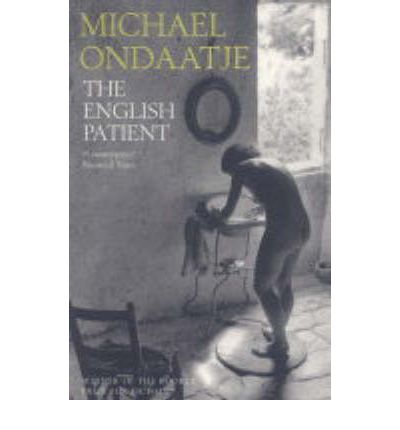 Finally I have managed to make my way through a book that, by Booker panel adjudication, is a worthy read.
Many, many years ago I went to the movies and saw Anthony Minghella’s Oscar-winning adaptation. I believe it won 9 golden statues in total. Sadly, all these years later, I can barely remember much about it. Apparently it wasn’t earth-shattering in my world. Now, having read the book I feel the urge to go back and see the film. I have strong suspicions that Ralph Fiennes (eye-candy value aside) and Kristin Scott-Thomas may have been mis-cast. Still, I’ll withhold judgement until such time as I rent the movie.
So, the book.
I am a little bit out of practice in reading interesting novels, so please cut me some slack on my minimalist review and probable obtuse comments regarding the underlying themes of the novel.
This is a tale of woe before and during WWII. Four people come together at the Villa San Girolamo in Italy as the war in Europe comes to a close. The English Patient, who appears to have lost his memory and is badly burned in an aeroplane crash in the deserts of North Africa; Hana, a young Canadian nurse who has lost a baby and her father during the war; Caravaggio, a thief and spy who has his thumbs cut off by the Germans and knows Hana from their previous life in Canada; and Kip, a young Sikh who is working his way through Italy defusing bombs, booby traps and other nasty devices while blocking out the harsh reality of the personal and professional loss being a sapper brings.
The writing style is quirky, and disjointed, but you get used to it very quickly. As the book moves on it gets easier to follow and it stops you from getting too bored with what is a particularly simple story about relationships. The ‘trick’ of this novel is the way in which the author chooses to tell us about those relationships.
Ondaatje chooses to release small snippets of information at a time. We get to know the characters at a leisurely pace, and without cramming masses of details into each passage. It is a very relaxing novel in that sense. You have time to think about everyone’s story and what brings them to the point we join them at the Villa. This can be quite hard going for those of us (no fingers pointed at Ms O, of course) who are used to reading books crammed with detail, forcing as much in to 300 pages as is humanly possible and treating their readers as though they have no imagination. (Ooo, was I just scathing about most of the chick-lit and trashy reading I’ve been doing lately?)
Anyway.
I agree with the Amazon reviewers who gave it a 4 out of 5 rating.
Personally I would have to give it a 2.5 or 3. I understand you may be confused by this double rating, so here’s my explanation.
Even though I didn’t find it a 4 star read, I know that it is. This is the danger of reading candy floss books. They can block your ability to appreciate the art of storytelling, especially if you get caught up in ‘instantaneous gratification’ mode and want things laid out in front of you at top speed, preferably without distracting things like interesting prose and unusual imagery. Having read this novel, I now find myself feeling the need to check-in to junk fiction rehab. Is it possible to get the DTs in a novel-reading sense? I’m beginning to think it is.
Mr Ondaatje really has an eye for unusual phrasing and beautiful sounding words. So here are some that I thought worthy of noting down.
Imagery:
- Dust coagulating
- The paranoia and claustrophobia of hidden love.
Words:
- autodidact
- burnoose
- antiphonal
- propinquity
- fata morgana
—
Also on an historical note, the descriptions of the bombs and how many there were, was quite an eye-opener.
The names for them: Hermann, Esau, Satans.
The number of them: 2,500 unexploded bombs in August of the blitz, 3,700 by September.
The insanity of the mine-laying:
The scale of the laying of mines in Italy and in North Africa cannot be imagined. At the Kismaayo-Afmadu road junction, 260 mines were found. There were 300 at the Omo River Bridge area. On June 30, 1941, South African sappers laid 2,700 Mark 11 mines in Mersa Matruh in one day. Four months later the British cleared Mersa Matruh of 7,806 mines and placed them elsewhere.
 1001 Books to Read Before You Die