The 39 Steps – John Buchan

Book #743

Reviewer: Ms Oh Waily


T39SWelcome to the early world of the ‘spy-thriller’ and the inspiration for the first  ‘man-on-the-run’ films.

John Buchan wrote The 39 Steps in 1915 while convalescing with a duodenal ulcer.  It is set in 1914 in the lead up to World War I and puts mining engineer and general adventurer, Richard Hannay, on the run in the borders of Scotland.  There is a very good chance you will have seen Alfred Hitchcock’s film of the same name, which is loosely based on this story.

We first meet Richard Hannay three months in to his return to the Old Country from southern Africa.  He’s made his ‘pile’ out in Rhodesia and decides to return to England, but is disappointed from the very first and at the point we join him he is giving it one more day to find some reason to stay.

And reason he gets.

On returning to his flat one evening he is accosted by the man who lives in the top floor flat of his building.  The man asks to come in, and there begins Hannay’s introduction to pre-WWI espionage.  Franklin Scudder introduces a wild and barely plausible tale with the wonderful throw-away line,

‘Pardon,’ he said, ‘I’m a bit rattled tonight.  You see, I happen at this moment to be dead.’

While clearly he is not dead at this point, he shortly fulfills his own prophecy with a knife through the chest, pinned to the floor of Hannay’s flat.  Left with the choice of face the police and a murder charge, or follow up on the fanciful tale that Scudder tells him, he chooses to flee London and head to the remotest part of the Isles he can find – Galloway in the borders of Scotland.  Here we get to enjoy multiple run-ins with various local characters and watch Hannay bounce from one piece of bad luck to good, to incredulous, eventually back to bad luck and then to good.  Eventually we return to England, first to London and then to Kent and the mystery of the 39 steps is revealed.

It is certainly a dated work.  The language is almost Wodehousian, but not quite yet.  You find lovely words like aquascutums presumably from the business of the same name, and knickerbockers.  Despite the amount of pages devoted to Hannay’s scurrying around the countryside it is surprisingly still short enough not to get too boring.  By the time he finally heads south again, having eluded the spies chasing him, you are glad to see things moving on as his luck is nothing short of outrageous for most of the flight.

My volume was 174 pages long which I read comfortably in one day.  I am not a fast reader.  This is not complicated writing, nor overly descriptive in any way.  It is a bald adventure story where we learn almost nothing of note about the characters other than that which is required to move the adventure along.  I felt rather like I was reading the bridge between the Conan Doyle adventures of Sherlock Holmes and those of John Le Carre’s spymaster, George Smiley.  It was neither, in my opinion, of the quality nor graceful style of the other authors but there were elements of both clearly visible in the writing.  It had quite a few tinges of Victoriana, yet also looked ahead to what would eventually become the modern spy genre.

Buchan apparently called the style of his book a “shocker”, which dear Wikipedia notes,

He described a “shocker” as an adventure where the events in the story are unlikely and the reader is only just able to believe that they really happened.

I think Mr Buchan had a good handle on his writing.  It is a good and fair description of the story.  Barely believable, but just enough of an end-of-fingernail grip on reality to keep you reading until the end.

If you have a spare afternoon or evening and want to see the starting shoots of a genre, then this is the book for you.

Absalom, Absalom – William Faulkner

Book #622

Reviewer: Beth’s List Love (first published January 2013)


AASo I braved more Faulkner for my Mississippi read and was not sure at first that it was a good idea, but I have been converted. The Sound and the Fury will never truly be my friend, but one of its characters, the male Quentin who kills himself in his freshman year at Harvard, is still alive and well and telling a story of Southern life to his roommate from Alberta in Absalom, Absalom!, and I like him much better now. He and his roommate stay up all night discussing this complex tale of the Sutpen family, and by the time you realize you are in the Harvard dorm room, you are willing to stay up to hear the rest too. That doesn’t mean this is an easy read, but there is a beauty and tragedy to this tale that makes it compelling. Here is what I said about the book on Goodreads:

My rating: 5 of 5 stars

From a little after two oclock until almost sundown of the long still hot weary dead September afternoon they sat in what Miss Coldfield still called the office because her father had called it that–a dim hot airless room with the blinds all closed and fastened for forty-three summers because when she was a girl someone had believed that light and moving air carried heat and that dark was always cooler, and which (as the sun shone fuller and fuller on that side of the house) became latticed with yellow slashes full of dust motes which Quentin thought of as being flecks of the dead old dried paint itself blown inward from the scaling blinds as wind might have blown them. There was a wistaria vine blooming for the second time that summer on a wooden trellis before one window, into which sparrows came now and then in random gusts, making a dry vivid dusty sound before going away: and opposite Quentin, Miss Coldfield in the eternal black which she had worn for forty-three years now, whether for sister, father, or nothusband none knew, sitting so bolt upright in the straight hard chair that was so tall for her that her legs hung straight and rigid as if she had iron shinbones and ankles, clear of the floor with that air of impotent and static rage like children’s feet, and talking in that grim haggard amazed voice until at last listening would renege and hearing-sense self-confound and the long-dead object of her impotent yet indomitable frustration would appear, as by outraged recapitulation evoked, quiet inattentive and harmless, out of the biding and dreamy and victorious dust.

That is the first paragraph of Absalom, Absalom! by William Faulkner – please note that the whole thing is just two sentences – and it was nearly enough to make me run screaming for something else from my bookshelf. My introductory psychology classes taught me that human working memory can hold on to 7 plus or minus 2 “chunks” of information before becoming overloaded. There is no way that Faulkner’s prose respects this limitation. And yet, by the end of this book (unlike with my last Faulkner experience), I had somehow become a huge fan anyway. Sick with the flu last night, I was desperately trying to keep my eyes open and make it to the end, not only of sentences, but of the whole book, because I really had been captured by this Shakespearean tragedy of a family saga set in Civil War era Mississippi. I have discovered that the strategy is to simply let the prose wash over you and not struggle too hard for meaning. Eventually the successive waves of narration begin to build a coherent narrative that is compelling. Faulkner also adds chronology and genealogy sections in the back that help provide scaffolding when you are lost, but also contain spoilers, so while I used them, I was a little ambivalent about doing so. I will say that despite understanding some basic facts that were not known to the characters for much of the book, I nonetheless found myself riveted as the plot unfolded, but I should also say that it took about a third to halfway into the book to feel this commitment to it. So stick with it, I think you will find it is worth it. At the start of this book, I was seriously considering giving up on further Faulkner, but now I look forward to future Faulkner novels with a pleasant anticipation.

The Little Prince – Antoine de Saint-Exupéry

Book #574

Reviewer: Ange from Tall, Short & Tiny

The Little Prince​My copy of The Little Prince was bought for £1.99 in 2009, just days before we left London to return to New Zealand, and was immediately sealed in a box, ready to be shipped home. There it stayed, for almost four months, until being unpacked when we moved into our new house. Once it was unpacked, I read it over a few hours while putting things in their new places, and when I’d finished, I sat with a smile on my face.

It is a beautiful story, magical, poignant, sad, poetic​​; I only wish I could read it in its original French, as I imagine that would simply enhance its beauty.

The Little Prince is essentially a children’s story, but it has massive appeal for adults too. It is quite complex in its themes and metaphors which I think many (perhaps most?) children would not get, but its simplicity and imagery ​would be enough to capture and hold young imaginations. The story begins with the narrator lamenting the fact that adults often lack imagination, which children would identify with,

“All grown-ups were once children… but only few of them remember it.”

“Grown-ups never understand anything by themselves, and it is tiresome for children to be always and forever explaining things to them.”

and the little prince himself comments that,

“Grown-ups are very strange/really very odd/certainly absolutely extraordinary”.

The basic story is of the narrator, a pilot who crashes his plane in the desert, meeting a young boy (the little prince) from a distant planet. Over eight days, the narrator attempts to repair his plane, while the little prince tells stories about his home planet, and the places he has been. He tells of his tiny home planet, with its three little volcanoes (which he cleans) and a variety of plants. He tells of his love for a beautiful rose that suddenly appeared growing; he tended the rose until he began to feel that she was taking advantage of him, and although she apologises for her vanity, he decides to travel and explore the universe.

He tells of the interesting characters he has met along the way (including a king with no subjects, and a man who believes himself to be the most admirable person on a planet inhabited by no other), and that he first believed Earth to be uninhabited due to landing in the desert. When he discovers a whole row of rosebushes, he is sad, because he’d believed his rose was unique. He meets a fox who explains that his rose really is special, because she is the object of the prince’s love. The fox is wise, and asks the prince to tame him; he is given many of the story’s most profound, memorable lines:

“I shall look at you out of the corner of my eye, and you will say nothing. Words are the source of misunderstandings.”

“To me, you are still nothing more than a little boy who is just like a hundred thousand other little boys. And I have no need of you. And you, on your part, have no need of me. To you I am nothing more than a fox like a hundred thousand other foxes. But if you tame me, then we shall need each other. To me, you will be unique in all the world. To you, I shall be unique in all the world….”

“Goodbye,” said the fox. “And now here is my secret, a very simple secret. It is only with the heart that one can see rightly. What is essential is invisible to the eye.”

When the narrator has fixed his plane, it is time for the little prince to return home. Their farewell is quite emotional but sweet and beautiful:

“When you look up at the sky at night, since I shall be living on one of them and laughing on one of them, for you it will be as if all the stars were laughing. You and only you will have stars that can laugh!”
And as he said it he laughed.
“And when you are comforted (time soothes all sorrows) you will be happy to have known me. You will always be my friend. You will want to laugh with me…”

The story is supposedly based on aspects and experiences of de Saint-Exupéry’s own life; the rose is said to represent his wife, whom he loved but was unfaithful to. It is a story rich with beauty and imagination, and I never grow tired of flicking through its pages.

I look forward to the time when I can read this with my sons, and I hope they will enjoy it as much as I do. The Little Prince deserves 5/5 stars – there is nothing I can fault with it, and I loved it.

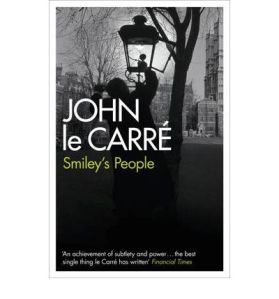
Smiley’s People – John le Carré

Book #295

Reviewer: Ms Oh Waily

SP

Back in October 2012 I reviewed the wonderful Tinker Tailor Soldier Spy, the first in the trilogy of “Karla” novels featuring spymaster George Smiley.
Today we visit the final chapter.

George is in retirement, ostensibly composing a monograph on Opitz.  He is totally unaware of the two events occurring as he sits in the London Library, researching and writing, that will bring his retirement to a swift end.

The first event happens in Paris amongst the Russian émigré community.  Maria Andreyevna Ostrakova is approached and told that there is hope that the daughter she chose to leave behind in Russia when she escaped to the west may be able to be reunited with her in France.

The second event occurs a few weeks later in Hamburg with a young man on a steamer following the precise orders of ‘the General’, scared and determined alternately as he does the work of a courier.  The same night that this young man returns to England Smiley is summoned by Oliver Lacon.

Lacon wants him to identify the body of a man killed on Hampstead Heath and to bury any connection he may have had with the Circus.   The man, an ex-Soviet General and covert British agent, had recently tried to re-establish contact with the Circus and his old handlers by telephoning in to say that he had something urgent for ‘Max’*.  Unlike the incumbents in the Circus and the Civil Service, Smiley believes that the General, Vladimir, was not simply trying to seek attention and had a genuine source of important information.  It is this belief that Smiley decides to follow and which eventuates in the succeeding happenings described in the remainder of the novel.

Just as Smiley follows the breadcrumb trails left by the General and his assistant, Otto Leipzig, we are taken along with him.  Le Carré takes us from one person’s story to the next, weaving them together as he goes, once again using a mix of memories with present day events.  He gives us hints of what is to come but never seems to lose the tension.  You are left on the edge throughout the story, as there are so many ways that Smiley’s investigation could go wrong and be found out before it reaches it’s end.

And what end will that be?  Will George Smiley manage to outwit and outmanoeuvre his Russian nemesis, Karla?  Or will Karla, once again, manage to stay out of reach?

You’ll just have to read and see.

In this novel we see the reappearance of Connie Sachs, the Circus’ retired researcher on Soviet intelligence, and Toby Esterhase the Lamplighter from Tinker Tailor and Vladimir’s old handler and “postman”, as well as Oliver Lacon.  We are taken from France to Germany, Germany to England, back to Germany and France and finally to Switzerland.  It is quite a ride.

I enjoyed it immensely and the 454 pages of my copy seemed to fly past.  The writing style and language, once you are familiar with the spy-world jargon, flows easily.  The characters are sketched in such a way that you are drawn in to them.  Take the unique style of Connie Sachs when Smiley goes to visit her in order to access her long wealth of knowledge of Karla and the Soviets.

‘Connie’s not coming back, George,’ she called as she hobbled ahead of him.  ‘Wild horses can puff and blow their snivelling hearts out, the old fool has hung up her boots for good.’  Reaching her rocking-chair, she began the ponderous business of turning herself round until she had her back to it. ‘So if that’s what you’re after, you can tell Saul Enderby to shove it up his smoke and pipe it.’  She held out her arms to him and he thought she wanted him to kiss her. ‘Not that, you sex maniac.  Batten on to my hands!’
He did so, and lowered her into the rocking-chair.
‘That’s not what I came for, Con,’ said Smiley. ‘I’m not trying to woo you away, I promise.’
‘For one good reason, she’s dying,’ she announced firmly, not seeming to notice his interjection. ‘The old fool’s for the shredder, and high time too.  The leech tries to fool me, of course.  That’s because he’s a funk.  Bronchitis. Rheumatism.  Touch of the weathers.  Balls, the lot of it.  It’s death, that’s what I’m suffering from.  The systematic encroachment of the big D.  Is that booze you’re toting in that bag?’

And that sums up the redoubtable Ms Sachs.  And Mr le Carré’s very clear characterisation.

If you are looking for something light, but interesting, and have not considered wandering into the world of the Cold War spy then you could do no better than choose to read the Karla trilogy, Tinker Tailor Soldier SpyThe Honourable Schoolboy, and this excellent conclusion, Smiley’s People. But do start at the beginning.  Although they can be read on their own, it will be much better to have the foreknowledge of that which has past before in the series.

As for myself, I am considering hunting down the remainder of the novels featuring George Smiley, including the famous The Spy Who Came in from the Cold, in which he has a minor role and the 2011 film adaptation of Tinker Tailor to see if Gary Oldman can carry my vision of George.  This series of books will certainly be added to my bookshelves at home in due course, they are eminently readable.

Happy reading everyone.


* Max = Smiley.

An Artist of the Floating World – Kazuo Ishiguro

Book #230
REVIEWER:
Beth’s List Love (first published February 2013)

An Artist of the Floating WorldI have read Ishiguro before, and liked his work very much. I found this novel somewhat less engaging than The Remains of the Day, but still it was a quick and easy read.

“I believe I have already mentioned the fact that I played a small part in the Migi-Hidari’s coming into existence. Of course, not being a man of wealth, there was little I could do financially. But by that time my reputation in this city had grown to a certain extent; as I recall, I was not yet serving on the arts committee of the State Department, but I had many personal links there and was already being consulted frequently on matters of policy. So then, my petition to the authorities on Yamagata’s behalf was not without weight.

‘It is the owner’s intention’, I explained,’that the proposed establishment be a celebration of the new patriotic spirit emerging in Japan today. The decor would reflect the new spirit, and any patron incompatible with that spirit would be firmly encouraged to leave. Furthermore, it is the owner’s intention that the establishment be a place where this city’s artists and writers whose works most reflect the new spirit can gather and drink together. With respect to this last point, I have myself secured the support of various of my colleagues, among them the painter, Masayuki Harada; the playwright, Misumi; the journalists, Shigeo Otsuji and Eiji Nastuki–all of them, as you know, producers of work unflinchingly loyal to his Imperial Majesty the Emperor.’”

So remembers Masuji Ono, looking back on his pre-war life as a prominent artist in Imperial Japan. He is writing at a time after the war when a younger generation, and Japanese society at large, devastated by the effects of Japan’s role in the Second World War, look with criticism on those involved in engineering and promoting that war to the nation. His past actions have affected his professional relationships and have also created tension in the relationships with his own daughters. Ono must come to terms with the meaning of his own professional and artistic choices and their moral import in light of Japan’s recent history.

This is a fairly dry read, but an interesting study in the changing attitudes in Japanese society, the nature of artistic training in Japan, and the dynamics of relationships between the sexes and generations in Japanese families of the period. I found it interesting, but not particularly moving. Ironically, as one who lived briefly in Japan in the 1980s, I shared with Ono a certain concern about the degree to which American influences have come to predominate over traditional Japanese attitudes since American post-war occupation there. While I absolutely value the shift from aggressive nationalism to a more democratic and international perspective, I remember being somewhat horrified at the degree to which American materialism and less appealing cultural norms were sweeping Japan when I was there.