Farewell, My Lovely – Raymond Chandler

Book #586

Reviewer: Ms Oh Waily


Please do not adjust your computer screens, you are not seeing double.  Or perhaps you are.  Usually we post two reviews of the same book together, on the same day. This time we have split them into two posts.  You may wish to cast your mind back a week to Beth’s review before reading on.
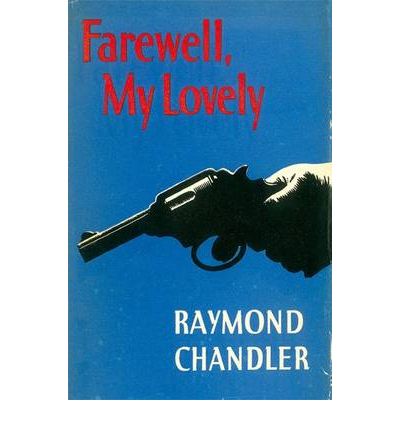
FMLFarewell, My Lovely was written in 1940 and is the second of Raymond Chandler’s novels featuring the private investigator, Philip Marlowe.  The story starts, as Beth notes, with Marlowe working a dead-end case when he inadvertently becomes embroiled with ex-convict Moose Malloy’s search for his old girlfriend Velma Valento.  Murder, drugs, jewellery gangs, gambling and varying other mysteries of the underworld all follow on from this initial encounter.

This was my first time reading an American noir novel.  And I loved it. Perhaps that’s in part due to an age-old love affair I have going with Humphrey Bogart and having the film version of The Big Sleep under my belt.  The wit and snappy dialogue that Marlowe spits out at nearly every opportunity is worth the read alone.  He’s the sort of character that speaks his mind, rubs people up the wrong way and doesn’t give a darn.

Hired to help recover a stolen necklace, he ends up talking with the beautiful owner, and this passage of banter is a great example of Chandler’s writing style and Marlowe’s speech.

Her eyes flashed at that.  I liked them that way. ‘There’s such a thing as being just a little too frank,’ she said.
‘Not in my business.  Describe the evening.  Or have me thrown out on my ear.  One or the other.  Make your lovely mind up.’
‘You’d better sit over here beside me.’
‘I’ve been thinking that a long time,’ I said. ‘Ever since you crossed your legs, to be exact.’
She pulled her dress down. ‘These damn things are always up around your neck.’
I sat beside her on the yellow leather chesterfield. ‘Aren’t you a pretty fast worker?’ she asked quietly.
I didn’t answer her.
‘Do you do much of this sort of thing?’ she asked with a sidelong look.
‘Practically none.  I’m a Tibetan monk, in my spare time.’

And that’s just how he chats to the clients.  Try his style with the police.  Speaking with Randall, the police detective working on the case, he isn’t any less snappy despite an horrific couple of days locked in a hospital prior to this conversation.

‘Was that a gag, about your being sick, in a hospital?’
‘No gag.  I ran into a little trouble – down in Bay City.  They took me in.  Not the cooler, a private dope and liquor cure.’
His eyes got distant. ‘Bay City, eh?  You like it the hard way, don’t you, Marlowe?’
‘It’s not that I like it the hard way.  It’s that I get it that way.  But nothing like this before.  I’ve been sapped twice, the second time by a police officer or a man who looked like one and claimed to be one.  I’ve been beaten with my own gun and choked by a tough Indian.  I’ve been thrown unconscious into this dope hospital and kept there locked up and part of the time probably strapped down.  And I couldn’t prove any of it, except that I actually do have quite a nice collection of bruises and my left arm has been needled plenty.’

He’s one tough cookie.  Indeed one of the archetypal hard-boiled detectives.  He deserves his place on the 1001 list and I hope that some time soon you take up a copy and meet Mr Marlowe.

One note though, is that the time period in American history also brings with it some unpleasant language to a modern ear.  The dice emporium, Florian’s, mentioned in the opening quote of Beth’s review is an African-American establishment and the first section of the novel involves the use of the “n-word”, although not excessively so.  I also learned a couple of new (to me) derogatory terms that were clearly commonplace at the time – dinge being one and shines being another – which were used more frequently.   While I, in no way, countenance the use of offensive terms, I am also of the school of thought that does not like the expunging of the language of eras past.  For me, cleaning up the language from original works seems to be a way of denying those attitudes and conditions existed.  If you are not comfortable seeing life represented in linguistic terms as it was in the mid-20th century then you may not find the first portion of this novel to be comfortable reading.  But do stick with it, the story and Marlowe’s character are worth the effort.

The Wasp Factory – Iain Banks

Book #254

Reviewer: Inspirationalreads


wasp

Two years after I killed Blyth I murdered my young brother Paul, for quite different and more fundamental reasons than I’d disposed of Blyth, and then a year later I did for my young cousin Esmeralda, more or less on a whim.That’s my score to date. Three. I haven’t killed anybody for years, and don’t intend to ever again.It was just a stage I was going through.

Let me introduce Frank Cauldhame; sixteen years old and living a reclusive lifestyle in rural Scotland with his father.The typical adolescent though, Frank is not.  If it is not obvious from the above quote, Frank is a sociopath; although he has limited his murder of humans to three, he continues to torture and murder animals, using them in rituals to help predict the course of events in his life.  Told from Frank’s perspective, the story opens with news that Frank’s older brother Eric has escaped from a psychiatric holding facility.  Oh yes blog follower, not one but two mentally deranged individuals in one family.   With Eric arrival imminent, Frank’s story unfolds switching between current events and Frank’s memories including the abandonment of his mother, a savage attack on him by the family dog which maimed and physically altered Frank, and the three horrific acts of detached, calculated murder.

Which leads me to that regular old disclaimer from me; if you are at all easily offended or squeamish and wish not to purposefully introduce dark, disturbing reading material into your life, then avoid this novel. I like to think I am providing at least some small kind of service to those who wish to avoid such books.  Don’t all rush to thank me.

This is a masterful novel, the first outing for Banks.  This is the first of SIX of his books on the list and is a quick read, but by no means easy.  The prose is straight forward but the subject matter is hard hitting.  Frank’s internal monologue is far from a rambling mass of delusional diatribes.  He is clear, methodical and applies his own brand of morality on everything he does.  There is a genuine quality in Frank, a madness that is not in any part an affectation and it is this, the characterisation of someone abhorrent and yet deserving of our sympathies and in some way, affection, that Banks genius is clearly evident.  For example, when Eric and Frank get a chance to talk Frank becomes horrified that Eric could possibly have a dog with him, setting dogs alight being one of the key indicators of Eric’s deepening instability.  Yet, earlier that same day, Frank kills one rabbit with his bare hands and then blows up a warren, delighting in his victory.  Frank is self-aware, he knows just what kind of monster he is and is often repentant, but is unwilling or unable to change.

The story itself moves along at a great pace, never feeling sluggish.  This is aided by its short length, but also in the way that the past and the present being are revealed at the same time.  All leading to Eric arriving back at the family home, bringing revelations that changes Frank’s world and the readers perspective of it.

I feel like I am doing a disservice to those who will avoid this book because of some content.  It really is a great story, with one of the most interesting characters I have read in a long time.  The elements of ick can be viewed as sensationalist or can be viewed as necessary to Frank, his inner dialogue, his idea of himself and therefore necessary to the story.  I would like to therefore take back my advice and just add a little cautionary message because this book is worth reading and I feel like it is a great introduction to a wonderful author.  Highly recommended.

Heart of Darkness – Joseph Conrad

Book #780

REVIEWER: Tall, Short & Tiny

Heart of DarknessI’d like to start this review by being totally honest…I didn’t like Heart of Darkness one little bit. I didn’t hate it, but I certainly groaned inwardly each time I picked it up, and very nearly didn’t finish it. However, having glowingly reviewed a number of books on the list, it felt only proper to be able to balance all those fantastic reads with one that, in my humble opinion, was not an enjoyable read (plus it’s short, and I was sure I could get through it!).

Nothing about this novella grabbed me. I didn’t enjoy the way the story was narrated, or the language that was used to do so. I found myself scoffing quietly, wondering if the person orating the story would really have used words such as “declivity” and “recrudescence”?

I did like a couple of Conrad’s descriptive sentences, and on the whole, I quite liked the majority of his descriptive passages, but that wasn’t enough.

“…on some quiet night the tremor of far-off drums, sinking, swelling, a tremor vast, faint; a sound weird, appealing, suggestive, and wild.”

“…this papier-mâché Mephistopheles…”

The subject matter is dark and gruesome, and I’m sure it would have been shocking at the time of publication, but I found it rather offensive and brutal. The story touches on cannibalism, colonialism and deception, none of which make for cheerful reading. There’s also the very Victorian ideals of men as heroes and women as love interests and belongings.

The language used to describe the “savages” made me uncomfortable, even though I tried very hard to put myself in the late-1800s frame of mind; it was interesting also to think that this novella remains controversial due to the subject of savagery, but perhaps for different (contradictory?) reasons.

“…these creatures rose to…hands and knees, and went off on all fours…”

“Why in the name of all the gnawing devils of hunger they didn’t go for us – they were thirty to five – and have a good tuck in for once, amazes me now when I think of it.”

“I looked at them with a swift quickening of interest – not because it occurred to me I might be eaten by them before very long…I perceived how unwholesome the pilgrims looked, and I hoped, yes, I positively hoped, that my aspect was not so…unappetising: a fantastic touch of vanity…”

The basic premise behind Heart of Darkness is that the human soul and mind has the capacity for extreme darkness, that every human being has two sides to their heart, and that in the right (or wrong, whichever way you’d like to look at it) situation, people act in unusual ways. However, I think that Conrad was trying to say that there is also inherent goodness in everyone too. Whether he extended that to his “savages” or not remains to be seen!

For me, this was a disappointing read and a bit of a drag, so unfortunately, I’m giving it just 2/5 stars.

Farewell, My Lovely – Raymond Chandler

Book #586

Reviewer: Beth’s List Love (first published January 2013)

FMLovely

It was a warm day, almost the end of March, and I stood outside the barbershop looking up at the jutting neon sign of a second floor dine and dice emporium called Florian’s. A man was looking up at the sign too. He was looking up at the dusty windows with a sort of ecstatic fixity of expression, like a hunky immigrant catching his first sight of the Statue of Liberty. He was a big man but not more than six feet five inches tall and not wider than a beer truck. He was about ten feet away from me. His arms hung loose at his sides and a forgotten cigar smoked behind his enormous fingers.

…The doors swung back outwards and almost settled to a stop. Before they had entirely stopped moving they opened again, violently, outwards. Something sailed across the sidewalk and landed in the gutter between two parked cars. It landed on its hands and knees and made a high keening noise like a cornered rat. It got up slowly, retrieved a hat and stepped back onto the sidewalk. It was a thin, narrow-shouldered brown youth in a lilac colored suit and a carnation. It had slick black hair. It kept its mouth open and whined for a moment. People stared at it vaguely. Then it settled its hat jauntily, sidled over to the wall and walked silently splay-footed off along the block.

Silence. Traffic resumed. I walked along to the double doors and stood in front of them. They were motionless now. It wasn’t any of my business. So I pushed them open and looked in.

With writing like this, how can you not enjoy a nice noir mystery? Farewell, My Lovely is a brilliant effort from Raymond Chandler, and definitely deserves its place on the 1001 Books list. Marlowe is smart but not smart enough not to get hurt, or end up with a bout of the DTs, but you want him to succeed in his quest to figure out what is going on in the situation he links himself to inextricably by pushing these doors open to look in. He makes wry and witty observations about life, pisses off most of the people he meets, and knows a decent person when I encounters one.

I have always enjoyed Robert B. Parker‘s Spenser, and he is clearly modeled on Marlowe. It is no surprise that Parker at one point finished an unfinished Chandler novel. He was the right man to do it, but nothing equals the original. Chandler’s voice and eye for detail are flawless. He has a marvelous sense of pacing and creates delicious characters to play out his drama. He even quotes a little Shakespeare when you least expect it. I feel crazy giving this 5 stars when I’ve given so many other excellent books just 4, but this is the best of a genre, so it gets all 5.

Casino Royale – Ian Fleming

Book #518

Reviewer: Ms Oh Waily

CR

Well hello Mr Bond.

In Casino Royale we get to meet the literary Bond in the flesh, so to speak.  He does have more than a passing resemblance to his film alter ego, but not so much the current version.

Casino Royale is the first Bond novel and it runs to 213 pages in the edition that I have.  It is a very quick and easy read. There are no fancy literary flourishes or playing with language, other than an excessive fondness for French phrases.  Most readers would be capable of starting and finishing this over a weekend, or an afternoon would even suffice if you dedicated the time.

If you have seen the 2006 film of the same name you can rest assured that it is a fairly faithful representation of this story.  The main difference being an updated setting in geopolitical terms.

The book was written in the early 1950s and reflects that era.  Bond works for the British secret service and his mission is to bankrupt a fifth-columnist called Le Chiffre.  Most of the first half of the book is dedicated to this process, including quite a lot of description around the Baccarat table and the ensuing duel between the two men.  The remainder of the book follows what happens after the Baccarat duel is over.  Vesper Lynd is the “Bond girl” in this novel.  She is the personal assistant to the Head of Section S, and is assigned to help Bond in bringing Le Chiffre down.  She becomes the central figure when she is kidnapped, and Bond finds that he has come to love her.

If I go more in to the plot, and you haven’t already read the book or watched the film, then the whole game is given away.  So instead I am going to make some observations about the differences that are noticeable between the onscreen Bond and Bond as he comes across in Casino Royale.

Bond simply isn’t suave.  He’s sexist, cold and clearly manipulative.  He is also a gambler.  The book is quite clear on this, while the films blur this and give the impression of a roguish bad boy.

Bond saw luck as a woman, to be softly wooed or brutally ravaged, never pandered to or pursued.  But he was honest enough to admit that he had never yet been made to suffer by cards or by women.

Perhaps he becomes suave sometime in the series of eleven novels about him.

For those who may be interested in a couple of famous Bond traits – here are a couple of passages for you.  The first is the famous Martini.

‘A dry martini,’ he said. ‘One.  In a deep champagne goblet.’
Oui, monsieur.’
‘Just a moment.  Three measures of Gordon’s, one of vodka, half a measure of Kina Lillet.  Shake it very well until it’s ice-cold, then add a large thin slice of lemon-peel.  Got it?’

The second is an explanation of the “00” designation.

‘For those two jobs I was awarded a Double O number in the Service.  Felt pretty clever and got a reputation for being good and tough.  A Double O number in our Service means you’ve had to kill a chap in cold blood in the course of some job.’

And although I did say that there is very little literary flourish about the writing, there are still some nice crisp pieces to enjoy and even some thoughtful musing on the part of Bond.  It seemed so uncharacteristic of him, but the ideas are still very applicable today.  On his doubts about working for the secret service,

‘You see,’ he said, still looking down at his bandages, ‘when one’s young, it seems very easy to distinguish between right and wrong, but as one gets older it becomes more difficult.  At school it’s easy to pick out one’s own villains and heroes and one grows up wanting to be a hero and kill the villains.’

As part of this conversation, Mathis (Bond’s French equivalent and friend) makes a wry observation of this “new Bond”.

‘Continue, my dear friend.  It is interesting for me to see this new Bond.  Englishmen are so odd.  They are like a nest of Chinese boxes.  It takes a very long time to get to the centre of them.  When one gets there the result is unrewarding, but the process is instructive and entertaining.  Continue.  Develop your arguments.  There may be something I can use to my own chief the next time I want to get out of an unpleasant job.’  He grinned maliciously.

If you are a fan of the Bond franchise then reading this will certainly give you more understanding of what is going on in his head, and what sort of character Fleming actually had in mind.  For those who are not fans, but are interested in the origins of one of cinema’s largest and lasting characters, it will be a quick and painless visit with the world’s best known spy.

Happy reading.