War and Peace – Leo Tolstoy

Book #857

Reviewer: Kara
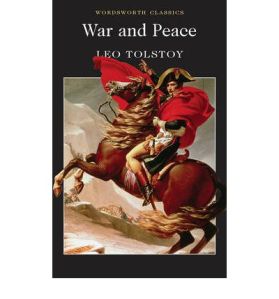

W&P

War and Peace is the epic story of several Russian aristocratic families during Napoleon’s invasion. The book covers the period from about 1805 to 1812, with a bit in the epilogue jumping ahead to around 1819.

Tolstoy himself writes that his book is unlike anything that has been written before when it comes to its form. Many have described it as part novel, part history book, part philosophical treatise, and this is pretty accurate. Many characters and events are fictional creations, and this part of the book is chock full of family drama and meandering love stories that end in both happiness and heartbreak. Other characters and events are historically accurate (at least, according to Tolstoy’s research, which some historians disagree with). However, real historical figures (Napoleon, Alexander I of Russia, Kutozov) and their real, historical actions are part of the story, and Tolstoy conducted interviews and perused diaries and letters to inform his writing. This part of the book is stuffed with battle scenes, the minutiae of war, and ongoing commentary on how war really works. Towards the end of the book, Tolstoy more and more often drifts into asides describing his philosophical take on history and how we understand it. This culminates in the second epilogue with a 40-page treatise on free will vs. fate.

Overall, I was astounded by how very accessible and readable this book is. Is it long? Yes. A time commitment? Absolutely – my edition has over 1300 pages. But at least 90% of what’s inside is easy to follow and interesting to read.

Though there are tons of major characters, it wasn’t long at all before they distinguished themselves and I had no trouble remembering each one. They are lively and full of depth, and the major players change in ways over the course of the book that ring true. Without giving away any details: One character ultimately channels her obsessive emotional energy into family. Another moves past the distractions that have filled his life. A third finally stands up for herself. One story, however, was unfortunately brushed aside – I can’t help but feel that any healing or resolution for her is omitted because she is not really part of the aristocracy.

War and Peace has many themes, and while it is certainly rife full of tragedy, I can’t help but feel that the fictional portion of the book is ultimately about finding true happiness in life. Several key characters experience a transformation that helps them see how wonderful life is.

One character learns: “Compassion, love for brothers, for those who love us and for those who hate us, love of our enemies; yes, that love which God preached on earth … — that is what made me sorry to part with life, that is what remained for me had I lived.'”

For another: “She did not know and would not have believed it, but beneath the layer of slime that covered her soul and seemed to her impenetrable, delicate young shoots of grass were already sprouting, which, taking root, would so cover with their living verdure the grief that weighed her down that it would soon no longer be seen or noticed. The wound had begun to heal from within.”

For a third: “Now, however, he had learnt to see the great, eternal, and infinite in everything, and therefore — to see it and enjoy its contemplation — he naturally threw away the telescope through which he had till now gazed over men’s heads, and gladly regarded the ever-changing, eternally great, unfathomable and infinite life around him. And the closer he looked the more tranquil and happy he became.”

There are also lovely descriptions that are full of joyfulness. For example:

“The stars, as if knowing that no one was looking at them, began to disport themselves in the dark sky: now flaring up, now vanishing, now trembling, they were busy whispering something gladsome and mysterious to one another.”

My favorite moment came at the very end of the fictional part of the story. Two characters are married and very much in love. Tolstoy describes the way that they sort of speak their own language, and understand each other in a way that no one else can. I love this because it reminds me of myself and my husband, and the fact that love is one of life’s greatest joys.

I highly recommend War and Peace to any lover of classic literature. It’s not overrated, and it’s worth all the many hours it takes to experience it.

Love Medicine – Louise Erdrich

Book #222a

Reviewer: Kara

love medicine

Love Medicine, by Louise Erdrich, is a book of short stories, but looking at them as a novel shows that the book is much bigger than the sum of its parts. This is a group of very interconnected short stories that cover many decades in the lives of members of two interconnected and very extended families – the Kashpaws and the Lamartines.

Each short story is a first-person perspective from one of the major characters and serves to show what made that individual who they are in the contemporary time of the novel (the 1980s). We see many events and scenes from the perspective of several different characters at different times.

Much of what happens is about love – marriages beginning and failing, extramarital affairs, and youthful love abound. Love Medicine opens with the death of June who is both matriarch and outcast, and comes full circle at the end when we hear from Lipsha, a young man who was raised without ever knowing the story of his past.

Each short story in Love Medicine stands alone, but it is their novelistic reflection of each other that makes the book worth reading. Different stories often depict the same events from new perspectives, or show a character earlier in their life to indicate how things got to be the way they were later on.

Erdrich delves into the treatment of Native Americans in our country over the past few hundred years, but I do think she could have gone deeper. Some of the tragic events that various Kashpaws and Lamartines have faced have much deeper and messier causes than Erdrich describes.

Where Erdrich truly succeeds in Love Medicine is in showing how upbringing and parentage (adoptive or otherwise) deeply influence the lives of children. Lipsha’s story at the end of the book is fantastic. It stands alone, of course, and it’s also a culmination that brings everything together. Lipsha is both a Kashpaw and a Lamartine, and his story offers a road forward for the families.

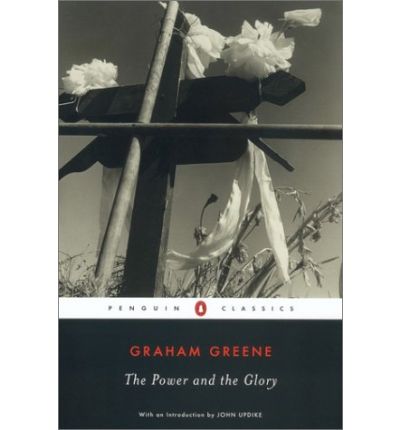
The Power and the Glory – Graham Greene

Book #589

Reviewer: Kara

In the 1930s Mexico of Graham Greene’s classic novel, God and religion have been outlawed and any priest who hasn’t escaped or relinquished his faith has been hunted down and killed. The last surviving priest who still practices religious rites is not only running for his life, but self-destructing under the weight of both his outlaw situation and his past.

I was fascinated by this unnamed main character, a ‘whiskey priest’ who drinks endlessly and is struggling to come to terms with the mortal sin he has committed and feels he can never be absolved of. Even as he runs and hides and does all he can to avoid capture and be able to continue serving his faith, he is buried deep in his own emotional upheaval and the heavy judgment his faith imposes.

The whiskey priest has many fascinating musings during his journey, but the most profound to me is this:

“That was another mystery: it sometimes seemed to him that venial sins — impatience, an unimportant lie, pride, a neglected opportunity — cut you off from grace more completely than the worst sins of all…in his innocence, he had felt no love for anyone; now in his corruption he had learnt.”

Before he committed his mortal sin, the whiskey priest had no empathy for anyone. His faith was a pulpit to stand on. Now, “in his corruption,” he sees what the grace of God and Catholic piety really mean, and his faith becomes a rock to cling to.

Greene’s novel was widely criticized by members of the Catholic clergy when it was first published for being ‘anti-Catholic’ and offensive. For me, though, and many others, including Pope Paul VI who met Greene in 1965, the novel celebrates piety and faith in their pure and empathetic forms.

Greene’s novel is full of gorgeous description of the decaying Mexican towns and the cold and mountainous countryside. Greene wrote his novel in short and very powerful scenes that pack a psychological punch. They are uncomfortable and beautiful at once. When the priest helplessly watches the policemen drink down his wine, I was livid with anger on his behalf. When he meets an elderly man in prison who takes comfort in being near him, I was moved by the connection they quickly formed.

The end of the whiskey priest’s story is both triumphant and tragic and verifies the power and the glory of the whisky priest’s Catholic faith. This is a short novel and a quick read, but it is profoundly affecting. I highly recommend this novel to anyone who has struggled to understand their own identity and sense of purpose: namely, everyone. Greene’s explorations of humanity and emotion are not often matched in their impact.

Sometimes a Great Notion – Ken Kesey

Book #420

Reviewer: Kara

Sometimes a Great Notion is a great American novel if I’ve ever read one (and I’ve read a few). It’s long and meandering, overflowing with detail. The characters are exceptional; they’re stubborn and angry and very much alive. The setting is soggy and green, with big trees and beer drinking – just like a real Oregon winter.

The novel tells the story of Wakonda, a fictional logging town on the Oregon coast. Virtually everyone is on strike, except for the Stampers who are continuing to log and jeopardizing the whole strike, for no reason except that they’re renegades like that. The crux of the story is the broken, vengeful relationship between Hank Stamper, the oldest son of patriarch Henry, and the leader of the clan since Henry was injured, and his younger half-brother Lee. Hank is strong, hardworking, and prone to fist fights. Lee is an intellectual who spent much of his life on the east coast and hasn’t logged a day in his life until he returns to Oregon.

Hank and Lee are surrounded by a host of other characters, both family members and townspeople, whose stories are woven into the Stamper story like the soft-needled green pine saplings that grow in droves around the ancient giants in an Oregon forest.

This plethora of stories and perspectives makes diving in to the novel a little difficult. Kesey constantly bounces from one character’s perspective to another without chapter or section breaks to clue in readers. Frequently there are multiple perspectives at once (one in parenthetical notes sprinkled among the other). For the first 100 pages, this meant I had to keep careful track and watch for the perspective switches. From then on though, I knew the characters well and the switches became more obvious. The style became fascinating instead of hard work. Kesey also throws in a little light stream-of-consciousness in tense situations, especially between the two brothers. Nothing too extreme, but enough to heighten certain moments to great effect.

What ties all these other characters and their stories to the main plot line is that every character, major or minor, is yearning to be true to him or herself. Some are succeeding, many are failing, but the striving is what Sometimes a Great Notion is all about. Hank (and a minor character called Biggy Newton too) goes through life fighting and knowing that fights are inevitable, but is just so tired of being sized up and having to size up other big men. Lee is struggling to deal with his identity as a Stamper, and yearns most to win against his brother, to steal back what he feels Hank stole from him. Viv, Hank’s wife, has given up the things she swore she never would, like cutting her hair short and having birds. Joe Ben, a Stamper cousin, is both religious and superstitious, and optimistic to a fault. He is also a bit of a foil – as a young man he struggled in his father’s shadow, but later he is exactly who he wants to be, and is the happiest character in the book for it.

The yearning among the characters to be true to themselves comes to a climax as the novel closes. I don’t think it’s too much of a giveaway to quote Lee when he says that each of us has a stronghold that can never be taken, only surrendered, and he wants his back:

“Which meant winning back the strength I had bartered away years before for a watered-down love. Which meant winning back the pride I had exchanged for pity.”

The Grass is Singing – Dorothy Lessing

Book #538

Reviewer: Kara

The Grass is Singing is Doris Lessing’s first novel, and it is fantastic. It chronicles one woman’s psychological disintegration in the context of poverty and white rule in 1940s and 1950s Southern Rhodesia. This woman is Mary, who grew up poor (hating her father, watching her mother suffer) and as a young adult has a good secretarial job, and a decent single life. Mary marries Dick Turner and becomes suffocated and depressed by her new life on a poverty-stricken farm with a man she doesn’t love. Over the years, both Mary and Dick weaken and become more and more frustrated and ill, leading up to the murder that frames the novel at its beginning and end. This heartbreaking story is embedded in a swirl of social, racial and gender tension and inequality. In 1950s Southern Rhodesia, white rule is in full force, and the pressure of fulfilling her gender role leads Mary into her miserable situation in the first place.

If you’re looking to read something light and fun, this isn’t it. But it will expand your literary horizons and open your eyes. The Grass is Singing is a compact and powerful story that makes clear how destructive racial and gender inequities without becoming a treatise and nothing more. Lessing demonstrates right from the start of her career her amazing talent for intense prose that is thought-provoking and cuts like a knife.

I was really impressed by the way Lessing weaves social criticism of race relations and social expectations (i.e. women marry and bear children) at the time into a deeply psychological narrative. Both Mary and Dick are sympathetic characters, and both are fraught with ugly flaws especially, but not only, when it comes to race relations. Both Mary and Dick completely fall apart over the course of the novel. Dick becomes nervous, frustrated and miserable, which doesn’t help his inability to complete anything he starts. Mary becomes a mere shell of herself – spending hours staring at the wall in a deep depression.

The Grass is Singing is a closely attuned depiction of the destructive power of socially-mandated hatred and expectations. My edition also included a supplement at the end with Doris Lessing’s Nobel Prize for Literature acceptance speech. It is fascinating! She discusses how in Africa people yearn for books and literature and education, even when they’re hungry and exhausted. She also talks about how these places are the future of literature – great writing comes from experiencing hardship and we in the western world have pretty easy lives.