House of Leaves – Mark Z. Danielewski

Book #67
Reviewer: Tall, Short, Tiny & a Pickle

House of LeavesHouse of Leaves was, quite honestly, the oddest novel I have ever read. It was a mind-bender in both story and style, and when I finished, I felt as though my brain was going to explode. However, don’t take this the wrong way – I thought it was insanely clever and it’s strangeness wasn’t a bad strangeness.

House of Leaves tells a story within a story (and possibly more within more). It tells the story of Johnny Truant, an aspiring tattoo artist who begins to compile the notes of a recently-deceased blind man named Zampano. Zampano’s manuscript is an academic study of a (fictional) film called ‘The Navidson Record’, which captures the explorations of Will Navidson, and various others, into the ever-changing darkness of Navidson’s home. The dimensions outside the house never change, but inside, they do, in an unlikely, impossible,sometimes sudden, and horrific way. Alongside this, are Truant’s footnotes, which are often rambling and confused, echoing the unravelling of the minds of Zampano, Holloway (an expert explorer who attempts to understand the house from the inside), Johnny’s mother (as hinted at in his footnotes, and confirmed in one of the book’s many appendices), and even the madness inherent in the house. There are footnotes within footnotes, and it is lucky that each narrative has a different font, otherwise it would be even more confusing than it already is.

House of Leaves is thought of by some as a horror story

“Since when did you bring a gun?” Navidson asks, crouching near the door.
“Are you kidding me? This place is scary.”

~~~~~~~~~

In the end Navidson is left with one page and one match. For a long time he waits in darkness and cold, postponing this final bit of illumination. At last though, he grips the match by the neck and after locating the friction strip sparks to life a final ball of light.

First, he reads a few lines by match light and then as the heat bites his fingertips he applies the flame to the page. Here then is one end: a final act of reading, a final act of consumption. And as the fire rapidly devours the paper, Navidson’s eyes frantically sweep down over the text, keeping just ahead of the necessary immolation, until as he reaches the last few words, flames lick around his hands, ash peels off into the surrounding emptiness, and then as the fire retreats, dimming, its light suddenly spent, the book is gone leaving nothing behind but invisible traces already dismantled in the dark.

and by others, a love story

…she still cannot resist looking out the window every couple of minutes. The sound of a passing truck causes her to glance away. Even if there is no sound, the weight of a hundred seconds always turns her head.
and I think Danielewski has left this for each reader to decide themselves. For me, I see it as a bit of both. The horror of the house, of death, and of madness are explicit, but the underlining story of Will Navidson and his partner, Karen Green, is too strong to ignore.

The book is structured in a way that is extremely unconventional; Danielewski uses the pages and the space on them to mirror the chaos and madness of the story. As the story advances, each page becomes more unusual than the last; on one, there may be just one or two words, on another, the words slant up the page like stairs, and on yet another, the words are contained within a small box.

As I read, my mind continuously flickered between thinking the story, and ‘The Navidson Record’ , were a work of fiction, and actually real. I’m not ashamed to admit that on one particularly confused evening, I googled the name of the film, just to be sure.

The footnotes and appendices serve to add to the mystery of the novel, and the purpose of them can only be to do just that. Danielewski is a clever, clever writer, and the huge fan base for the novel evidences this.

If you decide to read House of Leaves, do so with an open mind, and an eagerness to be surprised with every turn of the page.

The Maltese Falcon – Dashiell Hammett

Book #660

Reviewer: Ms Oh Waily


TMFAnd finally we reach the last remaining Dashiell Hammett novel on the 1001 list. I can say, categorically, that I have enjoyed each and every one of them despite the great variance of topic and tale telling.
If you have missed them, I reviewed The Thin Man back in March and have completed the remaining three this month.  That would be Red Harvest, The Glass Key and today’s review of The Maltese Falcon.

Samuel Spade and the story of the Maltese Falcon is arguably Hammett’s best known work. It certainly was to me, with The Thin Man a distant second.  That could be a result of an earlier obsession with Humphrey Bogart films, of course, including the 1941 rendition of this story.

We meet Sam and his partner, Miles Archer, in their offices in San Francisco.  A young woman, Miss Wonderly, comes to hire them to follow a man who has supposedly run off with her younger sister.  The money is good, so they take her on.  Miles, with an eye to the pretty lady, says he will do it for her and does so.  Spade, on the other hand, thinks she looks like trouble.

Later that night Spade is rung by the police and told that Archer has been shot.  He goes down to the scene, but appears disinterested.  As the story progresses, it is clear that he is not fond of Archer and has been playing around with his wife, but he feels he owes it to his partner to find out the truth about his death.
Spade is not a particularly likeable character, is quite loose with the women in his life, but is smart, cunning and determined.  Hammett’s description of him is quite telling of his character.

Samuel Spade’s jaw was long and bony, his chin a jutting v under the more flexible v of his mouth.  His nostrils curved back to make another, smaller, v.  His yellow-grey eyes were horizontal.  The v motif was picked up again by thickish brows rising outward from twin creases above a hooked nose, and his pale brown hair grew down – from high flat temples – in a point on his forehead.  He looked rather pleasantly like a blond satan.

Spade ends up in the firing line from the police investigation when not only is Miles Archer murdered, but so is the man he was tailing – on the same night.
As the story progresses we find out that Miss Wonderly is not who she says she is, nor is her non-existent runaway sister real.  We find her to be Brigid O’Shaughnessy, a rather cunning liar and thief.  She also is not a particularly likeable character, especially from a modern woman’s perspective.  She sets her sights on Spade and embroils him in the cross and double-cross world of international thievery.  Along the way we meet the wonderful cast of characters that Hammett has created; Joel Cairo, Wilmer Cook and Casper Gutman are all marvellous to read and beautifully described.  I must say that although the 1941 film does not necessarily cast quite according to Hammett’s descriptions (Humphrey Bogart would need to grow another 3 or so inches to be “quite six feet tall”), they do all bring to life each of the main characters in a fair representation.  So much so that whenever I read Casper Gutman’s dialogue I continually saw and heard Sydney Greenstreet‘s voice and inflection in my head.

Unlike The Thin Man, this one’s one-liners and comebacks were relatively toned down, but Spade is still prickly and quick with his words.  In this instance he is facing down Lieutenant Dundy’s questioning over Archer’s death.

Placidity came back to Spade’s face and voice. He said reprovingly: “You know I can’t tell you that until I’ve talked it over with the client.”
“You’ll tell it to me or you’ll tell it in court,” Dundy said hotly. “This is murder and don’t you forget it.”
“Maybe. And here’s something for you to not forget, sweetheart.  I’ll tell it or not as I damned please.  It’s a long while since I burst out crying because policemen didn’t like me.”

Still the same pig-headed, gritty character as many of Hammett’s others.  But a smooth ladies man with it.  Or is that a heartless ladies man?  You need to decide.

I have thoroughly enjoyed my time travel back to the late 1920s courtesy of Dashiell Hammett and I don’t think you will be disappointed if you choose to find one or two of his works either.   The writing is good, the characters are interesting, the stories are well plotted and not obvious from start to finish.  All round easy, fun reads.  I’m rather sad that there are no more on the list.

Happy Reading everyone.

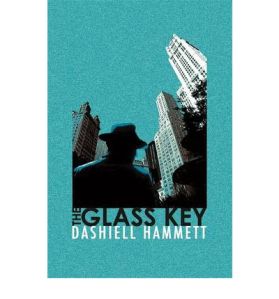
The Glass Key – Dashiell Hammett

Book #655

Reviewer: Ms Oh Waily


TGKBy now it is clear that I have become a great fan of Dashiell Hammett’s work, and having a two week holiday in which to indulge myself in his works has only continued to confirm for me that his writing is not only sharp, but varied as well.  The 1931 work, The Glass Key shows this beautifully.  No private detectives to be found here, not many sardonic, funny and sharp one-liners, instead we have Ned Beaumont – gambler and best friend to local political boss (and apparent business man) Paul Madvig.

The story opens with Ned and Paul discussing politics and the Henry family -the father being a Senator whom Paul intends backing for re-election.  Paul clearly also likes the daughter and is intent on marrying her.

A little later Ned finds the body of the senator’s son a couple of blocks down the street from Paul’s club.  The death of the young man, Taylor Henry, begins to pose real problems for Paul Madvig.  His daughter, Opal, was Henry’s girlfriend and she suspects her father of murdering him because he disapproved of the relationship.  The other political faction, represented by Shad O’Rory in the novel, start to make plenty out of the non-investigation of the lad’s death (courtesy of Paul controlling the local District Attorney’s office) and this is escalated by Paul’s boots and all attitude to dealing with O’Rory.

Ned Beaumont works hard to keep the election work on target, Paul out of the electric chair, and to get his money back from a dubious bookie.  Unlike Paul, who seems to have trouble seeing too far ahead, Ned is very much the thinker of the pair.  He sees that Paul is being set up and manipulated due to his infatuation with Janet Henry (Taylor’s sister).  So he works as Paul’s ‘fixer’ and through his interactions with the various characters we build up a picture of life in the underworld and back-door, influence-peddling politics of prohibition America.
I had never come across the term ‘political boss‘ before reading this novel, so for those unfamiliar with their role in late 19th and early 20th century US politics the power and role of Paul may be somewhat confusing – and he may simply be seen as a corrupt businessman with a hand in the speakeasy workings of his city.

I enjoyed reading this story, but for different reasons to the earlier works I’ve reviewed.  Unlike Red Harvest for instance, where the story is told from the point of view of The Continental Op, here the story is told from the outside and we are never given a look at the thoughts or feelings of the characters except as they play out in their actions and words. There was less murder and mayhem, but still plenty of violence and corruption.  At one point Ned is trapped by Shad O’Rory while trying to lay his own trap.  What happens to him as a result is brutal and in keeping with Hammett’s tough, no-nonsense approach to the violent lifestyle of the underworld gangsters of the time.  Realism is king here. Having been beaten senseless and worse, Ned shows his stubbornness in this passage that typifies Hammett’s descriptive style.

Ned Beaumont was tugging at the door-knob.
The apish man said, ‘Now there, Houdini,’ and with all his weight behind the blow drove his right fist into Ned Beaumont’s face.
Ned Beaumont was driven back against the wall.  The back of his head struck the wall first, then his body crashed flat against the wall, and he slid down the wall to the floor.
Rosy-cheeked Rusty, still holding his cards at the table, said gloomily, but without emotion: ‘Jesus, Jeff, you’ll croak him.’
Jeff said: ‘Him?’ He indicated the man at his feet by kicking him not especially hard on the thigh. ‘You can’t croak him.  He’s tough. He’s a tough baby. He likes this.’  He bent down, grasped one of the unconscious man’s lapels in each hand, and dragged him to his knees. ‘Don’t you like it, baby?’ he asked and, holding Ned Beaumont up on his knees with one hand, struck his face with the other fist.

By the time you have worked your way through the initial chapters, identifying characters and who they are to each other you will be hooked enough to keep reading to find out if Paul is Taylor Henry’s murderer, and just what Ned Beaumont is all about.  In the end, I spent several hours straight reading in to the night in order to finish this one up.  It became a case of not wanting to put the book down until I had the solution to the crime, and I must say I enjoyed the entire story.

Well worth the effort and definitely deserving of a place on the list. Highly recommended reading from me.
Happy Reading everyone.

Quote of the Week

I spent three days a week for 10 years educating myself in the public library, and it’s better than college. People should educate themselves – you can get a complete education for no money. At the end of 10 years, I had read every book in the library and I’d written a thousand stories.” 

Ray Bradbury