Professor Martens’ Departure – Jaan Kross

Book #237

Reviewer: Beth’s List Love (first published 2 March, 2012)
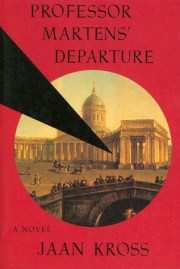

PMD

I have to admit that all through the past week [March 2012], I had two urges: to zoom in very close on Google earth to have a close look at the Estonian countryside, and to take a really good course in a couple centuries European diplomatic history. The book that inspired these urges was Professor Martens’ Departure by Jaan Kross.

A few chapters into this book, I was scrambling for Google. What I discovered is that this novel’s protagonist, Professor Martens, was a real historical figure, an international law expert in the Russian court of the early 20th Century. He was an important figure in numerous important international treaty negotiations. This novel, set late in his life, takes us with him on a train trip from his small village toward a rendezvous with his wife and official meetings with other diplomats in St. Petersburg.  As he travels, we listen to his internal dialogue, anticipating a planned conversation with his wife in which he plans to begin an era of total candor. He reviews his personal and professional past, examining successes and failures and imagines that this new honesty will be insurance against his own death. During the journey, he also temporarily shares his compartment with a young professional journalist with socialist sympathies who knows a bit about him through her professional connections. At times Martens also tells the reader about another Martens, who lived a century earlier, another international law expert, but for Germany.

It is a rare novel that gives insight into what it must feel like to be in contention for, but not win, a Nobel Peace prize, or to be left unsure whether your absence from an official list of participants in a major treaty negotiation was a typist’s error or a sly political maneuver by a competitive colleague.

Through Martens’ self-exploration, Jaan Kross explores the moral challenges faced by highly placed civil servants in autocracies, as well as the complexities of Estonian identity. Martens regrets, as well as some professional compromises, ethical failures in his personal life: infidelity, a lack of generosity to those who sought his support, despite his own success after early humble origins. Martens is a wonderful character, drawn with subtlety and skill. Those with an interest in political history and moral self-reflection will find this book a fascinating trip.

My rating: 4 out of 5 stars; I definitely agree with the choice that placed this book on the list.

Welcome to the New Year

027840-glossy-space-icon-culture-books3-stackedHello Book Lovers,

After a long and relaxing summer break, we are heading back into reviewing mode for 2014.
This year you will find our reviews coming out on Wednesdays and our quotes on Fridays.

We have some plans to revamp the look of the blog in the upcoming months,  so look out for that.
As well as a new look we have an idea that should help you find your way to your favourite writing periods from each blog post, which we will roll out in a couple of months.

Don’t forget that we are always happy to hear from anyone who wishes to write a review, just check out our Join the Review Crew page for details.  Previously published reviews are welcome too.  The more voices, the merrier.

If you like to read what we have to say about the 1001 Books, don’t forget to spread the word amongst your bookish friends.  We can be followed by email, Twitter, Facebook, Google+ or the old fashioned RSS feed.  Look for the pretty, new icons in the sidebar of the blog.

Happy Reading everyone!


Summer Holidays

Hello lovely readers,

It is that time of year again.  Summer has arrived in our part of the world and that signals the start of the holiday season and enjoying time with our families.   We will be taking our annual holiday from posting reviews and will be back in the first week of February next year.  In the meantime we will continue to post quotes that catch our eye, and anything else that we think you might like to know about.

We would like to thank all the reviewers who have contributed to the blog this year, we love hearing your reading experiences with the 1001 books and look forward to you joining us again in 2014.

I would also like to specifically thank Ange from Tall, Short, Tiny & a Pickle for joining our editorial team this year.  Your contribution to the reviews and the administration of the blog has been immense.  Thank you so much!

We would like to wish you all a happy and safe holiday season, many books read and a fabulous 2014.

IR OW TSTP


The Editorial Team

Brave New World – Aldous Huxley

BOOK #649
Reviewer: Tall, Short, Tiny & a Pickle

Brave New WorldBrave New World joins 1984 (George Orwell) and We (Yevgeny Zamyatin) on this list as three of the most influential dystopian (or, anti-utopian) novels of the twentieth century. I haven’t read We, but of the other two, Brave New World is easily my favourite.

Set in A.F 632, ‘this year of stability’ is 632 years after the advent of car king Henry Ford. Huxley has cleverly chosen Ford as his “deity”; the Model T was the first car to be manufactured using mass-production methods and specialised labour. In Brave New World, the World State is maintained through biological engineering and excessive conditioning; its citizens have been “hatched” to fill pre-destined social roles, and throughout infancy, they are taught (through hypnotism and sleep-teaching) the “virtues” of passive obedience, promiscuity and mindless materialism. As adults, they are encouraged to take (and freely given) a government-approved drug (similar to marijuana), and to engage in orgies, all to further instil the virtues of Community, Identity, and Stability.

Every member of society in the World State seems to be happy with their life, except for Bernard Marx. Bernard alone seems to find the situation unbearable, and longs to escape from the brainwashed idealism. He visits a Savage Reservation, where there are people living the old way; by the end of the novel, he is resigned to the way of life in the World State and has accepted his role in this world.

I really enjoyed this book, with its moments of pure comic gold (hopefully intentional!) interwoven with seemingly prophetic passages. I think Huxley was trying to make the point that at some stage, humanity is going to lose some of its spontaneity, individualism and uniqueness in its quest for a society where everything is seemingly perfect. The idea that possessions will soon become more important than people is something not far off the way of the world now (and just before Christmas, it might be quite timely that I’m thinking this way?!).

I liked Huxley’s style, and his characterisations – they were still human, and still real in their “created” personalities, and their interactions were quite normal. Obviously, some of the ideas and reactions were rather different, but they were believable.

The other big plus for me was that this was an easy, quick read; I didn’t struggle to get through it the way I did with 1984 (which I still enjoyed; it just took me a while), and I didn’t find it depressing as I did with Orwell’s dystopia.