The Adventures of Sherlock Holmes – Sir Arthur Conan Doyle

Book #804

Reviewer: Ms Oh Waily 


TAOSH I read The Adventures of Sherlock Holmes a good number of years ago as a teenager and enjoyed them.  But they were essentially consigned to memory until I thought to revisit them after my earlier review of The Hound of the Baskervilles.

The adventures are a series of twelve, relatively, short stories.  Most will set you back less than an hour to read and each is a little vignette of Holmesian deduction.

The twelve cases are:

  • A Scandal in Bohemia
  • The Adventure of the Red-Headed League
  • A Case of Identity
  • The Boscombe Valley Mystery
  • The Five Orange Pips
  • The Man with the Twisted Lip
  • The Adventure of the Blue Carbuncle
  • The Adventure of the Speckled Band
  • The Adventure of the Engineer’s Thumb
  • The Adventure of the Noble Bachelor
  • The Adventure of the Beryl Coronet
  • The Adventure of the Copper Beeches

The most likely story that you would be familiar with is the first, A Scandal in Bohemia.  It is in this piece that we meet ‘that woman’, Irene Adler.  American opera singer, socialite and apparently a brilliant woman to have outwitted Mr. Holmes.  Then you read the story, or listen on audiobook as I did, and you are left wondering at the idea that being observant and quick witted equals being a brilliant woman and a great opponent for the master deducer.
Oh how times have changed Sir Arthur, oh how they have changed.

Each of the succeeding stories brings out different mini-mysteries, some of which Holmes solves faultlessly while others like the Irene Adler case, are not so clear cut in the perpetrators being brought to justice.  In some instances, it is a case of unmasking goings-on rather than actual crime.

I found the writing to be almost as good as The Hound of the Baskervilles, with just enough setting for each story before getting to the nitty-gritty of the various mysteries to be detected.  Holmes’ deductions are sometimes obvious in advance of his explanations, other times not so much.  And as I mentioned in my previous review, unlike the often portrayed superior attitude of Holmes to Watson in film versions, there is nothing to note of that in these stories either.  In fact, he is quite complimentary and warm about his companion for the most part.

It is another pleasant read, or listen, that will not tax you.  It is worthy of a place on the list as a good selection of the different types of mystery story and if you enjoy it enough you will find it to be the first of five Sherlock Holmes short(ish) story collections for you to hunt out.  This one is the earliest, dated 1892, and was published ten years before The Hound of the Baskervilles but only two years after The Sign of Four.
If you find yourself enjoying the Victorian world of Holmes and Watson, I can only imagine reading the novels and short stories in published order, would give an even more rounded aspect on Conan Doyle’s characters.  To do that, start at the beginning with A Study in Scarlet, and then check the list at the bottom of the page here at Wikipedia for published order.

I hope you enjoy this slice of Victoriana as much as I did.

A Room With A View – E.M Forster

Book #761

Reviewer: Tall, Short, Tiny & a Pickle


A Room With A ViewWhen I was 16-years-old, a friend and I became obsessed with the novels of E.M Forster. We thought we were incredibly sophisticated and open-minded, and went so far as to write our own stories using similar language and ideas.

One of my favourites was A Room With A View; it was amusing in its portrayal of pretentious Victorian manners, and the dialogue was brilliant. In flicking back through the novel for the purposes of this review, I found myself again smiling at a few exchanges.

“Am I to conclude,” said Miss Bartlett, “that he is a Socialist?”
Mr Beebe accepted the convenient word, no without a slight twitching of the lips.
“And presumably he has brought up his son to be a Socialist, too?”
“I hardly know George, for he hasn’t learned to talk yet. He seems a nice creature, and I think he has brains. Of course, he has all his father’s mannerisms, and it is quite possible that he, too, may be a Socialist.”

A Room With A View is set in Italy and England. In Florence, Italy, young Lucy Honeychurch and her cousin Charlotte meet a Mr Emerson and his son George; they are staying at the same hotel and when the gentlemen offer to switch rooms with the young women, they are offended by their lack of “manners”. Charlotte forms an instant dislike of the Emersons and convinces Lucy to feel the same; Lucy falls for young George, but upon her return to England, accepts the proposal of someone else. The novel ends back in Florence, with Lucy having eloped with one of her suitors…you’ll have to read it to find out who!

Like many writers of the time, Forster had a tendency to comment on sexuality, religion and class. A Room With A View is a definite commentary on these, with a focus on the repression of women and feminine sexuality at the time. There is an obvious struggle in Lucy between the old-fashioned values she has been raised by, and the more liberal values she believes in. This is made more prominent for her after her stay in Italy, where the gap between the classes is much less than in England, and she realises how much ridiculous value is placed on class and society back home. Most importantly, A Room With A View is a novel about following your heart, despite what society thinks or tells you to do.

The notes at the back of my copy of the novel explain the symbolism of the title of the book, which is rather handy, because I know 16-year-old me wouldn’t have picked up on this: the “rooms” refer those characters and places that are considered conservative, like England, Lucy’s mother, and her pretentious fiancé, while the “views” refer to those that are considered liberal and open-minded, like Italy, the Emersons and Lucy herself.

I enjoyed A Room With A View immensely as a young adult, and the passages I re-read now brought that enjoyment flooding back. A recommended read if you like amusing Victorian-era novels that allude to society’s failings before their time.

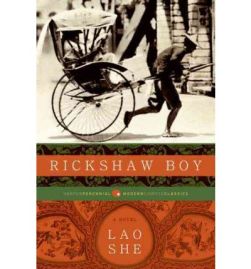
Rickshaw Boy – Lao She

Book # 626a

Reviewer: Kara


RB“The life of a poor man…was like the pit of a date, pointed on both ends and round in the middle. You’re lucky to get through childhood without dying of hunger, and can hardly avoid starving to death when you’re old. Only during your middle years, when you’re strong and unafraid of either hunger or hard work, can you live like a human being.”

This is the essence of Lao She’s Chinese classic novel Rickshaw Boy. Xiangzi is an impoverished rickshaw puller in his twenties who is ambitious enough to make sacrifices and save up to improve his lot in life, only to have his hopes and dreams dashed over and over again. The moment things are going right for Xiangzi, another misadventure befalls him. Despite this endless tragedy, Lao She’s story is comical, if painfully so. The sheer unfairness of the ups and downs and the matter-of-fact tone of the writing force the reader to laugh with a grimace.

The city of Beiping (now known as Beijing) plays a critical role in the book.  As a rickshaw man, Xiangzi knows every nook and cranny. Despite the poverty and lack of opportunity he faces, Xiangzi never has a negative thought about his city. In fact, “Xiangzi had but one friend: this ancient city.” He can’t imagine ever leaving it, even if leaving might improve his situation. Beiping is home for Xiangzi in the fullest sense of the word.

Ultimately, Rickshaw Boy is the story of the hopelessness that results from extreme poverty. Without the slightest chance to ever live comfortably, Lao She makes clear that a rickshaw man has little reason to work any harder than he must to survive the day:

“Sloth is the natural result of unrewarded hard work among the poor, reason enough for them to be prickly.”

He also has little reason to even think about the future. After all, any gains he makes will be taken from him:

“Experience had taught him that tomorrow was but an extension of today, a continuation of the current wrongs and abuses.”

Rickshaw Boy is a quick and fairly easy read, with a very overt message. What I enjoyed most about it reading it was the fact that it took me well outside the usual realm of literary classics from America and Great Britain. Rickshaw Boy is a Chinese story and a successful portal into 1930s China. But it’s also a universal story of the hopelessness that extreme economic disparity breeds; this is a very relevant message in our world today.