“Books are the quietest and most constant of friends; they are the most accessible and wisest of counselors, and the most patient of teachers.”
― Charles William Eliot
This is why my books are unpacked first whenever I move somewhere new!
“Books are the quietest and most constant of friends; they are the most accessible and wisest of counselors, and the most patient of teachers.”
― Charles William Eliot
This is why my books are unpacked first whenever I move somewhere new!

Welcome to what is likely to be the shortest of the 1001 Books reviews. The Nose by Nikolai Gogol, in the edition of his tales that I have, is a whole 23 pages long.
That makes reviewing it rather difficult and rather simple in the same breath. Here is my précis of the story.
We begin by meeting a working class barber, Ivan Yakovlevich waking up and having breakfast. He asks his wife for the freshly baked bread, which he proceeds to cut in two. On cutting it and examining the inside of his half he finds a nose. Not just any nose, but that of a regular client, a Major Kovaliov. Horrified, and unable to remember if he had pulled or cut his client’s nose off he heads out to dispose of it.
We then shift to the story of the now noseless Major. He wakes up with a flat pancake face right where his nose should be. Through this narrative we find that the nose is living a life of its own and is unwilling to return to the Major’s face.
Hmmm. Yes. Suspend that disbelief.
I won’t tell you what occurs in the last section of the story. It is short, but you might as well have some sort of “unknown” ending should you choose to read this.
It is certainly the strangest tale I have read to date. Frankly I had to turn to Wikipedia to even have a clue as to the underlying ‘meaning’ of it all. I was struggling to find one. It is satire. For those with no real connection to Russian literature and culture this went mostly over my head. And in the translation that I read, the Major does not wake up from a dream (which is a possible version you may encounter), and therefore it is considered to be a precursor to magical realism. Well, a nose with a life of it’s own, masquerading as a civil official? Certainly is the impossible occurring within the confines of an otherwise reasonable story.
It does, apparently, have potential themes around castration, impotence and similar.
Fine.
I suppose if I sat and squinted a lot I could make that connection.
I cannot genuinely recommend this, but then again, at around an hour of reading time perhaps you won’t mind making the effort. If you do, or if you have a much greater understanding of the Russian idiom and culture, then please come back and explain it to me. I’d like to know what I spent my irreplaceable hour on. Thanks.
Happy reading everyone.
“Make it a rule never to give a child a book you would not read yourself.”
― George Bernard Shaw
I am definitely guilty of filling my sons’ bookshelves with books that I loved as a child!
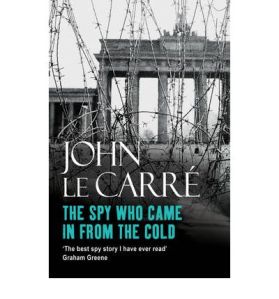
Back in October 2012 I reviewed the wonderful Tinker Tailor Soldier Spy, and then this past April I reviewed the final ‘Karla’ novel, Smiley’s People. It has been a consistent pleasure reading Mr le Carré’s work and his novel, The Spy Who Came in from the Cold is absolutely no different. Sadly for me, it is the last of his novels on the list.
Written right at a time of heightened tension in the Cold War, and when the Berlin Wall went up, we are introduced to the British Station Head in Berlin – Alec Leamas.
Leamas is having all sorts of issues with his East German counterparts in the Abteilung. His opposite number, Hans-Dieter Mundt is slowly weeding out Leamas’ agents. And by weeding out, I mean killing. The novel starts with the last, and most significant of Leamas’ double agents trying to cross from East Berlin to the West as his network is compromised.
Karl Riemeck almost makes it across, but is shot at the last moment by the Vopos and Leamas, with no agents left, returns to London in disgrace and expects to be put out to pasture with a desk job.
Le Carré’s work carries us along with Leamas as he faces his disgrace and downward spiral, and his one final job before ‘coming in from the cold’. His job is to help Control, and the Circus, bring down Hans-Dieter Mundt. Thereby removing a major threat, and in Leamas’ case, avenging the losses of his agents.
The writing and characterisation is pithy, clear and believable. At a little over 200 pages of very easy reading, this is a nice book to work through on a wet weekend. It takes you back to the heart of Cold War Europe and right in to the West vs East German situation. It’s realism and portrayal of the true behaviour of the British Secret Service was shocking to the public at the time of publication. The Secret Service had it’s glamour boy in James Bond, Le Carré shows the other side – the burnt out agent, the nasty, dirty means used to gain the ends and the fact that there is very little difference in operating methods between spy services looking after their national security.
He was mad, you see. Le Carré. He says so in the 1989 Foreword to my edition.
Staring at the Wall was like staring at frustration itself, and it touched an anger in me that found its way into the book. In interviews at the time, I am sure, I said none of this. Perhaps I was still too much the spy, or perhaps I didn’t know myself well enough to understand that, by telling an ingenious tale, I was making some kind of bitter order out of my own chaos.
Certainly I never wrote this way again, and for a while the smart thing to say of me was that I was a one-book man, that The Spy Who Came in from the Cold was a grand fluke, and all the rest was aftercare.
This book is about morality. What we will and won’t do for the ‘greater’ cause. Leamas rants about this towards the end of the story.
That’s easy enough to understand, isn’t it? Leninism – the expediency of temporary alliances. What do you think spies are: priests, saints and martyrs? They’re a squalid procession of vain fools, traitors too, yes; pansies, sadists and drunkards, people who play cowboys and Indians to brighten their rotten lives. Do you think they sit like monks in London balancing the rights and wrongs?
It is very cleverly constructed, even when you eventually have enough clues to work out the last part of the plot, and is uncompromising in its closure. Sadly, too much more information from me and it wouldn’t be much of a thriller for a new reader.
This too shall eventually have a place on my bookshelf. I can’t give higher praise than a spot on my shelf.
Happy reading everyone.

 1001 Books to Read Before You Die