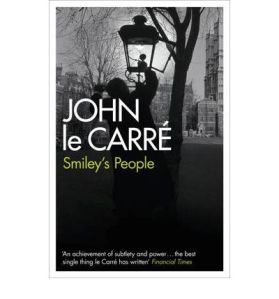
Smiley’s People – John le Carré

Book #295

Reviewer: Ms Oh Waily
SP

Back in October 2012 I reviewed the wonderful Tinker Tailor Soldier Spy, the first in the trilogy of “Karla” novels featuring spymaster George Smiley.
Today we visit the final chapter.

George is in retirement, ostensibly composing a monograph on Opitz.  He is totally unaware of the two events occurring as he sits in the London Library, researching and writing, that will bring his retirement to a swift end.

The first event happens in Paris amongst the Russian émigré community.  Maria Andreyevna Ostrakova is approached and told that there is hope that the daughter she chose to leave behind in Russia when she escaped to the west may be able to be reunited with her in France.

The second event occurs a few weeks later in Hamburg with a young man on a steamer following the precise orders of ‘the General’, scared and determined alternately as he does the work of a courier.  The same night that this young man returns to England Smiley is summoned by Oliver Lacon.

Lacon wants him to identify the body of a man killed on Hampstead Heath and to bury any connection he may have had with the Circus.   The man, an ex-Soviet General and covert British agent, had recently tried to re-establish contact with the Circus and his old handlers by telephoning in to say that he had something urgent for ‘Max’*.  Unlike the incumbents in the Circus and the Civil Service, Smiley believes that the General, Vladimir, was not simply trying to seek attention and had a genuine source of important information.  It is this belief that Smiley decides to follow and which eventuates in the succeeding happenings described in the remainder of the novel.

Just as Smiley follows the breadcrumb trails left by the General and his assistant, Otto Leipzig, we are taken along with him.  Le Carré takes us from one person’s story to the next, weaving them together as he goes, once again using a mix of memories with present day events.  He gives us hints of what is to come but never seems to lose the tension.  You are left on the edge throughout the story, as there are so many ways that Smiley’s investigation could go wrong and be found out before it reaches it’s end.

And what end will that be?  Will George Smiley manage to outwit and outmanoeuvre his Russian nemesis, Karla?  Or will Karla, once again, manage to stay out of reach?

You’ll just have to read and see.

In this novel we see the reappearance of Connie Sachs, the Circus’ retired researcher on Soviet intelligence, and Toby Esterhase the Lamplighter from Tinker Tailor and Vladimir’s old handler and “postman”, as well as Oliver Lacon.  We are taken from France to Germany, Germany to England, back to Germany and France and finally to Switzerland.  It is quite a ride.

I enjoyed it immensely and the 454 pages of my copy seemed to fly past.  The writing style and language, once you are familiar with the spy-world jargon, flows easily.  The characters are sketched in such a way that you are drawn in to them.  Take the unique style of Connie Sachs when Smiley goes to visit her in order to access her long wealth of knowledge of Karla and the Soviets.

‘Connie’s not coming back, George,’ she called as she hobbled ahead of him.  ‘Wild horses can puff and blow their snivelling hearts out, the old fool has hung up her boots for good.’  Reaching her rocking-chair, she began the ponderous business of turning herself round until she had her back to it. ‘So if that’s what you’re after, you can tell Saul Enderby to shove it up his smoke and pipe it.’  She held out her arms to him and he thought she wanted him to kiss her. ‘Not that, you sex maniac.  Batten on to my hands!’
He did so, and lowered her into the rocking-chair.
‘That’s not what I came for, Con,’ said Smiley. ‘I’m not trying to woo you away, I promise.’
‘For one good reason, she’s dying,’ she announced firmly, not seeming to notice his interjection. ‘The old fool’s for the shredder, and high time too.  The leech tries to fool me, of course.  That’s because he’s a funk.  Bronchitis. Rheumatism.  Touch of the weathers.  Balls, the lot of it.  It’s death, that’s what I’m suffering from.  The systematic encroachment of the big D.  Is that booze you’re toting in that bag?’

And that sums up the redoubtable Ms Sachs.  And Mr le Carré’s very clear characterisation.

If you are looking for something light, but interesting, and have not considered wandering into the world of the Cold War spy then you could do no better than choose to read the Karla trilogy, Tinker Tailor Soldier SpyThe Honourable Schoolboy, and this excellent conclusion, Smiley’s People. But do start at the beginning.  Although they can be read on their own, it will be much better to have the foreknowledge of that which has past before in the series.

As for myself, I am considering hunting down the remainder of the novels featuring George Smiley, including the famous The Spy Who Came in from the Cold, in which he has a minor role and the 2011 film adaptation of Tinker Tailor to see if Gary Oldman can carry my vision of George.  This series of books will certainly be added to my bookshelves at home in due course, they are eminently readable.

Happy reading everyone.


* Max = Smiley.

An Artist of the Floating World – Kazuo Ishiguro

Book #230
REVIEWER:
Beth’s List Love (first published February 2013)

An Artist of the Floating WorldI have read Ishiguro before, and liked his work very much. I found this novel somewhat less engaging than The Remains of the Day, but still it was a quick and easy read.

“I believe I have already mentioned the fact that I played a small part in the Migi-Hidari’s coming into existence. Of course, not being a man of wealth, there was little I could do financially. But by that time my reputation in this city had grown to a certain extent; as I recall, I was not yet serving on the arts committee of the State Department, but I had many personal links there and was already being consulted frequently on matters of policy. So then, my petition to the authorities on Yamagata’s behalf was not without weight.

‘It is the owner’s intention’, I explained,’that the proposed establishment be a celebration of the new patriotic spirit emerging in Japan today. The decor would reflect the new spirit, and any patron incompatible with that spirit would be firmly encouraged to leave. Furthermore, it is the owner’s intention that the establishment be a place where this city’s artists and writers whose works most reflect the new spirit can gather and drink together. With respect to this last point, I have myself secured the support of various of my colleagues, among them the painter, Masayuki Harada; the playwright, Misumi; the journalists, Shigeo Otsuji and Eiji Nastuki–all of them, as you know, producers of work unflinchingly loyal to his Imperial Majesty the Emperor.’”

So remembers Masuji Ono, looking back on his pre-war life as a prominent artist in Imperial Japan. He is writing at a time after the war when a younger generation, and Japanese society at large, devastated by the effects of Japan’s role in the Second World War, look with criticism on those involved in engineering and promoting that war to the nation. His past actions have affected his professional relationships and have also created tension in the relationships with his own daughters. Ono must come to terms with the meaning of his own professional and artistic choices and their moral import in light of Japan’s recent history.

This is a fairly dry read, but an interesting study in the changing attitudes in Japanese society, the nature of artistic training in Japan, and the dynamics of relationships between the sexes and generations in Japanese families of the period. I found it interesting, but not particularly moving. Ironically, as one who lived briefly in Japan in the 1980s, I shared with Ono a certain concern about the degree to which American influences have come to predominate over traditional Japanese attitudes since American post-war occupation there. While I absolutely value the shift from aggressive nationalism to a more democratic and international perspective, I remember being somewhat horrified at the degree to which American materialism and less appealing cultural norms were sweeping Japan when I was there.

March Update

​8 books reviewed
132 books in total
869 to go

Last month we managed to hit our target of publishing two reviews per week, which is great – and no small feat!

We began with Franny and Zooey, and finished with The Wasp Factory, both novels whose authors have multiple entries in this list. The similarities, it is fair to say, would seem to end there, though – these are two very different stories.

In fact, I think contrasts could have been our theme for March:

a glowing 5/5 star-review for Farewell, My Lovely followed a dismal 2/5 star-review for Heart of Darkness;

The Corrections is a commentary on modern late-20th Century life, while Northanger Abbey is set in Austen’s 1800s;

and the first Bond novel, Casino Royale, preceeded fantasy novel Legend. Actually…perhaps these two are more alike than you would first assume, with their larger-than-life characters, impossible action sequences and legendary heroes!

Quote of the Week

Quite apt for those of us in the Southern Hemisphere as we come to the end of a glorious summer…

“Books are more real when you read them outside.”
Maggie Stiefvater, Shiver

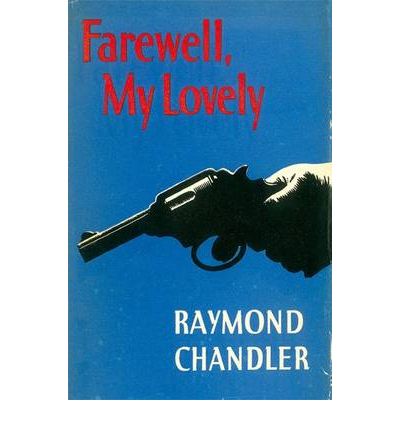
Farewell, My Lovely – Raymond Chandler

Book #586

Reviewer: Ms Oh Waily


Please do not adjust your computer screens, you are not seeing double.  Or perhaps you are.  Usually we post two reviews of the same book together, on the same day. This time we have split them into two posts.  You may wish to cast your mind back a week to Beth’s review before reading on.

FMLFarewell, My Lovely was written in 1940 and is the second of Raymond Chandler’s novels featuring the private investigator, Philip Marlowe.  The story starts, as Beth notes, with Marlowe working a dead-end case when he inadvertently becomes embroiled with ex-convict Moose Malloy’s search for his old girlfriend Velma Valento.  Murder, drugs, jewellery gangs, gambling and varying other mysteries of the underworld all follow on from this initial encounter.

This was my first time reading an American noir novel.  And I loved it. Perhaps that’s in part due to an age-old love affair I have going with Humphrey Bogart and having the film version of The Big Sleep under my belt.  The wit and snappy dialogue that Marlowe spits out at nearly every opportunity is worth the read alone.  He’s the sort of character that speaks his mind, rubs people up the wrong way and doesn’t give a darn.

Hired to help recover a stolen necklace, he ends up talking with the beautiful owner, and this passage of banter is a great example of Chandler’s writing style and Marlowe’s speech.

Her eyes flashed at that.  I liked them that way. ‘There’s such a thing as being just a little too frank,’ she said.
‘Not in my business.  Describe the evening.  Or have me thrown out on my ear.  One or the other.  Make your lovely mind up.’
‘You’d better sit over here beside me.’
‘I’ve been thinking that a long time,’ I said. ‘Ever since you crossed your legs, to be exact.’
She pulled her dress down. ‘These damn things are always up around your neck.’
I sat beside her on the yellow leather chesterfield. ‘Aren’t you a pretty fast worker?’ she asked quietly.
I didn’t answer her.
‘Do you do much of this sort of thing?’ she asked with a sidelong look.
‘Practically none.  I’m a Tibetan monk, in my spare time.’

And that’s just how he chats to the clients.  Try his style with the police.  Speaking with Randall, the police detective working on the case, he isn’t any less snappy despite an horrific couple of days locked in a hospital prior to this conversation.

‘Was that a gag, about your being sick, in a hospital?’
‘No gag.  I ran into a little trouble – down in Bay City.  They took me in.  Not the cooler, a private dope and liquor cure.’
His eyes got distant. ‘Bay City, eh?  You like it the hard way, don’t you, Marlowe?’
‘It’s not that I like it the hard way.  It’s that I get it that way.  But nothing like this before.  I’ve been sapped twice, the second time by a police officer or a man who looked like one and claimed to be one.  I’ve been beaten with my own gun and choked by a tough Indian.  I’ve been thrown unconscious into this dope hospital and kept there locked up and part of the time probably strapped down.  And I couldn’t prove any of it, except that I actually do have quite a nice collection of bruises and my left arm has been needled plenty.’

He’s one tough cookie.  Indeed one of the archetypal hard-boiled detectives.  He deserves his place on the 1001 list and I hope that some time soon you take up a copy and meet Mr Marlowe.

One note though, is that the time period in American history also brings with it some unpleasant language to a modern ear.  The dice emporium, Florian’s, mentioned in the opening quote of Beth’s review is an African-American establishment and the first section of the novel involves the use of the “n-word”, although not excessively so.  I also learned a couple of new (to me) derogatory terms that were clearly commonplace at the time – dinge being one and shines being another – which were used more frequently.   While I, in no way, countenance the use of offensive terms, I am also of the school of thought that does not like the expunging of the language of eras past.  For me, cleaning up the language from original works seems to be a way of denying those attitudes and conditions existed.  If you are not comfortable seeing life represented in linguistic terms as it was in the mid-20th century then you may not find the first portion of this novel to be comfortable reading.  But do stick with it, the story and Marlowe’s character are worth the effort.