Perfume:The Story of a Murderer – Patrick Süskind

Book #243

Reviewer: Sweetp
2895

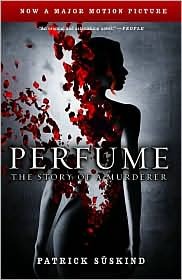
Perfume: The Story of a Murderer is a book I’ve had on my ‘to-read’ list for some time. I started reading it with some trepidation since horror isn’t my usual genre of choice, and I was under the impression this was a particularly gruesome book.

I was soon quite engrossed in this story about Jean-Baptiste Grenouille who is born in the squalidness of pre-Revolution Paris (1730s) and who has no personal odour.  As he manages to survive a bleak and loveless childhood he discovers he has a ‘gift’ for smells – in that he can smell everything in the world in the most minute detail. The descriptions of Grenouille’s olfactory experiences are lush and you can almost smell them coming off the page – from the suffocating stench of overcrowded Paris with it’s oozing cemeteries, fish markets and tanneries and stinking river, to the sweet scent of all the individual flowers used to make a perfume.

Eventually Grenouille ends up working for a master perfumer, learning how to distill perfumes and extract scents. I found this part of the book quite fascinating (probably my science background coming to the fore) particularly the techniques used in an age without modern laboratory facilities. Pages are devoted to describing the extraction of scents and the manufacture of perfumed oils and other accessories, and I can only wonder at the amount of research that must have gone into this subject. Far from boring, the juxtaposition of the stench of the city with the descriptions of the aristocracy wearing these manufactured perfumes is cleverly done and makes for an interesting historical commentary.

Grenouille is an odd character, freakish in both physical appearance and in temperament. Aloof, disconnected from the world around him, and seemingly without any sense of social propriety or conscience he increasingly becomes obsessed with his gift and embarks on a journey to learn other techniques for extracting scents. He uses his new found skills to extract the scent of inanimate objects, creating art-like “masterpieces”.

He was enchanted by their meaningless perfection; and at no time in his life, either before or after, were there moments of such truly innocent happiness as in those days when he playfully and eagerly set about creating fragrant landscapes, still lifes, and studies of individual objects.

Soon his obsession reaches new heights, and eventually he begins to murder in order to possess the scent of beautiful young girls.

The murder aspect of the book begins at roughly the 75% mark. Perfume: the story of *murder* it really isn’t and my assumptions about gruesomeness or gore were totally unfounded. The book doesn’t dwell on the violence, but more on the increasingly bizarre behaviours of Grenouille and the obsessive nature of his quest to possess the scents and his ability to catalogue them inside himself. As titled, the novel is really the story of a *murderer* – Grenouille – and he is not an easy character to empathize with. While his originality and creativity are almost admirable, to be honest there’s not a lot to like here. The obsession that drives him is pretty creepy and the overall tone of the book smells like a sinister Gothic horror.

This isn’t a long book and I read it quite quickly. The magical realism themes occur near the end of the book and will be a disappointment for some readers. The end perhaps is not as strong as the rest of the book, but to my mind Grenouille’s final ‘decision’ seemed a fitting end to his story.

He who ruled scent ruled the hearts of men.

The Plague – Albert Camus

Book #559

Reviewer: Inspirationalreads

9687890

Oran is a small town like any other; populated by people who seem to be engaged in a busy nothingness.  Happy in their everyday life, not overly spectacular in one way or another.  Then one day rats start showing up in frightening numbers, dead or dying in a horrific manner.  It isn’t long before this sickness spreads to the human population and soon this town is shut off from the rest of the world, quarantined and left to deal with it on their own.  Our anonymous narrator attempts to report the events in an observational and unbiased manner and is successful in their reporting but is not entirely able to remove the element of human nature; the fear, the desperation to return to normality and absent loves, the despair at death and too, the prevailing nature of humanity itself.

Albert Camus was a  Nobel laureate, philosopher and contemporary of that other famous literary philosopher, Jean-Paul Sartre.  This allegorical tale is a platform on which Camus is able to present his main philosophical ideals, key of which is that of man seeking to find meaning and significance in his life and finding none.  That is not to say that a life without meaning is all for nothing, but that being happy in your life and the way that you live it should be reward enough and does not need any further significance attributed to it.  These ideas are laid out clearly.  In fact many of Camus’ philosophies are put directly into our narrator’s mouth:

But the narrator is inclined to think that by attributing over-importance to praiseworthy actions one may, by implication, be paying indirect but potent homage to the worst side of human nature.  For this attitude implies that such actions shine out as rare exceptions, while callousness and apathy are the general rule.  The narrator does not share that view.  The evil that is in the world always comes of ignorance and good intentions may do as much harm as malevolence, if they lack understanding   On the whole men are more good than bad; that, however, isn’t the real point.  But they are more or less ignorant and it is this that we call vice or virtue; the most incorrigible vice being that of an ignorance which fancies it knows everything and therefore claims for itself the right to kill .  The soul of the murderer is blind; and there can be no true goodness nor true love without the utmost clear-sightedness.

The allegory of The Plague is that of Nazi Germany’s invasion of France, Oran being France and the plague itself being the Nazi occupation that effectively cut France off from the rest of the world for a time, of which Camus lived through.  This is an interesting premise to set, that of isolation in terror, because Camus is able to use it to demonstrate his philosophies, those developed based on his own observation.  It is an interesting setting to observe just what men and women do to cope and continue on.  There is almost a dismissive tone in describing the residents of Oran before the plague hit, almost condescendingly stating that their happiness is mundane and based on ignorance of anything better.  But what comes out of their ordeal is an acceptance of what has happened, that there is nothing or no one to blame and that death is unavoidable for everyone.  They may survive the plague but in the end everyone dies.  That it is the idea of community, finding comfort in those suffering along side you and doing what you can to comfort them in return.

The enjoyment I got from this book was actually reading it alongside reading of Camus’ ideas and philosophies.  From here it would be good to move onto some of Sartre’s work and others from our more modern philosophers. At a very basic level, this is an interesting story, relevant even now with flu pandemics being touted every cold season.  A reader would be hard-pressed not to come away with food for thought, which in my personal opinion, is what a great book should do.

Welcome

Today we are rolling out the welcome mat for the newest member of the 1001 Books editorial team.  You will know her from such reviews as The Gormenghast Trilogy and Possession.  It is the wonderful Ange from Tall, Short and Tiny.  Thanks for joining our editorial madhouse.

Welcome Mat

If you want to get to know more about our newest editor’s views on some of the 1001 books you can read through her previous reviews here.  Once you are done reading you might like to join us in a big group hug welcome.

Quote of the Week

And in direct contrast to last week’s quote…


“Finally, from so little sleeping and so much reading, his brain dried up and he went completely out of his mind.”
― Miguel de Cervantes SaavedraDon Quixote


Beware you bibliophiles, beware !

Kafka on the Shore – Haruki Murakami

Book #28

Reviewer: Ange from Tall, Short & Tiny

KafkaHaruki Murakami is a dear friend’s favourite author, but until reading ‘Kafka on the Shore’, I’d had no experience of him whatsoever. Now, I am desperately awaiting a delivery from The Book Depository of another four of his books; needless to say, I am converted fan. I can’t recall another author I’ve read who can write a novel with such a combination of whimsical, fantastical, ethereal, spiritual, metaphysical words.

In saying this, I am not claiming to fully understand this novel – not by a long shot – but I certainly enjoyed it, and it got some rusty cogs turning in my brain. I had to think and process everything twice; there were long-dormant neurons firing up in my brain and I felt like I was back in a philosophy lecture at university.

There are two parallel stories in ‘Kafka’, with chapters alternating between the two. After each story is established, there is a hint that they will come together, and towards the end, the lines of each are running so closely together that I was excitedly turning pages to find out if they met.

We never find out the real name of 15-year-old Kafka Tamura, the main character in the odd chapters. He has run away from home, desperate to escape a curse that his father has deemed he will fulfill. He has an alter-ego, the Boy called Crow, who appears during times of anxiety and stress to advise and cajole. Kafka is very wise and intelligent, more than his 15 years would suggest. His ability to comprehend intensely metaphysical, improbable situations adds to the whimsy; his uncharacteristic traits don’t seem too out of place in Murakami’s world. I didn’t exactly like him as a character, but I also didn’t hate him. He was, in that respect, a good main character, in that he carried the story well without the interference of too much emotion.

Paralleling the story of Kafka is the story of Nakata, an old man who has the ability to talk to cats. As a boy, he was unconscious for three weeks, and upon waking, had no memories and had lost his ability to read and write. Throughout the story, he is often heard saying, “Nakata isn’t very bright”, or “I’m stupid, you see”, yet as the story unfolds it becomes clear that his lack of intelligence makes him the perfect vehicle for what transpires, and that his intelligence lies along another path. Nakata was hugely likeable; he was simple, but polite, funny and honest.

The novel features fish that fall from the sky, and a spectral pimp dressed as Colonel Sanders. There is a flute made from the souls of cats, and un-aged WWI soldiers living in a forest. There’s a transgender haemophiliac, a prostitute spouting philosophy, and a woman living in the past with the ability to travel through space and time. Many times, I had to re-read passages, to put the book down in order to digest what I had just read. It filled my head, it consumed me, and it confused me…but I loved it.

There are many questions left unanswered at the end of the story. I had many a theory, yet by the end, nothing was certain. Murakami is reported to have said that his novels are meant to be read again and again, and that it is up to the reader to formulate their own thoughts and conclusions. I imagine that every reader could theorise something different; book group discussions of this work would be lengthy, heated and perhaps polarising.

I can honestly say I’m a convert to Murakami’s work. I enjoyed being challenged as I read, and I loved being left to draw my own conclusions; I loved the poetic way the story was written, combined with humour, fantasy, spirituality and surrealism. ‘Kafka on the Shore’ gets a big 5/5 from me.