War and Peace – Leo Tolstoy

Book #857

Reviewer: Kara
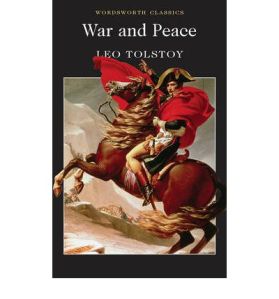

W&P

War and Peace is the epic story of several Russian aristocratic families during Napoleon’s invasion. The book covers the period from about 1805 to 1812, with a bit in the epilogue jumping ahead to around 1819.

Tolstoy himself writes that his book is unlike anything that has been written before when it comes to its form. Many have described it as part novel, part history book, part philosophical treatise, and this is pretty accurate. Many characters and events are fictional creations, and this part of the book is chock full of family drama and meandering love stories that end in both happiness and heartbreak. Other characters and events are historically accurate (at least, according to Tolstoy’s research, which some historians disagree with). However, real historical figures (Napoleon, Alexander I of Russia, Kutozov) and their real, historical actions are part of the story, and Tolstoy conducted interviews and perused diaries and letters to inform his writing. This part of the book is stuffed with battle scenes, the minutiae of war, and ongoing commentary on how war really works. Towards the end of the book, Tolstoy more and more often drifts into asides describing his philosophical take on history and how we understand it. This culminates in the second epilogue with a 40-page treatise on free will vs. fate.

Overall, I was astounded by how very accessible and readable this book is. Is it long? Yes. A time commitment? Absolutely – my edition has over 1300 pages. But at least 90% of what’s inside is easy to follow and interesting to read.

Though there are tons of major characters, it wasn’t long at all before they distinguished themselves and I had no trouble remembering each one. They are lively and full of depth, and the major players change in ways over the course of the book that ring true. Without giving away any details: One character ultimately channels her obsessive emotional energy into family. Another moves past the distractions that have filled his life. A third finally stands up for herself. One story, however, was unfortunately brushed aside – I can’t help but feel that any healing or resolution for her is omitted because she is not really part of the aristocracy.

War and Peace has many themes, and while it is certainly rife full of tragedy, I can’t help but feel that the fictional portion of the book is ultimately about finding true happiness in life. Several key characters experience a transformation that helps them see how wonderful life is.

One character learns: “Compassion, love for brothers, for those who love us and for those who hate us, love of our enemies; yes, that love which God preached on earth … — that is what made me sorry to part with life, that is what remained for me had I lived.'”

For another: “She did not know and would not have believed it, but beneath the layer of slime that covered her soul and seemed to her impenetrable, delicate young shoots of grass were already sprouting, which, taking root, would so cover with their living verdure the grief that weighed her down that it would soon no longer be seen or noticed. The wound had begun to heal from within.”

For a third: “Now, however, he had learnt to see the great, eternal, and infinite in everything, and therefore — to see it and enjoy its contemplation — he naturally threw away the telescope through which he had till now gazed over men’s heads, and gladly regarded the ever-changing, eternally great, unfathomable and infinite life around him. And the closer he looked the more tranquil and happy he became.”

There are also lovely descriptions that are full of joyfulness. For example:

“The stars, as if knowing that no one was looking at them, began to disport themselves in the dark sky: now flaring up, now vanishing, now trembling, they were busy whispering something gladsome and mysterious to one another.”

My favorite moment came at the very end of the fictional part of the story. Two characters are married and very much in love. Tolstoy describes the way that they sort of speak their own language, and understand each other in a way that no one else can. I love this because it reminds me of myself and my husband, and the fact that love is one of life’s greatest joys.

I highly recommend War and Peace to any lover of classic literature. It’s not overrated, and it’s worth all the many hours it takes to experience it.
Timbuktu – Paul Auster

Book #70

Reviewer: Ms Oh Waily

T
Timbuktu is a novella that runs to 186 pages and is my second Paul Auster.

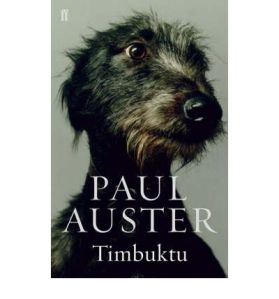
The main character is a dog, as you can see from the lovely cover chosen to go with this review.  His name is Mr. Bones.  He is of the multi-parental background, otherwise known as a mutt or a bitzer.

We meet Mr.Bones and his master, Willy G. Christmas, as they make their final trip together to Baltimore.  Willy is dying and his final wish is to see his old high school English teacher so that his years of writing are not wasted and at the same time attempt to secure a home for Mr.Bones.

The first half of the book is devoted to discovering how these two characters come together as dog and master, exploring Willy’s promise of youth only to then fall prey to a drug induced ‘flip out’, thereafter becoming a part-time tramp and a part-time poet.  One night the television starts to talk to Willy, and he transforms himself from William Gurevitch, son of post-war Polish immigrants, into the spirit of Christmas.  And Mr. Bones joins the family.

We find out all about Willy’s musing on life, the potential of his dog, and Timbuktu.  Timbuktu being the place one goes to after one dies.

That was where people went after they died.  Once your soul had been separated from your body, your body was buried in the ground and your soul lit out for the next world.  Willy had been harping on this subject for the past several weeks, and by now there was no doubt in the dog’s mind that the next world was a real place.  It was called Timbuktu, and from everything Mr. Bones could gather, it was located in the middle of a desert somewhere, far from New York or Baltimore, far from Poland or any other city they had visited in the course of their travels.  At one point, Willy described it as “an oasis of spirits.”

And so, when the time finally comes for Willy to pass out of this life and head on over to Timbuktu, Mr. Bones is left to fend for himself.   In the first instance he comes across a young Chinese boy, Henry Chow, who longs for a pet but is not allowed one.  The dog’s constant thoughts turn to imminent death, following Henry’s feeding him a feast of McDonalds :-

Run away from this, he told himself, and you’ll die in the streets.  Go home with him, and you’ll die there too.  But at least you’ll be with Henry, and if death is everywhere, what difference does it make where you go?

This musing comes from Willy telling Mr.Bones not to go near Chinese restaurants for fear of being made part of a meal.  But being with young Henry kept his stomach full, although his mind inclined to dwell on Willy’s comments.

Willy’s prejudices had become his fears, and as he bit down on the obscure new concoction, he couldn’t help wondering if he was eating a fellow dog.  He would stop chewing then, suddenly frozen with remorse, but it was always too late.

His time with Henry is short, until the end of summer, when he is chased off by the very pet-unfriendly Mr Chow.  After running for three days he ends up with a suburban family with issues of their own.

I would love to share the final line of the book with you.  It’s quite a doozy, but it would give the ending away.

The first time I read the book I enjoyed it, but didn’t read so much into all of the musings on life after death and do dogs have souls (and do we, for that matter).  I think it is up to you whether you simply enjoy the story of one dog and his master, or whether you take on board Auster’s deeper and more philosophical ideas.
As for his writing style, it is quite simple to follow along and in parts reminded me of Thurber’s poetical ways of writing.  The main difference being the tone.  Thurber I found to be light, refreshing and invigorating to read, Auster is dark and edgy and less pleasant despite being very clever.

It darts and dives at you, keeps churning away in your head until it all melts down into a big buttery ooze.  Vasco da Gama in his puffy pantaloons.  FDR’s cigarette holder. Voltaire’s powdery wig. Cunégonde! Cunégonde!  Think of what happens when you say it.  See what you say when you think it.  Cartography. Pornography. Stenography. Stentorian stammerings, Episcopalian floozies, Fudgicles and Frosted Flakes.

Personally I didn’t find this story stayed with me after I had read it and had to re-read it to write this review.  Perhaps that says more about Timbuktu than the rest of my review put together.  I don’t think you will regret reading it, but I’m not sure that it will make an indelible mark either.

Happy reading.

A Severed Head – Iris Murdoch

Book #446

Reviewer: Inspirationalreads

Martin Gibbon-Lynch is a 4o-ish wine seller, who is married to ageing beauty Antonia.  While not entirely overjoyed in the marriage, Martin is content and assumes Antonia is as well.  Despite having his own mistress on the side, Martin is destroyed when Antonia announces that she is leaving him for their psychoanalyst friend, Palmer Anderson.   This move sets of a chain of a bed-hopping, partner-swapping search for happiness and sense of self.

This satirical novel written in 1961 came at a time when Britain was moving into a period of sexual freedom.  Our characters are well educated and seemingly well moneyed as well.  They are trying to shake off  their society’s moral dictates in pursuit of what they think will make them happy.  This is not as successful as they would hope as they love then leave and swap a number of times.  I wish I could draw a diagram for you all, without completely spoiling the story.  It was this aspect that kept the story highly entertaining, particularly as a lot of the “moves” came as a complete surprise for me.  This became more important as the characters became  more unlikeable and my sympathy for them waned.  Martin in particular, displays old-fashioned attitudes towards having a wife and a mistress and then becomes enthralled with his wife again only after finding out she is leaving him. Even when Antonia and Palmer out their relationship, Martin doesn’t disclose his relationship with Georgie, his mistress, only for it to be discovered later on.  As Martin himself says;

There is no substitute for the comfort supplied by the utterly taken-for-granted relationship.

A forward thinking and brave novel for its time, Murdoch was not afraid to ramp it up with incest and abortion thrown in for measure.  Yet there is still a lightness, a humour about it all.  As if to say, look at these people, so silly in their machinations.  Because in their attempt to live their own lives, to live more freely and truthfully to their own instincts,  it all becomes apparent that this is just a contrivance for justifying bad behaviour.  Perhaps that these people are able to give so much effort and thought to these problems because they have no other concerns.  They are wealthy, they are educated, they are healthy and attractive.

This being my first Murdoch, I am happy to not make it my last. Very witty and bitingly insightful wrapped in an entertaining and fun story, Iris Murdoch has a new fan in me.

Quote of the Week

To restart our quote posts is an oldie, but a goodie…

“Outside of a dog, a book is man’s best friend. Inside of a dog it’s too dark to read.”
― Groucho MarxThe Essential Groucho: Writings For By And About Groucho Marx