Love Medicine – Louise Erdrich

Book #222a

Reviewer: Kara

love medicine

Love Medicine, by Louise Erdrich, is a book of short stories, but looking at them as a novel shows that the book is much bigger than the sum of its parts. This is a group of very interconnected short stories that cover many decades in the lives of members of two interconnected and very extended families – the Kashpaws and the Lamartines.

Each short story is a first-person perspective from one of the major characters and serves to show what made that individual who they are in the contemporary time of the novel (the 1980s). We see many events and scenes from the perspective of several different characters at different times.

Much of what happens is about love – marriages beginning and failing, extramarital affairs, and youthful love abound. Love Medicine opens with the death of June who is both matriarch and outcast, and comes full circle at the end when we hear from Lipsha, a young man who was raised without ever knowing the story of his past.

Each short story in Love Medicine stands alone, but it is their novelistic reflection of each other that makes the book worth reading. Different stories often depict the same events from new perspectives, or show a character earlier in their life to indicate how things got to be the way they were later on.

Erdrich delves into the treatment of Native Americans in our country over the past few hundred years, but I do think she could have gone deeper. Some of the tragic events that various Kashpaws and Lamartines have faced have much deeper and messier causes than Erdrich describes.

Where Erdrich truly succeeds in Love Medicine is in showing how upbringing and parentage (adoptive or otherwise) deeply influence the lives of children. Lipsha’s story at the end of the book is fantastic. It stands alone, of course, and it’s also a culmination that brings everything together. Lipsha is both a Kashpaw and a Lamartine, and his story offers a road forward for the families.

The Wonderful O – James Thurber

Book #487

Reviewer: Ms Oh Waily

The Wonderful O front page
The Wonderful O
is the fifth and final short book for children by James Thurber.  I reviewed the other to appear in the 1001 Books list earlier, The 13 Clocks.

In this fairy tale Thurber takes us along with a couple of pirates, Littlejack and Black.  Littlejack is definitely pirate material, with a Thurber twist.

There was a green parrot on the man’s shoulder, and a tarred pigtail hung down his back.  He carried no crutch, for he had two legs, and he rolled like a goose when he walked.

So rather a sly anti-Long John Silver to start us off.

Littlejack has a map that bodes of treasure on the faraway island of Ooroo, but he needs a ship.  Enter Black, a man with a ship and a deep hatred of the letter O.  His ship is the Aeiu.   He explains to Littlejack why she is named thus, and why he hates the letter O.

I’ve had a hatred of that letter ever since the night my mother became wedged in a porthole.  We couldn’t pull her in and so we had to push her out.

So the two men agree terms and head off for Ooroo where they set about searching for the treasure.  The local people deny having any treasure but that does not deter Littlejack, Black and their crew.  In the process of stripping the inhabitants of their possessions they also strip them of the letter O.  Gradually diminishing the language as they diminish the island.

And so the following morning the crew went from house to house, seizing violins and cellos, trombones, horns and oboes, pianos, harpsichords, and clavichords, accordions and melodeons, bassoons and saxophones, and all the other instruments with O’s, up to and including the woodwinds.

As you would expect in a book about the letter O, there is a lot of wordplay.  For my taste there are far too many passages like the one above.  It drags and is, essentially, redundant.  Very clever and witty, but redundant.

Eventually the islanders are set free from oppression and miscommunication (try removing a few Os from any given sentence and you’ll see the problem) by an old legend, but this section of the story feels very disjointed and distinct from the bulk of the work.

It is very reminiscent of The 13 Clocks in style, with sections of internal meter and rhythmic prose.   It would make another good read-aloud for children, but if you must read only one of the Thurber books on the list you would be best served to choose The 13 Clocks.  If you are going to read both, then perhaps start with this one and then move on to the better one (in my opinion) to conclude.

Still it is an unusual and cleverly written work, but not quite in the class of his earlier entry.

Dirk Gently’s Holistic Detective Agency – Douglas Adams

Book # 209

REVIEWER: T, OF AS LONG AS I’M SINGING

DGHDA

“This was the evening of the last day of Gordon Way’s life, and he was wondering if the rain would hold off for the weekend.”

If Dirk Gently’s Holistic Detective Agency is the first Douglas Adams book you’ll ever read, then I would highly recommend that you first put that damned thing down, and pick up either “Hitchhikers…” or “Tea Time…” before giving this one a go. In fact, it’s for this very reason that I reviewed it last of all the Douglas Adams entries that I was tasked with (volunteered for) for 1,001 Books To Read Before You Die.

Don’t get me wrong, this is a wonderful read, but of all of his books, it’s the one that requires the most concentration. Throughout it, he pushed the boundaries on the idea of the “holistic” nature of Dirk’s work, and as such, there’s a fair share of story strands to be mindful of. Hell, I had to read the 1st chapter alone some five times before deciding that I simply wasn’t built to understand it. Not without first reading on, in the hopes that somewhere deeper within the book, illumination would come.

It did eventually, but not until almost the very end.

In addition to Mr. Way’s dying (an event that doesn’t serve to silence his participation in the pages that follow, mind you), we’re also faced with his best friend who finds himself somewhat brain-washed; his sister, who finds herself one of the few strong characters in the story; an eccentric (read: straight out batty, but not nearly as mad as all that) college professor; a time machine; something called an electric monk (a simply delightful invention, by the by) and an eternal ghost. One that has plagued us, as it turns out, for a very stupid yet vital reason throughout the entirety of the planet’s existence. And, oh, there’s a missing cat as well, of course.

According to the big wide world of wikipedia, this story was born out of two screenplays Adams wrote for the Doctor Who television series. As such those of you who are of the Whovian persuasion will not be disappointed. And those of you, who are of an Adamsian persuasion, may see your way to tuning into the Doctor for a spell, unless of course, Whovians and Adamsians are already one and the same? I’ve no idea if they are. I mean, I know I am – but I hardly ever count myself as being indicative of the norm.

At any rate, of all the books I’ve read twice in the entirety of my lifespan, this is one of the few that I did so merely in the hopes of understanding it the second time around. Well, understanding it better than I did with the first pass through, at any rate. Again, don’t get me wrong, it is a very good book, and one I’m proud to have on my bookshelf (well, it’s more along the lines of a bric-à-brac shelf, containing not only the book – along with several others – but a Fred Astaire Christmas doll, a personalized Las Vegas lighter/bottle opener and a Nunzilla wind-up sparkler). Wonderfully written, and chock full of all the usual wordsmithing that you would expect from Mr. Adams, these three hundred and six pages entertain in a mind-bending fashion, and while the story gets us acquainted with several of the characters (though oddly, not as strongly as he did in “Hitchhikers…”) that remerge in “Tea Time…” this tale is by no means a preemptive retread of that second tale.

As this will be – by all reports – the final book review that I’ll be posting for 1001 Books To Read Before You Die, I’m sure that I’m shortcutting this review quite a bit in the process. As such, and in order to not make reading this a total waste of your time, I thought I would include in parting, one of the review blurbs that can be found on the back cover of my paperback copy. One from the Philadelphia Inquirer that, in sixteen short words additional to the title, summed up the whole of this novel (and possibly Douglas Adams’ entire fictional career) far better than I ever could:

“Dirk Gently’s Holistic Detective Agency by Douglas Adams is the skateboard on which the thinking person plays hooky from the universe.”

I hope that one day (rainy or otherwise) you’ll decide to take the time to “skip class” for a spell, and get acquainted with both Dirk and Douglas.

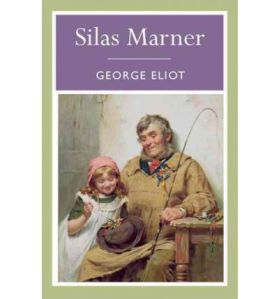
Silas Marner – George Eliot

Book #875

REVIEWER: Ange, of Tall, Short & Tiny

SM

Silas Marner is a story about redemption, sin and repentance, love, honesty, loyalty and prejudice. It tells the story of Silas, an unimposing and unfortunate (in looks as well as experience) young man who is unfairly run out of his home village, Lantern Yard, for a crime he did not commit. He begins a new, reclusive life for himself in Raveloe, where the villagers consider him to be a rather enigmatic, unusual character. Silas is a weaver by trade, and spends every possible moment at his work; he weaves when he is sad, he weaves when he is lonely; he weaves. Consequently, he amasses quite a fortune, which brings him great joy. However, when his fortune is stolen, he finds himself aided and finally accepted by the village; when a young child is left orphaned and appears on his doorstep, he is desperate to adopt and raise her, believing his golden fortune to have been symbolically exchanged for this golden-haired toddler.

He raises Eppie alone, and she grows up to be a beautiful, sweet young woman. As she promises herself in marriage, she also promises Silas that she will never leave him alone.

When the thief is discovered, 16 years later, Eppie’s real father, and brother to the thief, wishes to do right by Silas and the daughter he failed to own previously. The story ends with he and his wife proposing to Eppie that she live with them, expecting her to choose their higher position in society over that of her adoptive father.

The blurb on the back of my copy touts Silas Marner as one of Eliot’s most successful and admired works, but I’m not sure I agree. I enjoyed it, but found it very predictable, and there were some chapters that I thought quite irrelevant and unnecessary. Eliot writes in the typically and excessively descriptive style of the 1800s, and I am a little ashamed to admit that I actually fell asleep whilst reading on more than one occasion.

None of the characters really gripped me. Silas was sweet and slightly endearing; I felt for him and the injustices he faced, but was never fully drawn to him. Eppie was bland, although her love for Silas and her strength of conviction for him did give her an extra edge not often found in 1800s heroines. However, the only characters I thought had any real substance were the young cad, Dunstan Cass, and Silas’ motherly neighbour, Dolly Winthrop.

The bonus with this story is that it’s very short, so there isn’t too much time for real boredom to sink in; if it had been longer, I think I would have struggled to get through it in one piece. However, the beginning meandered so slowly that I found my mind wandering quite often. In saying that, it’s not that I didn’t like Silas Marner…I just felt it didn’t live up to my expectations, which were based solely on the blurb on the back of the novel. A good friend of mine loved it, so it obviously has its appeal for some.

I’ll give it 3/5 stars.

Unless – Carol Shields

Book #27

Reviewer: Inspirationalreads

I too am aware of being in incestuous waters, a woman writer who is writing about a woman writer who is writing …  We may pretend otherwise, but to many writers this is the richest territory we can imagine… This matters, the remaking of an untenable world through the nib of a pen; it matters so much I can’t stop doing it.

Unless is the last novel from Pulitzer Prize winner Shields, written shortly before her death in 2003, and is often claimed as her most personal.  Reta Winters is a writer,  living a charmed life of moderate professional success, loving family life and a full and supportive circle of friends.  When her eldest daughter decides to abandon her studies, family and friends for life on a street corner, holding up a sign saying only “goodness”, Reta brings her writerly contemplation to bear on the situation and its repercussions on her life.

Told from Reta’s perspective, the story of daughter Norah and her withdrawal from society is a vehicle in which Shields is able to voice her opinions on being a female, particularly a female writer.  Incestuous waters indeed.  There is a ongoing comment about female literature, how it is compartmentalised and trivialised, Reta often writing imaginary letters to convey her strong opinions on the subject.  But what does this have to do with a daughter who does nothing but hold up her sign of “goodness”?  The link is of her removal being Norah’s giving over the power in a sense of helplessness does relate to Reta’s musings on the subject, but her role in this story itself is trivialised.  The catalyst itself that feels rendered secondary to what feels like what Shields is trying to say rather than what it has evoked in the character of Reta.

This is important stuff, not only to Reta or even to Shields.  I did not find out that this was the author’s last book, written so close to her time of death until I had finished the book but there is the feeling that this is something that she really felt needed to be said about her profession and her role as a female writer in it.  The feeling of personal really is the correct description for this book.  At times I felt that this message of dismissing the power of feminine literature uncomfortable, the message too unflinching.  But learning more about Shields has leant a lot of credibility to it as well.  She was a noted Jane Austen fan and also wrote a biography before her death.  As a Pulitzer Prize winning female author, and a student and fan of one of the most visible female authors ever, these thoughts were obviously something she needed to say before she died, something she had to say on behalf of herself and those female writers who came before and to those who have and will come after.

I almost dismissed this novel as one of a display of great writing but one where the story was lost for the main agenda of its author.  I was reading to find out about Norah, what caused her self-exile and what would happen to her eventually.  And the reader is given these things albeit as a secondary to the main message.  But the message is powerful, so-much-so that this inexperienced part-time blogger feels too inadequate to properly convey.  One of the most important things I have read in a long time.