A Suitable Boy – Vikram Seth

Book #141

Reviewer: Naomi, of Create-Believe-Dream
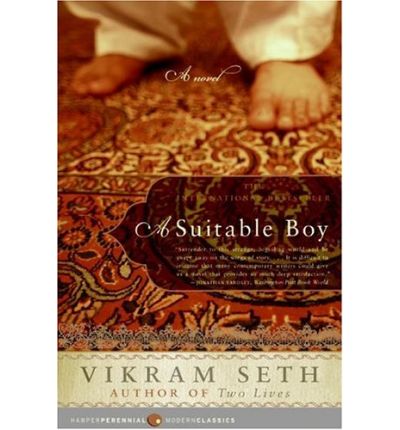
I feel the need to start this review with a disclaimer: I love reading big books. I get out doorstoppers from the library and when purchasing books often look to get the most pages per dollar. A Suitable Boy clocks in at 1488 pages (if you’re reading the paperback version as I was) and is one of the longest novels published in the English language. This was the second attempt I have made to read it.

The author makes light of A Suitable Boy’s length both in the rhyming couplet introduction and more obliquely at a book reading within the novel:

‘… I too hate long books: the better, the worse. If they’re bad, they merely make me pant with the effort of holding them up for a few minutes. But if they’re good, I turn into a social moron for days, refusing to go out of my room, scowling and growling at interruptions, ignoring weddings and funerals, making enemies out of friends. I still bear the scars of Middlemarch.’ 

Unfortunately this book falls into the ‘panting with the effort of holding it up’ category for me (especially as there is NO electronic version available, a glaring oversight by the publishers in my opinion…) But, to the story.

Best described as an epic novel, at its simplest A Suitable Boy is the story of Lata and the efforts of her family to find her a husband. On a broader scale it deals with the lead up to the first independent election in India after the end of British rule. Intertwined are the lives of four families. Spanning 18 months, the novel is divided into 19 sections each dealing with a different character than the previous section. This does make for confusion at points and I found myself often referring to the family trees at the beginning of the book to remember who was who.

There were some charming descriptions of characters, for example Mrs Rupa Mehra making gift cards by recycling cards she herself has been given. There were other moments in the novel, however, when the characters seemed almost un-humanly rational. When Lata finally wed her suitable boy she seemed to choose the suitor she liked the least and had the least in common with.  In fact for a large part of her narrative she had been almost derisive of him.

Much is discussed from a political perspective including land-rights, partition, the Hindu-Muslim struggle and the empowerment of women. Some of the 19 sections are set entirely in parliament sessions debating such issues. While interesting from an historical perspective I felt this element of the novel ground the pace of an already slow-moving narrative to a total halt. I also struggled to see how this contributed to the titular plot of the search for a suitable boy.

I am aware that I am critiquing a book that is beloved by many which is why I felt the need for the disclaimer at the beginning. It is not the length of this book that I found a struggle; it was the writing, which I found emotionally disconnected. A Suitable Boy is often described as a love story, but for me it read more like an historical novel written by a newspaper reporter. It left me, for the most part, completely unmoved which is the worst criticism I can ever make of a novel.

Monkey: A Journey to the West – Wu Cheng’en

Book #989a

Reviewer: Ms Oh Waily

I think I need a short disclaimer before I start this review.  When I was a child we were lucky enough to have the Japanese television show Monkey shown here.  And as an adult I still have some videos (yes, those funny things that old people used to watch or record on before DVDs) from that series.  Therefore when I came to reading the book version I happen to own, I also brought pre-conceived notions of what it was going to be like.

Like all pre-conceived notions, some were reinforced while others were altered beyond recognition.  So, I will start with some basic background information.

Journey to the West is one of the four great classical novels of Chinese literature, but in the west it is often referred to as Monkey.  Two of the other three Chinese classics also feature on the 1001 List – Book 997 a. The Water Margin and Book 998 a. Romance of the Three Kingdoms.

The work is definitely picaresque. Monkey is nothing, if not a rogue. It is an allegory of the journey to enlightenment as well as an adventure story, a fictionalised version of an historical event and a folk tale all wrapped up in one. So you get mythology, fantasy and adventure.

The main characters are Monkey, Tripitaka, Pigsy, Sandy and Kuan Yin. They have a variety of proper Chinese names, but for simplicity we will stick with the colloquial version for the review.

Monkey is a divine being created from a stone egg. He awakens and begins his adventures in annoying everyone and everything from the celestial palace downwards. He learns the Taoist arts, especially transformation, combat and immortality. He is even cheeky enough and clever enough to insist on a great name for himself, “Great Sage Equal to Heaven”, which takes him in to conflict with the Taoist deities. He is violent and uses force as one of his means of achieving his goals. Eventually he is trapped and subdued by Buddha for this and is put under a mountain for hundreds of years.

After we get to know Monkey through his growth and increased roguery we are introduced to each of the pilgrims, starting with the monk, Tripitaka. The Buddha instructs Kuan Yin to find someone in China to travel to the west in order to collect the Buddhist sutras to take back and enlighten the east. Hence the story’s name – Journey to the West. Tripitaka starts his journey along the Silk Road between China and India, and we begin a series of adventures most of which involve devils and demons rather than real people.

Monkey is the first of the disciples to appear at this stage of the story. Then comes Pigsy, who was previously the Marshal of the Heavenly Canopy but was banished for misbehaviour with the moon goddess during a heavenly banquet. He embodies the insatiable appetite, and while a reliable fighter is also fairly lazy and tries to avoid working if he can.

The third disciple is Sandy, a river ogre, who was previously the celestial Curtain Lifting General and was banished for dropping and breaking a crystal goblet belonging to the Queen Mother of the West. He is the straight man for both Pigsy and Monkey in the satire.
The fourth disciple is a son of the Dragon King of the Western Sea, who is sentenced to death for setting fire to his father’s great pearl. He is a fairly minimal character as he generally appears as the white horse that Tripitaka rides.

After a series of trials, tribulations, adventures, fighting, subduing and a variety of cunning subterfuges, the travelers eventually reach Vulture Peak, where Tripitaka receives the scriptures from the living Buddha. The return journey is glossed over and each of the five pilgrims receives rewards for their efforts.

I read the version of Journey to the West retold by David Kherdian, but I would suggest doing some research on which edition, and telling, is the most fluid reading. I found this telling to be a bit dry, despite all of the goings on and the wonderful reproduction woodblock images from an 1830s Japanese version. You may also be wise to invest in some paper and a pen to keep all the key deities in order, and perhaps Wikipedia open, if you are not familiar with the different gods of the Taoist pantheon.

What I did find extremely charming is the descriptive names and titles. For example:

“The Jade Emperor was sitting on his throne in the Treasure Hall of Divine Mists in the Cloud Palace of Golden Arches, surrounded by his immortal ministers, civil and military.”

or

“It is located in India, where the Buddha dwells, in the Great Temple of Thunderclap of the Great Western Heaven.”

or referring to six heavily armed bandits,

“If you really don’t know who we are, we will tell you. We are called Eye that Sees and Delights, Ear that Hears and Grows Furious, Nose that Smells and Covets, Tongue that Tastes and Desires, Mind that Conceives and Lusts, and Body that Supports and Suffers.”

It is fair to say that the allegory is reasonably visible throughout even without a great deal of understanding of Taoist, Confucian or Buddhist philosophy. However, I think it quite likely that the ease of reading and enjoyment will be determined by the translation you choose.  I didn’t find it particularly onerous reading, other than getting to grips with who is who amongst the Jade Court and how they all fit in.    But then I was predisposed to like it.  If you have an interest in Eastern philosophy then it is a must read.


Delta of Venus – Anais Nin

Book #311

Reviewer: Inspirationalreads

At the time we were all writing erotica at a dollar a page, I realised that for centuries we had had only one model for this literary genre – the writing of men.  

The preface of Delta of Venus is taken from Nin’s The Diary of Anais Nin, Volume III, and explains how she came to create this collection of erotica.  Through her famous friendship with Henry Miller, she is encouraged to start contributing to Miller’s collection of stories for a book collector.  When she forwards her stories she is told to “…cut out the poetry and anything but sex.  Concentrate on sex.”  She continues to submit them, the stories becoming more “outlandish, inventive and exaggerated.”

What starts as a need for money to fund her and her literary friends lifestyles, the final postscript of this preface, added over thirty years later, sees a more philosophical Nin.  Here she discusses the difference between Henry Miller’s masculine approach to the project and her feminine  poetic approach.

I had a feeling that Pandora’s box contained the mysteries of woman’s sensuality, so different from man’ and for which man’s language is inadequate.

Thus, Delta of Venus was born.  Female written erotica is a hot topic at the moment due to the popularity of a certain trilogy.  Much speculation and equal parts love and scorn have been heaped upon E.L James Fifty Shades Trilogy, which having not read I can not comment on.  What is of interest is that it is erotica (apparently in the tamest sense of the word, but again, I shouldn’t even comment) written by a woman for women and it has tapped into something that appears to be lacking.  There is a wealth of erotica that is written by women but not as accessible or as mainstream as their male counterparts.  So at the very least, this book and its authors comments about it, make it very relevant over 60 years after it was written.

And so, to the stories themselves.  What elevates Nin’s writing here is the very thing that the book collector complained of; the poetical, lyrical feel to these make them beautiful.  The words themselves feel sensual, the tone so fitting with the subject matter elevating it from lurid and seedy.  By her own admission, to combat the complaints over being over-poetical, there is a lot of boundary pushing here.  Necrophilia, incest, rape and bestiality all feature here and it does make for uncomfortable reading.  You admire how it is written and why it is being written but it is not an easy read.  A lot of this can be rationalised by the preface, but still, you know, icky.  Now, that isn’t a familiar word from me, is it?

In any list of any nature similar to that of 1001 Books to Read Before You Die, there will always be comment or disagreement about why something is on the list and I have to confess to thinking that about a number as well.  But it is very clear why  Delta of Venus its significance to not only erotic literature but female written erotic literature being key. I can clearly say that I admired the writing and what Nin was hoping to achieve (outside of the $1 a page she was paid) or attribute to it.  I was going to write that an open mind is needed when going into reading this, but this speaks to not approving or even relating to some of the more extreme subjects covered, just an understanding that they are in there and the purpose of why they are.  So be forewarned if you decide to take the trip.