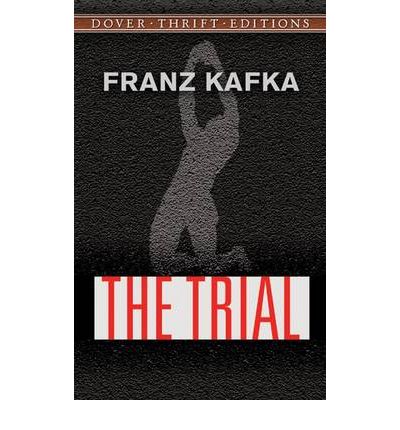
The Trial – Franz Kafka

Book #701

Reviewer: readlearnwrite
Please give a warm welcome to our newest reviewer, readlearnwrite.

The Plot
Josef K has just turned 30. He is a senior bank clerk. He is arrested by two unidentified agents for an unidentified crime.The arresting agents, however, do not take K away. Instead, K is told to await instructions from the Committee of Affairs. The story follows K over the course of the year after he is arrested as he struggles against the Law and the Court to resolve the charges made against him. All the while, he maintains his innocence. Ultimately the burden on K is too much and the result of his inability to resolve the charge is self-destruction.
Pressures stem from K’s dealings with the accusing “system,” the lawyers necessary to participate in the system, the social conditions surrounding the effect of the arrest on his employment, and the obvious effects on other accused seeking to prove their own innocence. Perhaps the only worthwhile advice comes to K from a chaplain associated with the court. The priest provides the advice in the form of a Parable known as “The Parable of the Doorkeeper of the Law” or “Before the Law.” The meaning of the parable is somewhat ambiguous to K and pages are devoted to its explanation in the form of a conversation between the priest and K. The parable and explanation signals K’s fate.

The Trial’s Bureaucratic Roots
Kafka worked as a bureaucratic employee for several years and wrote to stay sane. It was his passion. He passed away leaving a instructions to his executor to destroy his writing without it being published. Fortunately, his executor, Max Brod loved Kafka enough to ignore his request and his writings were published posthumously.  Kafka’s writing accurately captures the feel of a worker trapped in bureaucratic servitude. In the mind of a bureaucrat, appearances are more important than explanations. Accusations that threaten to ruin lives are looked at frivolously by everyone except the accused. The horror of K’s story in the trial is he can never quite come to understand what he has done wrong and why it is everyone assumes he will eventually be found guilty.
K devotes hours of his time and energy to show his innocence or to at least find someone to take his case as seriously as he does. At every turn he is told presenting his case is a formality that will ultimately have no effect on the predetermined outcome, guilt. Everyone suggests he simply avoid a resolution as long as he possibly can and in making that suggestion presume he will ultimately be unsuccessful in proving his innocence. K refuses to accept his fate.

The Parable, “Before The Law”.
I won’t reproduce the parable in its entirety, but it can be found in The Trial. It was also published separately in The Germanic Review, May, 1964. Within the parable is the very question of the meaning of life. I encourage you to read it and study it for yourself. It is this parable that makes The Trial my favorite novel. To me, the parable illustrates a certain hopelessness present throughout the novel. K does not know what he must do to be free. He hopes he can be free and prove his innocence but there is no indication aside from his own optimism this will happen.
In literary tradition, parables are meant to illustrate a point or teach a particular lesson. The parable conveys the entire meaning of the story. It tells us K, like the man in the parable, will struggle toward something for the rest of his life, but the thing he is struggling for is out of his grasp. The struggle K has been involved in has consumed his life to the same degree the man in the parable was consumed and as a result what life he had left was lost.

Kafka, The Master of Futility.
Kafka is a master of creating the futile scenario. K’s attempts to prove his innocence are futile. K’s heroes, though, always persist in their struggle. They are always just a touch too stubborn or come at the problem from just the wrong perspective. In this way they can not fully experience how futile their efforts are. As the reader, though, we can look down on them and see their futility. Our life may be every bit as futile as K’s, though. This is Kafka’s brilliance. Kafka uses the parable to show the reader even though K can see the futility of sitting before the doorkeeper of the law, he does not recognize his own existential futility. Even if the K did recognize the futility, though, and even if we recognize the futility of the menial tasks we engage in every day, would we act any differently? Our instinct is still to live even if existence is futile and we recognize it. We shouldn’t focus on the futility, but instead should live according to our instincts. In this way we can exist without being consumed by our inevitable fate.

White Teeth – Zadie Smith

Book #54

Reviewer: Inspirational Reads

Archie and Samad are the unlikeliest of friends. Archie is white, middle-class,with a lean towards insipidness. Samad is a Muslim, devout in his beliefs and sensitive to how foreign his race and religion make him. Meeting during World War 2, the story follows the two men and their friendship through marriage, children and life post-WW2 onwards in North London, England.

The characters and situations that Smith creates are so colourful and creative in their conception. Archie is left by his first wife and hits rock bottom, and at this time meets his soon to be second-wife; the tall, beautiful, toothless Jamaican-born Clara. And Samad has an arranged marriage which produces twin boys, as opposite in nature as they are similar in looks. Smith also looks back in the lives of both Archie and Samad, at how they came to be where they are and where they go with the advent of their offspring and the subsequent joys and disappointments that parenthood inevitably brings.

On paper, this book sounds like it has it all. A wide range of kooky characters and cultures; interesting story lines, particularly the coming-of-age stories of the children; and White’s writing itself is fun and vigorous, with a colloquial familiarity even though it is set in a time and place I am completely unfamiliar with. I really wanted to like this book but when I finished and put it down, I felt oddly disappointed.

It took a while for me to pinpoint what it was that I didn’t like about this book and what it came down to was that the characters were flat, unrelatable and frankly unlikeable. Yes, I liked the idea of the coming-of-age of the children but they never felt like they progressed. And this is the same for Archie and Samad. There was no growth in their characters despite the big changes happening around them. And the characters which I did feel mild warmth for, Clara and Clara and Archie’s daughter Irie, were disapointing in their diminishment in the latter half of the novel; diminishment in both character development and appearance. The reader is privy to their thoughts and emotions but it felt like despite this I had no understanding of their motivations or their actions.

When I think of this book, I think of vibrancy and energy. It was entertaining and there is a lot to admire about it. But in the end, oddly drawn characters in what is essentially a character-driven novel made it feel hollow and flat. I am still keen to try Smith’s other list book On Beauty, but it is quite far down an enormous TBR list.

The Poisonwood Bible – Barbara Kingsolver

Book #86

Reviewer: Ms Oh Waily (first published 2008)

This is my first foray into my Booklitzer Challenge.
If this novel is anything to go by, it truly will be a challenge to start and finish each one in it’s turn.

Set in the Belgian Congo, which later became Zaire, which later became the Democratic Republic of the Congo. The story follows the Price family from Georgia, USA into the Congo in 1959. They are missionaries. Ill-equipped, self-centred and self-absorbed. They are also odd, dysfunctional and frequently difficult to like. We follow their misadventures through the eyes of Orleanna, the mother and each of her four daughters; Rachel, the eldest and most self-absorbed, Leah and Adah, the twins – one whole, the other ‘slanted’, and Ruth May the baby.

We spend over half of the book watching them struggling with the reality of jungle and village life, as well as their own dysfunctional family life. Then the latter half of the book brings us in jumps through time into the 1970s, ’80s and ’90s.

The family’s story is the focus of the first part of the novel, with the latter half dealing predominantly with issues of the Belgian Congo’s transition to “independence”, international interference with that process and ultimately what each of the Price family live with as a result of being a white person in Africa during a time of change.

Kingsolver has given each character a unique and interesting voice. Rachel is often the only source of light relief in the entire book. She allows a small smirk during what is mostly a dark story with such classic malapropisms as:

The way I see Africa, you don’t have to like it but you sure have to admit it’s out there. You have your way of thinking and it has its, and never the train ye shall meet!

All I need is to go back home with some dread disease. Sweet sixteen and never been kissed is bad enough, but to be Thyroid Mary on top of it? Oh brother.

“Mr Axelroot,” I said, “I will commiserate your presence on this porch with me but only as a public service to keep the peace in this village.”

And my all-time favourite, speaking about the village children who try to pull her white blonde hair :

But at least I don’t have to be surrounded with little brats jumping up and pulling on my hair all the livelong day. Normally they clamber around me until I feel like Gulliver among the Lepidopterans.

I found the twins the most sympathetic, although it takes a while to warm up to them.

The novel is part history lesson, part psychology of the family. Both stories are dark and filled with actions to hide and run away from.

I struggled with reading this. It has taken over three weeks to make my way through 543 pages. Perhaps I am out of practice reading ‘serious’ literature. Maybe there has been far too much chick lit and murder mysteries on my bedside table.

I found the language of this novel difficult. Some passages were vague, flowery and completely fuzzy in meaning. I would come out the other end of the paragraph wondering what the heck it was all about. Then in contrast there would be wonderful turns of phrase and evocative images drawn in clever, concise word pictures.
I also felt that the book was too long. I think the first half could have been truncated without damaging the picture the author painted. It was only because I had committed to the Booklitzer Challenge that I struggled through to the point (somewhere around page 350) where I actually then wanted to read the remainder of the book. If I had picked this up off the library shelf, it would have gone back after about 50 or so pages.

Having just complained about it, I will give it a huge thumbs up for opening my eyes to the world of central Africa and more importantly the process that many of those nations have gone through to gain independence. Or rather, not quite gained independence. A country in name, but still a slave in economic terms.
Maybe a few more people in a few high places would do well to study the history of political change – and the aftermath of economic and ideological interference.

Suffice it to say, I am now much more interested in the history of this part of the world and will be making an effort to better understand how the current situations of many African countries came to be.

If you are feeling brave or are joining me in the Booklitzer Challenge, borrow this from your library. Otherwise I’d skip it.

The Week Ahead

Welcome to this edition of The Week Ahead.
This week we will be starting off with Barbara Kingsolver’s The Poisonwood Bible.
This is set in the Belgian Congo, or Zaire or the Democratic Republic of the Congo during the late 1950s.
It is the tale of a family of missionaries, and was the first Booklitzer book I read and wrote a review for back in 2008.  See if you agree with my view of the book, I know there are others who would hold a different opinion from my own.

We have our regular bookish quote for you on Wednesday, and on Friday we will have the review of White Teeth by Zadie Smith.

Set in north London it follows two families, one headed by Archie and the other by Samad.  They have been friends from the time they served together in World War II.  We are taken along on their journey through marriage and the upbringing of their respective children.
This novel won the Whitbread Award for First Novel in 2000.

Now, for the geek and nerd readers out there.  Sorry, I mean the technologically adept readers.  Here is something for you to consider if you own an iPad.  In the iBooks app you can take yourself off to the Apple store and download, for free, a fair number of classic works.  Some of which we would love to have you review for us.
Briefly, here are some of the free classics that also appear on the 1001 list.

  • 726. The Age of Innocence – Edith Wharton
  • 748. The Ragged Trousered Philanthropists – Robert Tressell
  • 749. Sons and Lovers – D.H. Lawrence
  • 752. Ethan Frome – Edith Wharton
  • 780. Heart of Darkness – Joseph Conrad
  • 783. Kim – Rudyard Kipling
  • 794. Dracula – Bram Stoker
  • 804. The Adventures of Sherlock Holmes – Sir Arthur Conan Doyle
  • 808. Tess of the D’Urbervilles – Thomas Hardy
  • 809. The Picture of Dorian Gray – Oscar Wilde
  • 820. The Strange Case of Dr. Jekyll and Mr. Hyde – Robert Louis Stevenson
  • 822. Kidnapped – Robert Louis Stevenson
  • 840. Anna Karenina – Leo Tolstoy
  • 843. Daniel Deronda – George Eliot
  • 848. Around the World in Eighty Days – Jules Verne
  • 853. Middlemarch – George Eliot
  • 857. War and Peace – Leo Tolstoy
  • 861. The Idiot – Fyodor Dostoevsky
  • 863. Little Women – Louisa May Alcott
  • 876. Great Expectations – Charles Dickens
  • 880. The Woman in White – Wilkie Collins
  • 893. Uncle Tom’s Cabin; or, Life Among the Lonely – Harriet Beecher Stowe
  • 902. Wuthering Heights – Emily Brontë
  • 904. Jane Eyre – Charlotte Brontë
  • 906. The Count of Monte-Cristo – Alexandre Dumas
  • 935. Rob Roy – Sir Walter Scott

I have not ventured into Project Gutenberg with this list, simply the Apple store link on the iPad.  There are bound to be others as these are only the ones I have seen and downloaded for my own reading.  Feel free to add to this list in the comments.

Just a reminder, the bold titles are those which are under offer of review, but have not yet appeared here at 1001 Books To Read Before You Die.

Happy reading everyone.