The Invisible Man – H. G. Wells

Book #791

Reviewer: inspirationalreads

H. G. Wells is synonymous with Science Fiction. As a fan of sci-fi I have to shamefully admit that this is my first Wells for he is often referred to as one of the Fathers of this genre.  It is clearly evident why he is heralded as such.

Wells opens his story not with an introduction to the Invisible Man and how he came to be in this incredible state, but with a stranger seeking lodging in a small English village in Iping.  He is curt and highly secretive and when strange occurances, including an odd burglary coincide with his arrival, local tongues are sent wagging and suspicions are aroused.   It is not long before the Invisible Man is revealed and he soon escapes leaving chaos and many victims behind him.

When he finds an old school acquaintance in the neighboring village, it is to this man Kemp that he pours his story out to.  He is Griffin, who left their mutual medical school to study in the field of optics.  Here is where Wells’s strength as a science fiction writer is clear. Griffin’s incredible achievement is explained in an almost credible way; through the manipulation of light refraction.

But it isn’t only a tale of scientific achievement.  For although he is successful, Griffin is unable to enjoy any of the things he has so longed for.  He can get riches and he can achieve fame, but being invisible meant it was impossible to enjoy them.  The realisation of “…what a helpless absurdity an invisible man was” creates a manic desperation in Griffin that soon gives way to outright madness.  Because now what he wants, is to inflict his “Reign of Terror” on the country.

This was an interesting lay out for this story.  To have the Invisible Man enter as a shadowy, underhand character and to be introduced to him at the same time as the villagers of Iping appears to be an attempt at a tense vibe.  And in part he is successful.  We don’t know how this invisible man came to be but we read of how rude and demanding he is and then how his dubious activities increase until he is forced to escape.  However, and this is not a small however, this section of the book became bogged down by unnecessary description and even more unnecessary meanderings by the characters.  themselves.  Interactions with newspaper reading extras does not for interesting reading make.

When our Invisible Man escapes to Dr Kemp’s house and we learn of how he came about is where the story truly came alive for me.  Invisibility has been dealt with a lot through other books, movies, tv shows etc.  The common theme is that invisibility has a demoralising effect; if your actions aren’t visible to those who can judge you or hold you in check are you able to continue to do what is right or ethical?  This isn’t a question posed by Wells.  Griffin is soon revealed as having dubious morals before he achieved invisibility.  When his miraculous achievement doesn’t bring what he hoped for and he has to start scrambling for survival, Griffin looses what little ethics he has.  Stealing, destroying property, frightening children, all is revealed to Dr Kemp and the reader.

This book is satisfying on a number of levels.  It is entertaining, gives you a few things to mull over, tense in parts and even has moments of humour; “…the anglo-saxon genius for paliamentary government asserted itself.  There was a great deal of talk and no decisive action“. There is definitely enough to satisfy the science-fiction fans and is a great introduction to Mr. Wells.  A solid 3 out of 5.

Treasure Island – Robert Louis Stevenson

Book # 831

Reviewer: Ange

Welcome aboard to our newest reviewer, Ange.  She is about to take us on a rollicking sea-faring adventure.

Fifteen men on a dead man’s chest –Yo-ho-ho, and a bottle of rum! Drink and the devil did for the rest — Yo-ho-ho, and a bottle of rum!

Treasure Island was a surprisingly good read! In fact, it’s a rip roaring yarn! Because of its age I thought it would be difficult to read, but it moved along at a good pace and while there was some old fashioned language and syntax, the meaning can be easily discerned by a confident reader.

The basic plot is that Jim and his mother run an inn and a disreputable sailor comes to stay. The sailor is scared of outsiders – particularly a man with one leg. The sailor dies in unusual circumstances and Jim becomes the owner of a map – with an X marks the spot! So of course he and his companions risk life and limb to find the treasure. Sadly, one of his companions is less than perceptive and so hires a ship full of corrupt sailors. Luckily the Doctor and the ship’s captain are full of integrity and, when added to Jim’s courage and luck, a mighty battle ensues over mastery of the ship, Treasure Island and the Treasure itself. There are shootouts, bonfires, men marooned for years, booby traps,being cast adrift on the sea, drunkenness, skeletons and even a bit of digging for treasure.

The highlight for me was that the one legged man was Long John Silver, who I’ve heard of all my life, but I had failed to connect him to Treasure Island. In particular I was interested to see how many times he could change sides, how long he could retain control over the pirates and how many different plans he could have going at once. Stevenson’s handling of Long John Silver is perhaps most masterful because I know people with similar characteristics and so I could relate to him. And he really does have a parrot that cries: ‘Pieces of eight! Pieces of eight!’

Treasure Island is justifiably famous. The imagery is good and Stevenson was great at adding atmosphere.

If the conduct of the men had been alarming in the boat, it became truly threatening when they had come aboard. They lay about the deck growling together in talk. The slightest order was received with a black look and grudgingly and carelessly obeyed… Mutiny, it was plain, hung over us like a thundercloud.

I found the baddies much more menacing than Voldemort.

‘Come now, march,’ interrupted he; and I never heard a voice so cruel, and cold, and ugly as that blind man’s. It cowed me more than the pain, and I began to obey him at once, walking straight in at the door and towards the parlour, where our sick old buccaneer was sitting, dazed with rum. The blind man clung close to me, holding me in one iron fist and leaning almost more of his weight on me than I could carry. ‘Lead me straight up to him, and when I’m in view, cry out “Here’s a friend for you, Bill.” If you don’t, I’ll do this,’ and with that he gave me a twitch that I thought would have made me faint. Between this and that, I was so utterly terrified of the blind beggar that I forgot my terror of the captain, and as I opened the parlour door, cried out the words he had ordered in a trembling voice.

I also found that compared to modern day writing the baddies were much more human by being bad for personal gain (when the risk was worth it), rather than just being evil for no reason at all.

I’m looking forward to reading Treasure Island aloud to my son when he is older.


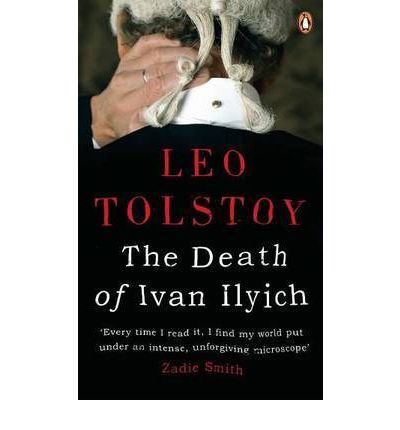
The Death of Ivan Ilyich – Leo Tolstoy

Book #829

Reviewer: Ms Oh Waily

For such a very short story, around the 50 to 60 page mark, this has been very hard for me to write a review.  Perhaps because it is a deceptively simple story.

First let me say that this is my first venture into reading Russian literature, and therefore, the formidable Leo Tolstoy of War and Peace renown. I must say that I felt a great deal of trepidation at tackling a work by such a literary giant. In the end I should not have been so concerned. My translation was by Hugh Aplin and the language flowed simply and elegantly.

The novella begins at the end, with the death of Ivan Ilyich, and his colleagues visiting to pay their respects. We are then transported back through the years to follow Ivan from his youth, through his education in the law and on through the life experiences of gaining better positions, a wife and children and eventually a good position as a judge in the city.
At the point where he gains this exulted position, he takes a grand house and sets about furnishing it to reflect his new social status. While involving himself in a hands-on way, he falls and hurts his side. Thinking nothing of this, he continues on with his life. Unfortunately for Ivan, the incident has life-changing impact. His health deteriorates and he suffers considerable pain. The doctors he consults contradict each other, but continue with an upbeat prognosis should he follow their advice. Sadly for Ivan, he declines steadily until eventually he succumbs to death at the youthful age of forty-five.

There are a number of themes running throughout. The most obvious one to me was the way in which Tolstoy brings into question all of the worldly trappings and accepted “striving” for position and status amongst the upper-middle classes. It is all for naught in Ivan’s case. He may have worked his way up the hierarchy, subsuming himself to whatever the norms of that class are, but in the end his mortality will not be avoided by accumulation of things or position.
His family and colleagues show this avoidance of reality in their dealings with him once he becomes ill. Death is not something they consider with regards to themselves, and are frankly glad it is happening to someone else. It makes them uncomfortable.

In fact, the only person in the story who is comfortable with death is Gerasim, Ivan’s peasant servant. He is able and willing to give of himself and his kindness at the very end of Ivan’s life, when the pain is so excruciating that Ivan screams for days on end. He gives this aid freely and willingly as he hopes someone will do for him when his time comes.

In the end, after much internal turmoil, Ivan comes to look back over his life and accept that his death is inevitable. In the process, he stops feeling irritated and angry with his family for their inability to see his death as imminent, and begins to pity them and their self-induced delusions.

My translation was very easy reading. The story was told in enough detail to build up a picture of Ivan and his life, but no aspect seemed to be overindulged. Tolstoy truly is a master of conveying meaning with brevity. The language is not flowery or effusive, but simple and straightforward. I found that the story was told with remarkable clarity and even I could see some of the themes he was incorporating without the need for external references to guide me. Recognition of other themes would require more knowledge of the author and his particular interests and outlook than I have, but can be readily accessed in the many other online reviews of his work.

If a near 1500 pages of War and Peace is too intimidating, then it is well worth reading this deceptively simple work. I can highly recommend this as an entry point to Tolstoy.

The Picture of Dorian Gray – Oscar Wilde

Book # 809

Reviewer: Hayley


The story is about a young man named Dorian Gray who becomes the subject of a painting by artist Basil Hallward. The artist, like everyone else, is taken aback by Dorian’s beauty. While he is being painted he meets a friend of the artist, Lord Henry Wotton. Lord Henry has a view on life that enthralls Dorian Gray; his view being that the only things worth pursuing in life are beauty and fulfillment of the senses. Dorian realises that one day his beauty will fade and expresses a desire that it be the painting that ages, not him. He gets his wish and his life becomes a series of debauched events and frivolous luxury. The portrait shows all these acts as Dorian remains unchanged.

I must admit prior to reading this book I did not know much about it or Oscar Wilde. I knew the basic storyline of a man who’s portrait ages instead of him, and I knew that Oscar Wilde was an Irish poet/storyteller who was seen as scandalous and immoral at the time for his homosexuality.

The novel starts out with one of the three main characters, Lord Henry Wotton, going to visit his good friend and artist Basil Hallward. He finds him painting a young man by the name of Dorian Gray and becomes instantly taken with him. Mr Wilde never holds back with his descriptions of how beautiful Dorian Gray is.  When Lord Henry first meets him he describes him as “wonderfully handsome, with finely-curved scarlet lips, frank blue eyes and crisp gold hair”. I’m sure most would agree that it is Lord Henry who starts Dorian Gray on his downward spiral, but it is also when he first lays eyes on the portrait and “The sense of his own beauty came on him like a revelation”. It is then that he starts to realise there will be a day when his beauty fades, “the grace of his figure broken and deformed”.  So he expresses a desire to “sell his soul” so that it is the painting that ages rather than he. And of course, he gets his wish.

This for me, is when the novel really gets good.  Dorian Gray, fuelled by a “poisonous” French decadence novelª, a present from Lord Henry, goes on a downward spiral of every vice and act of debauchery he can get his hands on. I won’t go into too much else of the plot as I don’t want to give the story away of what happens to the various characters.  There is an actress he “falls for” and her brother who become involved in the story and, of course, the main characters of Basil and Lord Henry. I found myself much hating Lord Henry and feeling very sorry for Basil (or “poor Basil” as I called him).

Overall I enjoyed the dark gothic nature of this book, having never really read anything like this before  and I’m now keen to read more!  I know the book was used in Mr Wilde’s trial where he was accused of “gross indecency with other men” but by today’s standards the homoerotic nature running through the book is very subtle.

I was interested to find out how Mr Wilde saw himself in the book, if at all, and found a quote from Oscar which said “Basil Hallward is what I think I am: Lord Henry is what the world thinks me: Dorian is what I would like to be—in other ages, perhaps”. I guess that sums up the three different characters in the book and when you read the book it definitely gives you an insight into Mr Wilde himself.

I’m glad I read the book as it was part of my book goals to read more “classics” and I think it was definitely a good one to start with. And to quote Irvine Welsh who wrote the introduction to the edition I read “The Picture of Dorian Gray is, and will continue to be, Oscar Wilde’s most accessible work, and the perfect introduction to this marvellous writer”. And I completely agree!


ª the title of the novel is never revealed but at Oscar Wilde’s trial he admitted that he had in mind Joris-Karl Huysman’s A Rebours.

The War of the Worlds – H.G. Wells

Book # 790

Reviewer: Sweetp


When I was growing up I used to love listening to Jeff Wayne’s musical version of the War of the Worlds. In my mind, I can instantly recall the sound of Richard Burton’s deep voice narrating – “No one would have believed in the last years of the nineteenth century that this world was being watched keenly and closely by intelligences greater than man’s and yet as mortal as his own.” Some twenty years later, I watched the story immortalised on the big screen by Tom Cruise and Spielberg, but it was only recently that I actually read the novel.

H.G. Wells published this book in 1898, long before moon landings, satellites, and humans living aboard space stations. His alien invaders, complete with destruction rays and gruesome feeding machines, would be just as horrifying if this story was set a hundred years later, and in that aspect this novel has lost none of its appeal, or impact. As a window into the beginnings of the science-fiction genre there is possibly nothing better.

Where this novel really shines though, is in the exploration of human nature – how different people cope in the face of disaster, and the lengths they will go to, to survive. The idea of the hunter becoming the hunted will appeal to all those who enjoy post-apocalyptic reads or themes of oppression, colonization and war. The story is narrated by a man who is witnessing the invasion first hand – his intelligent but often panicked version of events, gives an authentic, urgent immediacy to the novel as the horrifying events unfold.

At times the language feels a little stilted in a quaint Victorian way, but the book is also very short, and nothing is dragged out longer than it needs to be. Even being intimately familiar with the plot, I still found this to be an enjoyable and quick read.

I rated this 4/5 stars, a classic that should be on everyone’s “I’ve read this” list.