The Man Who Loved Children – Christina Stead

Book #599
Reviewer: Beth’s List Love (first published February 21, 2012)

The Man Who Loved ChildrenSam and Henny Pollit have too many children, too little money, and too much loathing for each other. As Sam uses the children’s adoration to feed his own voracious ego, Henny watches in bleak despair, knowing the bitter reality that lies just below his mad visions. A chilling novel of family life, the relations between parents and children, husbands and wives, The Man Who Loved Children, is acknowledged as a contemporary classic.

This novel is the dysfunctional family writ large. Dad is a civil servant naturalist with superficially benevolent ideas about the world and mankind, but with a heavy dose of sexism, a leaning toward eugenics, a disdain for literature, and most importantly a massive dose of narcissism hidden beneath the superficial shell. He looks initially like a fun dad, ring-master of “family fun day” on Sundays, and seemingly the younger kids enjoy him, but he contributes to the impoverishment of the family, belittles the children in various ways (including speaking a nauseating baby-talk to them), and has a major war going on with their mother.

“Mothering” (a nickname he coined, that she hates) is a former heiress who is less self-involved than she appears in some ways, but who speaks hatefully to the kids, especially the eldest who is a step-daughter, spends much of the time withdrawn or absent, and seems incapable of a kind word about anyone.

The eldest daughter Louie is the child who gets the most attention in the novel, but I had a soft spot for Ernie, the eldest boy, who is the only one in the family with financial sense. We watch the family unravel from a marginally middle-class existence in Georgetown to abject poverty and emotional chaos in Annapolis after the father becomes unemployed. The emotional toll of family life on the kids, particularly Louie and Ernie, gets clearer and clearer and leads them to desperate acts.

I found this an oddly enjoyable, but nonetheless bleak, read. My rating: 4 out of 5 stars

The Name of the Rose – Umberto Eco

Book #293
Reviewer: Tall, Short, Tiny & a Pickle

The Name of the RoseThe Name of the Rose tells the story of William, a Franciscan monk who travels to a monastery in Northern Italy with his apprentince, Adso, to attend a theological conference of sorts. Just before their arrival, it appears that one of the monks has either been murdered or committed suicide. As the story continues, a number of other monks mysteriously die, and William is asked by the abbey to use his superior skills of observation and curiousity to investigate the deaths.

Sounds exciting, right? Well, let me start by telling you that this review almost never eventuated. I stopped reading The Name of the Rose twice, and it almost didn’t make it back off my bookshelf. However, I was determined to finish it for a personal reading goal, and when I realised it was on the 1001 Books list…well, that made me even more determined to get to the end.

It will come as no surprise that I didn’t like this book at all; in fact, I found it incredibly boring and have nicknamed it The Book of Snore. To be fair, I imagine Eco didn’t have a sleep-deprived mother in mind when he wrote his novel, but I still think I wouldn’t have enjoyed it if I was getting a solid eight hours sleep each night. His method of telling a story within a story did nothing to endear me to his style of writing.

The length of the sentences, paragraphs and chapters was excessive; in some stories, this style works, but here, it simply didn’t. I waited for the pace to pick up…and I waited, and waited, and waited. It simply took too long to read; I wasn’t expecting instant gratification, but I was expecting to be entertained in some way, and I wasn’t.

The narrator was an insipid character, and his insights didn’t add anything to the story. Eco’s descriptive passages also missed the mark for me, which is saying a lot when I’m a big fan of Dickensian over-descriptions. I was disappointed, too, because the cover of my copy was so pretty and held such promise which the contents really didn’t deliver!

I didn’t like the use of Latin phrases when there were no translations or footnotes. It was frustrating to feel as thought I may have missed something important because of this; indeed, when I’d finished, I actually did wonder if I’d missed something and that’s why I didn’t “get” it? Because it bored and frustrated me so, I found that I didn’t retain a lot of what I read from one evening to the next, but wasn’t inclined to go back and refresh my memory. I am aware that this linguistic ambiguity is a special technique, but it’s not one I enjoyed reading.

There’s obviously a reason The Name of the Rose earned a place on the list, but I am at a loss to figure it out. If someone can convince me otherwise, I am eager to hear your glowing reviews of this book.

Faces in the Water – Janet Frame

Book #447

Reviewer: Beth’s List Love (first published April 3, 2012)


FITWJanet Frame’s Faces in the Water describes the experiences of a young woman hospitalized for most of 8 years in the psychiatric hospitals of New Zealand in the 1950s. Treatment seemed to have been largely a matter of ECT (or EST as it was called in the book) with apparently little anesthetic, or lobotomy. Patients lived in their own mini-society with its own rituals and routines, with little human contact other than that of burned-out ward nurses and brief exchanges with a few fairly helpless doctors. Frame can speak realistically of this world, as she herself was incorrectly diagnosed as schizophrenic and hospitalized for years.

While the world she portrays is a bleak one, Frame’s novel is a beautiful work of fiction.  Here is her opening sentence:

They have said that we owe allegiance to Safety, that he is our Red Cross who will provide us with the ointment and bandages for our wounds and remove the foreign ideas the glass beads of fantasy the bent hairpins of unreason embedded in our minds.

In the prose we see both the madness that led to protagonist Estina Mavet’s hospitalization, but also the intelligence and insight that indicate how much is lost by her being trapped there. From her first hospitalization, Estina is eventually released into her sister’s care, but soon finds herself a patient at another hospital in another part of the country. In her description of a cheery demonstration unit for the least troubled patients which provides a bright facade hiding a darker warren of disturbing wards for the more symptomatic and chronic patients, I felt a horrible echo of the descriptions I have recently been reading of the public and secret sides of Nazi internment camps.

When Estina finds herself reassigned to one of the less public units, she finds that she is left with little to call her own, dressed in hospital garb that may or may not even fit, and denied most personal possessions. She was a teacher before her hospitalization, and one item she does manage to keep is a volume of Shakespeare.

I seldom read my book yet it became more and more dilapidated physically, with pictures falling out and pages unleaving as if an unknown person were devoting time to studying it. The evidence of secret reading gave me a feeling of gratitude. It seemed as if the book understood how things were and agreed to be company for me and to breathe, even without my opening it, an overwhelming dignity of riches; but because, after all, the first passion of books is to be read, it had decided to read itself; which explained the gradual falling out of the pages.

She then goes on to describe moments when Shakespeare’s words come to her mind as she watches the situation of the patients around her. Estina travels back and forth between two hospitals and the cultures of the different wards within each hospital, terrified of the only treatments she can be offered, and often hopeless about the possibility of returning to the outside world.

I will leave you to discover where the journey ultimately takes her, but I will say that bleak as the vision of mid 20th century mental health care is in this tale, the vision of human courage and emotional depth conveyed in this novel is equally inspiring.

Veronika Decides To Die – Paulo Coelho

Book # 90

Reviewer: Ms Oh Waily (first published January 2014)


VDTDThis is my second Paulo Coelho book after reading The Devil and Miss Prym a couple of years ago.  It is book #90 on the 1001 Book List.

The novel is set in Ljubljana, Slovenia and the eponymous Veronkia is a beautiful young woman who seemingly should have the world at her feet.  Instead she decides to die.

Veronika is loved by her parents, she has a steady job as a librarian and has had a string of boyfriends.  She is not, however, happy with this life.  She decides, in quite an organised way, to end her life.  Her preference is by overdosing on sleeping pills, which she takes one day in her rented room in a convent.

Unfortunately for Veronika her attempt fails and she wakes in Villete, “the famous and much-feared lunatic asylum”.   Not only does she find herself in this hospital, but she also finds that she has damaged her heart with her suicide attempt and will die within the week.  The remainder of the novel follows her last week in Villete and her interactions with some of the other inmates.

She meets Zedka who has been in Villete for depression, Mari who suffers from panic attacks and Eduard who is a young schizophrenic.  Each of these individuals has something to teach Veronika about the state of life and a way of viewing what life is about.  Mari has the most influence on Veronika’s thinking during her last week and in return Veronika’s situation impacts profoundly on these three people.

The discussion centres around how we look at life, what we make of it and our time living it.  It really talks about the constriction of following the herd to the detriment of your own personality and needs; about cramming that square peg in to that round hole and the damage that does to a mind.  I think this passage pretty much sums up Veronika’s feelings about this as she comes to terms with the idea that she is now dying slowly.  She is talking to Eduard one night while he waits for her to play the piano.

‘No one should let themselves get used to anything, Eduard.  Look at me, I was beginning to enjoy the sun again, the mountains, even life’s problems, I was beginning to accept that the meaninglessness of life was no one’s fault but mine.  I wanted to see the main square in Ljubljana again, to feel hatred and love, despair and tedium, all those simple, foolish things that make up everyday life, but which give pleasure to your existence.  If one day I could get out of here, I would allow myself to be mad, because everyone is, indeed, the maddest are the ones who don’t know they’re mad, but keep repeating what others tell them to.’

In a ‘madhouse’ it is normal to be yourself because it is expected.  You have no need to conform and squash your square peg in to that round hole anymore.  It’s quite an interesting idea, I thought.

On the following page, in another setting, there is a visitor telling a Sufi story about Nasrudin in which he puts his audience through trial after trial of waiting and bad behaviour on his part until the 1700 people who originally wanted to hear him speak is reduced to the final group of nine.  At this point all of his bad behaviour ceases and he is himself again.  I think what he tells his nine person audience is quite profound with regards to patience and acceptance.

“Those of you who stayed are the ones who will hear me,” he said. “You have passed through the two hardest tests on the spiritual road: the patience to wait for the right moment and the courage not to be disappointed with what you encounter.  It is you I will teach.”

And, to be honest, the inner thoughts of Mari regarding punishment (she’s a lawyer) were cracking too and made me smile.

It was a shame that Allah, Jehovah, God – it didn’t matter what name you gave him – did not live in the world today, because if He did, we would still be in Paradise, while He would be mired in appeals, requests, demands, injunctions, preliminary verdicts, and would have to justify to innumerable tribunals His decision to expel Adam and Eve from Paradise for breaking an arbitrary rule with no foundation in law: Of the tree of knowledge of good and evil thou shalt not eat.
If He had not wanted that to happen, why did He put the tree in the midst of the garden and not outside the walls of Paradise? If she were called upon to defend the couple, Mari would undoubtedly accuse God of administrative negligence, because, as well as planting the tree in the wrong place, He had failed to surround it with warnings and barriers, had failed to adopt even minimal security arrangements, and had thus exposed everyone to danger.
Mari could also accuse him of inducement to criminal activity, for He had pointed out to Adam and Eve the exact place where the tree was to be found.  If He had said nothing, generation upon generation would have passed on this earth without anyone taking the slightest interest in the forbidden fruit, since the tree was presumably in a forest full of similar trees, and therefore of no particular value.
But God had proceeded quite differently.  He had devised a rule and then found a way of persuading someone to break it, merely in order to invent Punishment.  He knew that Adam and Eve would become bored with perfection and would, sooner or later, test His patience.  He set a trap, perhaps because He, Almighty God, was also bored with everything going so smoothly: if Eve had not eaten the apple, nothing of any interest would have happened in the last few billion years.

This musing does go on a bit more, but you get the idea.  It is very clever and very thoughtful.  The writing, as always, is a pleasure to read.  It seems to translate very well and is easily enjoyed.

I think I prefer The Devil and Miss Prym, but this is still a very interesting read and a good reminder to focus on what you make of your life – not what others want you to make of it.

Highly recommended.


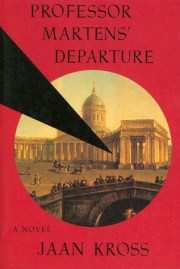
Professor Martens’ Departure – Jaan Kross

Book #237

Reviewer: Beth’s List Love (first published 2 March, 2012)


PMD

I have to admit that all through the past week [March 2012], I had two urges: to zoom in very close on Google earth to have a close look at the Estonian countryside, and to take a really good course in a couple centuries European diplomatic history. The book that inspired these urges was Professor Martens’ Departure by Jaan Kross.

A few chapters into this book, I was scrambling for Google. What I discovered is that this novel’s protagonist, Professor Martens, was a real historical figure, an international law expert in the Russian court of the early 20th Century. He was an important figure in numerous important international treaty negotiations. This novel, set late in his life, takes us with him on a train trip from his small village toward a rendezvous with his wife and official meetings with other diplomats in St. Petersburg.  As he travels, we listen to his internal dialogue, anticipating a planned conversation with his wife in which he plans to begin an era of total candor. He reviews his personal and professional past, examining successes and failures and imagines that this new honesty will be insurance against his own death. During the journey, he also temporarily shares his compartment with a young professional journalist with socialist sympathies who knows a bit about him through her professional connections. At times Martens also tells the reader about another Martens, who lived a century earlier, another international law expert, but for Germany.

It is a rare novel that gives insight into what it must feel like to be in contention for, but not win, a Nobel Peace prize, or to be left unsure whether your absence from an official list of participants in a major treaty negotiation was a typist’s error or a sly political maneuver by a competitive colleague.

Through Martens’ self-exploration, Jaan Kross explores the moral challenges faced by highly placed civil servants in autocracies, as well as the complexities of Estonian identity. Martens regrets, as well as some professional compromises, ethical failures in his personal life: infidelity, a lack of generosity to those who sought his support, despite his own success after early humble origins. Martens is a wonderful character, drawn with subtlety and skill. Those with an interest in political history and moral self-reflection will find this book a fascinating trip.

My rating: 4 out of 5 stars; I definitely agree with the choice that placed this book on the list.