The Nine Tailors – Dorothy L. Sayers

Book #632

Reviewer: Ms Oh Waily


TNTA goodly number of years ago I was mildly obsessed with 1920s and ’30s British crime fiction.  Specifically the grand dame, Agatha Christie.  When I had dispensed with her canon, I was left rather wondering what to do.  Thankfully for me, I learned about Dorothy L. Sayers and her creation, Lord Peter Wimsey.

I happily sat down to re-read The Nine Tailors recently and it was like walking in to a past world all over again.

The book opens with Wimsey driving his Daimler into a ditch on New Year’s Eve, having missed a rather nasty turn.  There is little else to do, but get out and walk in the miserable snowy landscape of the Fens, so that is what Wimsey and his manservant Bunter do.  They make their way to the village of Fenchurch St. Paul and become the guests of the local rector – Mr Venables – and his wife.

It turns out that there is something of an influenza epidemic going through the local populace and this threatens the good Reverend and assorted parishioners’ attempt at an impressive 15,840 Kent Treble Bob Majors.
The church of Fenchurch St Paul is a fine one, with eight bells.  Yes, this mystery is to be laid down in the most English of activities – change-ringing – and because of that I shall introduce you to the bells.

Gaude, Sabaoth, John, Jericho, Jubilee, Dimity, Batty Thomas and Tailor Paul.

Naturally Lord Peter is a bit of a dab-hand at bell ringing and takes the place of the ill man – Will Thoday.  Nine hours of ringing later and the goal is achieved.  Sadly the wife of the local squire, Lady Thorpe, dies the next day and as a result of her death Wimsey is acquainted with the tale of the theft of an emerald necklace of a distant, wealthy, and eccentric family member some twenty years earlier.  The Thorpe family having been haunted by this unsolved and unresolved case ever since it occurred in their home.

While all this is going on Wimsey’s car is hauled out of the ditch and repaired.  He thanks the good Reverend for his hospitality and heads on to his original destination in Walbeach.

Some months later, just after Easter, Sir Henry Thorpe joins his wife in the hereafter and is due to be buried with her.  Unfortunately when the sexton, Harry Gotobed, and his son are preparing the ground they come across something rather unexpected in the grave.  A body.  Or as Harry refers to it when talking to Mr Venables, ‘a corpus’.

“Well, sir, it’s about this here grave. I thought I better come and see you, being as it’s a church matter, like.  You see, when Dick and me come to open it up, we found a corpus a-laying inside of it, and Dick says to me —”
“A corpse?  Well, of course there’s a corpse.  Lady Thorpe is buried there.  You buried her yourself.”
“Yes, sir, but this here corpus ain’t Lady Thorpe’s corpus.  It’s a man’s corpus, that’s what it is, and it du seem as though it didn’t have no right to be there.”

As you can see, Sayers has a lovely turn of wit, even with the discovery of the body.  It is this body that begins the mystery, and the Reverend requests Lord Peter’s aid and advice in Fenchurch St Paul over the matter of ‘the corpus’.  From here we follow the trail of the Wilbraham jewel theft in tandem with the murder investigation.  In the process we get to know a little more about a few key villagers and perhaps less appealing, we also learn a bit about change-ringing.  And as is nearly always the case with this genre of crime fiction, the hero solves the puzzle of the dead man and the missing emeralds.

I will be honest with you, the change-ringing jargon is quite hard going if you are not an aficionado.  Luckily it does not extend too much past the first few chapters of the book in any great detail.  Each section is begun with a nod to it, and there are more understandable references scattered throughout the remainder of the story.  The bells are almost like eight extra characters, showing up throughout the story.

The writing is crisp, clear and often full of sly humour.  The solution to the mystery is not given away too early, but lead up to, and yet the ending is not completely predictable either.  Here are two more examples of Sayers’ writing style and humour.  The first, when she is introducing the subject of change-ringing and elaborating on it.

By the English campanologist, the playing of tunes is considered to be a childish game, only fit for foreigners; the proper use of bells is to work out mathematical permutations and combinations.  When he speaks of the music of his bells, he does not mean musician’s music – still less what the ordinary man calls music.  To the ordinary man, in fact, the pealing of bells is a monotonous jangle and a nuisance, tolerable only when mitigated by remote distance and sentimental association.

The second occurs when the local policeman, Jack Priest, arrives on the scene of the exhumation of the unexpected body.

“Half a minute, half a minute, sir,” interrupted the policeman. “What day was it you said you buried Lady Thorpe, Harry?”
“January 4th, it were,” said Mr. Gotobed, after a short interval for reflection.
“And was this here body in the grave when you filled it up?”
“Now don’t you be a fool, Jack Priest,” retorted Mr. Gotobed. ” ‘Owever can you suppose as we’d fill up a grave with this here corpus in it? It ain’t a thing as a man might drop in careless like, without noticing.  If it was a pocket-knife or a penny-piece, that’d be another thing, but when it comes to the corpus of a full-grown man, that there question ain’t reasonable.”

So, if you enjoy the golden age of detective fiction but have not yet come around to Dorothy Sayers, then it’s about time you did.  It is a great read.


An explanation:

The title The Nine Tailors comes from an old tradition in small villages of ringing the church bell to announce the death of a person.  From Wikipedia:

In some parishes in England the centuries old tradition of announcing a death on a church bell is upheld. In a small village most people would be aware of who was ill, and so broadcasting the age and sex of the deceased would identify them. To this end the death was announced by telling (i.e. single blows with the bell down) the sex and then striking off the years. Three blows meant a child, twice three a woman and thrice three a man. After a pause the years were counted out at approximately half-minute intervals. The word teller in some dialects becomes tailor, hence the old saying “Nine tailors maketh a man”.

Cranford – Elizabeth Gaskell

Book # 892
Reviewer: Beth’s List Love (first published July 23, 2012)

CranfordIn the first place, Cranford is in possession of the Amazons; all the holders of houses above a certain rent are women. If a married couple comes to settle in the town, somehow the gentleman disappears; he is either fairly frightened to death by being the only man in the Cranford evening parties, or he is accounted for by being with his regiment, his ship, or closely engaged in business all the week in the great neighbouring commercial town of Drumble, distant only twenty miles on a railroad. In short, whatever does become of the gentlemen, they are not at Cranford. What could they do if they were there? The surgeon has his round of thirty miles, and sleeps at Cranford; but every man cannot be a surgeon. For keeping the trim gardens full of choice flowers without a weed to speck them; for frightening away little boys who look wistfully at the said flowers through the railings; for rushing out at the geese that occasionally venture in to the gardens if the gates are left open; for deciding all questions of literature and politics without troubling themselves with unnecessary reasons or arguments; for obtaining clear and correct knowledge of everyone’s affairs in the parish; for keeping their neat maid-servants in admirable order; for kindness (somewhat dictatorial) to the poor, and real tender good offices to each other whenever they are in distress, the ladies of Cranford are quite sufficient.

So begins Cranford by Elizabeth Gaskell. This opening nicely foreshadows what is to come, as Gaskell lightly and gently describes the country life of the women, and occasional men, in this small English town. It quickly emerges that the ladies of Cranford are nearly all in tight to dire financial straights, and while they are ever concerned about living in properly genteel ways, they also make aristocratic virtues of the extensive lengths to which they must go to economize.

After this promising opening passage, I briefly rolled my eyes and thought, “Really, another 19th century novel of manners?” But then I came to appreciate the features that make this novel unique, and began to agree with its place in all editions of the 1001 Books list. This is a novel that deals with social class in gentle and observant ways, which acknowledges the gossip and small town rivalries that are inevitable in a social microcosm, but which also celebrates a tremendous spirit of basic human kindness that does the ladies of Cranford proud.

There is a section toward the end of the book in which a bank fails, and the behavior of one of the ladies involved and victimized by the failure is a lesson in ethics from which we could only wish that modern bankers and financiers would learn. I came to love this little book, after my initial skepticism, and am glad for my general commitment to seeing (at least well-reviewed) books through to their conclusions.

My rating: 4 out of 5 stars

The Thin Man – Dashiell Hammett

Book #652
Reviewer: Ms Oh Waily

The Thin ManI have discovered a love affair with the hard-boiled detective fiction from the 1920s and 1930s.  The stories are snappy, the dialogue is pithy and sometimes full of colourful, outdated idioms. The Thin Man fits in beautifully, showing all of these features.

We meet Nick Charles, retired detective, and his younger, glamorous wife Nora in New York for the Christmas season.  While waiting in a speakeasy for Nora to finish her shopping he is approached by a young lady, Dorothy Wynant, the daughter of a man for whom he did some work eight years earlier.  And there starts the downward spiral of the Charles’ quiet Christmas in New York.

Meeting Dorothy eventually embroils the couple in multiple murders, an absolutely dysfunctional family and some very interesting police and insalubrious ex-convicts.

We are taken through the process of trying to find Dorothy’s father, Clyde Miller Wynant, thought to be responsible for the murder of his assistant Julia Wolf.  He is the eponymous Thin Man of the title.  We learn all about Clyde’s manipulative ex-wife Mimi and her new husband Chris Jorgensen, and his two very odd children – Dorothy and Gilbert.  Throw in Wynant’s lawyer Herbert Macauley, police detective John Guild and ex-con Studsy Burke and an array of other minor characters and we have a very colourful story in the making.

It is quite an eye-opener looking in to life in the 1930s with the speakeasy culture and the pithy language.  The idea of  characters that wake up at lunchtime and stay out till the middle of the morning is quite decadent in an era of deprivation and poverty.

I thoroughly enjoyed reading this and at a little over 200 pages in my Penguin Classic version, it was fairly quick even for a slow reader like myself.  I certainly plan to read the remainder of Hammett’s books on the 1001 Book List.

To give you a taste of the style of writing and the sorts of characters to be found in the novel here is an excerpt of Mimi Jorgensen (the ex-Mrs Clyde Wynant) trying to manipulate Nick Charles:

‘Nick, what can they do to you for concealing evidence that somebody’s guilty of murder?’
‘Make you an accomplice – accomplice after the fact is the technical term – if they want.’
‘Even if you voluntarily change your mind and give them the evidence?’
‘They can.  Usually they don’t.’
She looked around the room as if to make sure there was nobody else there and said: ‘Clyde killed Julia.  I found proof and hid it. What’ll they do to me?’
‘Probably nothing except give you hell – if you turn it in.  He was once your husband: you and he are close enough together that no jury’d be likely to blame you for trying to cover him up – unless, of course, they had reason to think you had some other motive.’
She asked coolly, deliberately: ‘Do you?’
‘I don’t know,’ I said.  ‘My guess would be that you had intended to use this proof of his guilt to shake him down for some dough as soon as you could get in touch with him, and that now something else has come up to make you change your mind.’
She made a claw of her right hand and struck at my face with her pointed nails.  Her teeth were together, her lips drawn far back over them.
I caught her wrist. ‘Women are getting tough,’ I said, trying to sound wistful.  ‘I just left one that heaved a skillet at a guy.’

Well worth the effort and a nice slice of early 20th Century writing. Happy Reading everyone.

The Master and Margarita – Mikhail Bulgakov

Book #400
Reviewer: Tall, Short, Tiny & a Pickle

The Master and MargaritaThe Master and Margarita appears on numerous “must read” lists, and having recently inhaled it, I believe it is deserving of all the kudos. I had no prior knowledge of the story, and simply had the recommendation of a friend to go by; suffice to say I will be listening to any further book suggestions she makes!

The Master and Margarita is set mainly in Moscow, and begins with a meeting between two literary figures and a mysterious foreign gentleman – a professor of black magic. The conversation turns to one of the literary figures dismissing the idea of the existence of the devil; the foreign gent takes offense at this, and unfortunately for the former, things don’t turn out for the best. As the story unfolds, it becomes clear that the foreign gentleman is none other than Satan himself, calling to wreak havoc upon the predominantly-atheist, bureaucratic, materialistic society. He has brought with him a handful of weird and wonderful servants, who are essentially his go-betweens.

There is a host of interesting characters, with numerous crossing-of-paths moments. A few of the characters end up in an asylum, and as the story goes on, the reader wonders who else might be admitted. One such character is known as The Master; he has admitted himself to the asylum following a devastating review of his first literary piece, leaving behind a devastated lover by the name of Margarita, who has an interesting meeting with the Devil in the second part of the story.

It did get a little confusing at times, with Russian naming conventions and the use of diminutives as well as full names, and some of the characters had similar names. However, Bulgakov always added in a small descriptor which made it easier to track who was who.

This was an exciting, intriguing, beguiling read. I read at every opportunity, staying up way past my bedtime on numerous occasions, simply because I couldn’t put the book down. It was beautifully written; evocative and fascinating in both subject matter and style, poetic and sumptuous in characterisation and location.

Frozen to the spot in terror, Margarita somehow made all this out in the treacherous shadows from the candles. Her gaze was drawn to the bed, on which sat the one whom poor Ivan had been trying to convince, still very recently at Patriach’s, that the Devil did not exist. It was this non-existent one that sat on the bed.

The subject matter was intriguing, and the telling of the story was magical and quirky. At times, it was quite dark, but there was always an undercurrent of humour. I enjoyed the way the story continued to build impossible layer on top of impossible layer, adding to the element of sheer frivolity. I also liked that many of the characters spoke lines such as,

“He’ll get up to the devil knows what…” and “…it’s time to let everything go to the devil…”

The Master and Margarita was a surprising treat and I won’t hesitate to recommend it to you all.

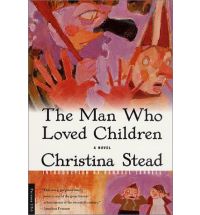
The Man Who Loved Children – Christina Stead

Book #599
Reviewer: Beth’s List Love (first published February 21, 2012)

The Man Who Loved ChildrenSam and Henny Pollit have too many children, too little money, and too much loathing for each other. As Sam uses the children’s adoration to feed his own voracious ego, Henny watches in bleak despair, knowing the bitter reality that lies just below his mad visions. A chilling novel of family life, the relations between parents and children, husbands and wives, The Man Who Loved Children, is acknowledged as a contemporary classic.

This novel is the dysfunctional family writ large. Dad is a civil servant naturalist with superficially benevolent ideas about the world and mankind, but with a heavy dose of sexism, a leaning toward eugenics, a disdain for literature, and most importantly a massive dose of narcissism hidden beneath the superficial shell. He looks initially like a fun dad, ring-master of “family fun day” on Sundays, and seemingly the younger kids enjoy him, but he contributes to the impoverishment of the family, belittles the children in various ways (including speaking a nauseating baby-talk to them), and has a major war going on with their mother.

“Mothering” (a nickname he coined, that she hates) is a former heiress who is less self-involved than she appears in some ways, but who speaks hatefully to the kids, especially the eldest who is a step-daughter, spends much of the time withdrawn or absent, and seems incapable of a kind word about anyone.

The eldest daughter Louie is the child who gets the most attention in the novel, but I had a soft spot for Ernie, the eldest boy, who is the only one in the family with financial sense. We watch the family unravel from a marginally middle-class existence in Georgetown to abject poverty and emotional chaos in Annapolis after the father becomes unemployed. The emotional toll of family life on the kids, particularly Louie and Ernie, gets clearer and clearer and leads them to desperate acts.

I found this an oddly enjoyable, but nonetheless bleak, read. My rating: 4 out of 5 stars