Elizabeth Costello – J.M.Coetzee

Book #52

Reviewer: Kara


ECElizabeth Costello is the story of an Australian novelist in her later years. Each chapter of the book features a lecture or debate, hers or someone else’s, as well as discussions and meetings surrounding the central lecture. Elizabeth’s thoughts and beliefs around a series of complex ideas are the threads tying the novel together.

This novel is relatively short in words, but long on ideas and themes. I read it in just a few days, but I spent at least as much time again to digest and gather my thoughts.

“Things can be true, she now thinks, even if one does not believe in them, and conversely.”  Elizabeth’s thoughts and ideas have changed since her youth, confusing the logic of her lectures, but leaving them much more fascinating than clearly articulated, logically-flawless arguments would be. After all, the themes themselves (the difference between humans and animals, the role of the novel, our ability to be the “other”) are messy and complex, not cut-and-dry. Coetzee elegantly navigates these ideas the way a real person who is intelligent and thoughtful, but also immersed in issues beyond easy human understanding, would. The result is a very interesting and interlocking set of ideas that give quite a bit of food for thought.

One idea is the differences and similarities between three categories of “life”: animals, humans, and god(s). In several lectures, Elizabeth argues for treating and understanding animals the same as we do ourselves. She argues that animals have a soul just as humans do. Where her argument (and also, I would say, human understanding) breaks down is when it comes to a difference between humans and animals: reason. Elizabeth argues that the scientific experiments designed to determine if animals can think are not useful because they lack complexity: “We understand by immersing ourselves and our intelligence in complexity. There is something self-stultified in the way in which scientific behaviorism recoils from the complexity of life.”  She says that animal reason is different from human reason, and there is no translation between the two.

Later, the novel discusses the relationship between humans and god(s) and it becomes clear that the major difference between the two is belief. In the final chapter, Coetzee writes “without beliefs we are not human.” Elizabeth also hears from another character that those with difficult lives (those who, unlike immortal gods, will face death) cannot afford not to believe and have faith. This echoes an earlier experience Elizabeth had in Africa where she learns that faith and company in suffering are critical comforts for people. Ultimately, Elizabeth says that all it means to be alive is “to be able to die.” The ultimate difference between humans and gods is that gods are not living.

Compounding these issues is the issue of our ability to be or experience “the other” – to stand in another’s shoes. When arguing that humans can indeed experience life as an animal does, Elizabeth says that “there are no bounds to the sympathetic imagination.” However, when it comes to humans and gods, Elizabeth changes her mind, seeing limits: “the physical mingling of two orders of being… is strictly speaking not possible, not while the laws of nature continue to hold.” She wonders what kind of hybrid being a god must become to allow humans to experience and understand. This argument is echoed later in the final chapter when Elizabeth glimpses beyond the gate to the afterlife and is disappointed to see nothing that is beyond human experience.

The most interesting moment is when Elizabeth describes the way the gods must see humans: “So like us in many respects, their eyes in particular so expressive; what a pity they lack that je ne sais quoi without which they can never ascend to sit beside us!” This is fascinating because it is so clearly the way humans see animals.

The final theme of the book is the role of the novel in allowing us to experience “the other,” for good or for bad. Elizabeth brings together all three modes of being when she says: “All is allegory… each creature is key to all other creatures. A dog … is at one moment a dog and at the next a vessel of revelation. And perhaps in the mind of our Creator… where we whirl about as if in a millrace we interpenetrate and are interpenetrated by fellow creatures by the thousand.” The novel is the ultimate allegory, offering guidance and experience that cannot be had otherwise. Elizabeth explains this most clearly when she describes writers as “secretaries to the invisible,” bringing the unknown to light. Over the course of her life, Elizabeth begins to see danger in this that she didn’t see earlier in life. She begins to believe that evil is everywhere, just waiting to creep into the light, and a novel is the perfect opportunity because, once released, it’s almost impossible to stop: “When the storyteller opens the bottle, the genie is released into the world, and it costs all hell to get him back in again.”

If you’re looking for fun or adventure in your next read, definitely look elsewhere, but if you’re in the mood to have your synapses poked and prodded, I highly recommend Elizabeth Costello. I have tried here in this review to share the themes of this wonderful novel without deluding myself or others that I can tie them up in a neat little bow. Part of the strength of Coetzee’s novel is that it allows Elizabeth to be human. She is a vehement defender of what she thinks she knows, or at least knows for the moment. Like animals, we do not always have reason and even when we do, reason sometimes turns out to be, in Elizabeth’s words: “the monster.”
Quote of the Week

Not so much a quote this week as a verse.  Enjoy!

Books to the ceiling,
Books to the sky.
My pile of books
Are a mile high.
How I love them!
How I need them!
I’ll have a long beard
By the time I read them.

-Arnold Lobel

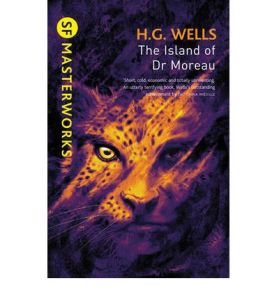
The Island of Dr Moreau – H.G.Wells

Book#796

Reviewer: Ms Oh Waily


TIODMThe Island of Dr Moreau was first published in 1896 and is another slim work at around 130 pages, requiring only a small investment of time to read.

The story is an unusual tale told by Edward Prendick of his shipwreck from the Lady Vain and the year that follows on from this.

After being adrift in the dinghy with two other survivors, who fight and perish as a result of doing so, he is spotted and collected up by the schooner Ipecacuanha.
He is nursed back from the brink of death by a passenger on board, Montgomery.  The captain is a drunkard and unpredictable.  When they reach the island where Montgomery, his very unusual manservant and his cargo of animals are being disembarked, the captain decides to set Prendick adrift once more.

Prendick finds himself, eventually, once more rescued by Montgomery and another man who in time we find is the eponymous Dr Moreau.  He lands on the island and is taken to an outer room of a compound that he finds is locked to him.

I followed him, and found myself in a small apartment, plainly but not uncomfortably furnished, and with its inner door, which was slightly ajar, opening into a paved courtyard.  This inner door Montgomery at once closed.  A hammock was slung across the darker corner of the room, and a small unglazed window, defended by an iron bar, looked out towards the sea.
This, the grey-haired man told me, was to be my apartment, and the inner door, which, ‘for fear of accidents’, he said, he would lock on the other side, was my limit inward.

Neither Montgomery nor Moreau explain anything about the animals, the ‘people’ that he observes, nor what keeps them in isolation from the rest of the world.  But it doesn’t take long for his observations to become concerns as he recognises Moreau’s name as belonging to that of a notorious vivisector and work begins within the locked enclosure on one of the cargo animals, a puma.  Prendick sums up his confusion thus,

What could it mean?  A locked enclosure on a lonely island, a notorious vivisector, and these crippled and distorted men? …

Indeed, what could it mean?  Well, you will have to read the novel to find out.

Yes, you will have to read it.  For me to give more information or specific quotes would take away some of the uncertainty and suspense that Wells builds up very nicely throughout the novel.

While I cannot say that I enjoyed reading the story, as it is not a salubrious topic, it was certainly gripping despite the scientific inaccuracies that are glaring to a modern eye.  In our minds, though, we could easily substitute the 19th century version of vivisection with other modern scientific ethical issues.  I think that is what makes this story such a timeless classic and fully deserving of its place on the 1001 list.
The ethical questions it raises, the statements it makes about how easily the abnormal can become normal, and about just how far is too far to go in the name of scientific curiosity, are still ones we confront today.

It is a quick and untaxing way to spend a few hours while also being immensely readable.  Fewer appearances of the word ‘incontinently’ makes it a vast improvement over The Time Machine, to be going on with, and more serious in it’s questioning nature makes it both interesting and thought-provoking.  All in all, I am happy recommending this to you.

Happy reading!

The Maltese Falcon – Dashiell Hammett

Book #660

Reviewer: Ms Oh Waily


TMFAnd finally we reach the last remaining Dashiell Hammett novel on the 1001 list. I can say, categorically, that I have enjoyed each and every one of them despite the great variance of topic and tale telling.
If you have missed them, I reviewed The Thin Man back in March and have completed the remaining three this month.  That would be Red Harvest, The Glass Key and today’s review of The Maltese Falcon.

Samuel Spade and the story of the Maltese Falcon is arguably Hammett’s best known work. It certainly was to me, with The Thin Man a distant second.  That could be a result of an earlier obsession with Humphrey Bogart films, of course, including the 1941 rendition of this story.

We meet Sam and his partner, Miles Archer, in their offices in San Francisco.  A young woman, Miss Wonderly, comes to hire them to follow a man who has supposedly run off with her younger sister.  The money is good, so they take her on.  Miles, with an eye to the pretty lady, says he will do it for her and does so.  Spade, on the other hand, thinks she looks like trouble.

Later that night Spade is rung by the police and told that Archer has been shot.  He goes down to the scene, but appears disinterested.  As the story progresses, it is clear that he is not fond of Archer and has been playing around with his wife, but he feels he owes it to his partner to find out the truth about his death.
Spade is not a particularly likeable character, is quite loose with the women in his life, but is smart, cunning and determined.  Hammett’s description of him is quite telling of his character.

Samuel Spade’s jaw was long and bony, his chin a jutting v under the more flexible v of his mouth.  His nostrils curved back to make another, smaller, v.  His yellow-grey eyes were horizontal.  The v motif was picked up again by thickish brows rising outward from twin creases above a hooked nose, and his pale brown hair grew down – from high flat temples – in a point on his forehead.  He looked rather pleasantly like a blond satan.

Spade ends up in the firing line from the police investigation when not only is Miles Archer murdered, but so is the man he was tailing – on the same night.
As the story progresses we find out that Miss Wonderly is not who she says she is, nor is her non-existent runaway sister real.  We find her to be Brigid O’Shaughnessy, a rather cunning liar and thief.  She also is not a particularly likeable character, especially from a modern woman’s perspective.  She sets her sights on Spade and embroils him in the cross and double-cross world of international thievery.  Along the way we meet the wonderful cast of characters that Hammett has created; Joel Cairo, Wilmer Cook and Casper Gutman are all marvellous to read and beautifully described.  I must say that although the 1941 film does not necessarily cast quite according to Hammett’s descriptions (Humphrey Bogart would need to grow another 3 or so inches to be “quite six feet tall”), they do all bring to life each of the main characters in a fair representation.  So much so that whenever I read Casper Gutman’s dialogue I continually saw and heard Sydney Greenstreet‘s voice and inflection in my head.

Unlike The Thin Man, this one’s one-liners and comebacks were relatively toned down, but Spade is still prickly and quick with his words.  In this instance he is facing down Lieutenant Dundy’s questioning over Archer’s death.

Placidity came back to Spade’s face and voice. He said reprovingly: “You know I can’t tell you that until I’ve talked it over with the client.”
“You’ll tell it to me or you’ll tell it in court,” Dundy said hotly. “This is murder and don’t you forget it.”
“Maybe. And here’s something for you to not forget, sweetheart.  I’ll tell it or not as I damned please.  It’s a long while since I burst out crying because policemen didn’t like me.”

Still the same pig-headed, gritty character as many of Hammett’s others.  But a smooth ladies man with it.  Or is that a heartless ladies man?  You need to decide.

I have thoroughly enjoyed my time travel back to the late 1920s courtesy of Dashiell Hammett and I don’t think you will be disappointed if you choose to find one or two of his works either.   The writing is good, the characters are interesting, the stories are well plotted and not obvious from start to finish.  All round easy, fun reads.  I’m rather sad that there are no more on the list.

Happy Reading everyone.

Quote of the Week

“There are three kinds of men. The one that learns by reading. The few who learn by observation. The rest of them have to pee on the electric fence for themselves.”

Will Rogers