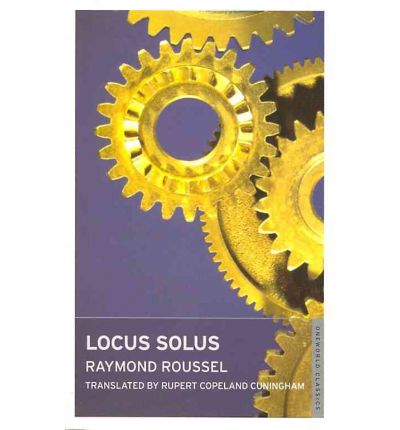
Locus Solus – Raymond Roussel

Book #745

Reviewer: Inspirational Reads
Synopsis:

Cantarel, a scholarly scientist, whose enormous wealth imposes no limits upon his prolific ingenuity, is taking a group of visitors on a tour of “Locus Solus,” his secluded estate near Paris. One by one he introduces, demonstrates, and expounds the discoveries and inventions of his fertile, encyclopaedic mind. An African mud-sculpture representing a naked child; a road-mender’s tool which, when activated by the weather, creates a mosaic of human teeth; a vast aquarium in which humans can breathe and in which a hairless cat is seen stimulating the partially decomposed head of Georges Danton to fresh flights of oratory. By each item in Cantarel’s exhibition there hangs a tale—a tale only Roussel could tell. As the inventions become more elaborate, the richness and brilliance of the author’s stories grow to match them; the flow of his imagination becomes a flood and the reader is swept along in a torrent of wonder and hilarity.

I am the type of reader that will easily abandon a book if I am not enjoying it. I have no shame about this; there are far too many books to be read and my time is too precious. But what this challenge has meant is that to fairly give a review of what I have read, I have to read my allocated book in its entirety. And this has been driven home quite clearly by this book.

Roussel has been described as a surreal science-fiction writer.  And by surreal, Roussel embraces the bizarre aspect much more than the dreamlike quality of surrealism, which is to the readers benefit. Because, as evident from the synopsis, the novel is full of Roussels outlandish creations (mosaic of human teeth people! Minute parasitic bugs used to create music and halos of light from within tarot cards!), explained in such excruciating detail that I can’t decide whether Roussel should be admired for his verbosity or have a thesaurus chucked at him (in his grave)

There are parts of this novel that I enjoyed; all the displays have a backstory as to what is being represented and why it was chosen by our host, Cantarel.  Most are heartbreaking, a few uplifting. But even this was disjointed as there is no flow or natural progression to the exhibits, just one after the other. And then at the end, they just return to the main house for tea.

To be fair, the sheer imagination involved is astounding and while wordy, they are well written. But the overwhelming detail and the lack of cohesion made this read a chore and has resulted in a mediocre rating of 2.5/5 from me.


The Devil and Miss Prym – Paulo Coelho

Book #52

Reviewer: Ms Oh Waily

This is the first novel by Paulo Coelho that I have read. I was aware of The Alchemist, but had somehow managed to get the idea into my head that Coelho was a “spiritual” type of writer. Also known as a bit “hippie”.

It is certainly true that spirituality is core to this story, but it cannot truly be said to be “hippie”. The Devil and Miss Prym is set in the village of Viscos and is a story of good versus evil and the temptations presented to us in life. Chantal Prym is a disaffected young woman who has lived in the village all of her life. She is pretty much the only young person left and like her peers she wants to leave for a better life elsewhere.  She works as a barmaid in the local hotel where visitors come for the hunting season and she often dreams that one of them will take her away for the repetitive life she leads. Berta is an old woman who’s husband died fifteen years before in a hunting accident and has sat at her door watching the village and the countryside ever since. She has sat, waiting, for evil to arrive in the village.
Finally, one day, it arrives.

A stranger arrives in the village and uses Chantal to propose an unthinkable act to the villagers in return for bars of gold and the future security of the village which has been dying slowly.   The story plays out the stranger’s scheme to test his idea of good and evil. In the process he drags both Chantal and Berta right into the heart of it all.

I love the easy flow of the writing and the ideas. I wanted to keep reading to see what would happen.  Would good or evil win?
The imagery was very nicely done too. For instance, gallows as conscience:

Ahab really understood human nature: it isn’t the desire to abide by the law that makes everyone behave as society requires, but the fear of punishment.  Each one of us carries a gallows inside us.

Then there is judgement:

He found one of the most interesting descriptions of this punishment in an Arabian book: there it was written that once the soul had left the body, it had to walk across a bridge as narrow as a knife edge, with paradise on the right and, on the left, a series of circles that led down into the darkness inside the earth.  Before crossing the bridge (the book did not explain where it led to), each person had to place all his virtues in his right hand and all his sins in his left, and the imbalance between the two meant that the person always fell towards the side to which his actions on Earth had inclined him.

A little further on he also goes on to say this:

The Chinese were also the only ones to offer a convincing explanation of the origin of devils – they were evil because they had personal experience of evil, and now they wanted to pass it on to others, in an eternal cycle of vengeance.

The whole debate over man’s inclination to be good or evil was very interesting and I completely agreed with his summing up at the end of the novel.  I won’t end my review with a spoiler, so you’ll just have to read the book to see if you agree with us.  I do think the novel had some weaknesses especially around the responses to temptation, but it didn’t particularly spoil it as a good read.  I can recommend this for a good, light read.  It was only 200 pages and I finished it in three evenings.

Ratings:
Oh Waily – 4 stars
Goodreads – 3.5 stars
Amazon – 3.6 stars


Junky – William Burroughs

Book #515

Reviewer: Alison

One line on the back cover sums this book up perfectly; “A legendary account of heroin addiction, drawn from William S Burroughs’ own life”

I knew this book would be special when I borrowed it from the library.  The librarian advised me that the reason it’s kept behind the desk is because it tends to get stolen!

First published in 1953 the book is still unnervingly relevant and modern today.

Set in the early – mid 1900’s it is a “no holds barred” story of the writers life as a heroin addict.  It depicts the highs and lows of addiction.  He “takes the cure” several times enduring the pain and sickness of withdrawal only to be drawn right back in.

All in all a great read however a little raw & confronting at times.


The Passion of New Eve – Angela Carter

Book #310

Reviewer: pixidee


Published 1977 – London Victor Gollancz Ltd
191 pages
Inside Cover

Baroque in style, apocalyptic in vision, The Passion of New Eve is a late twentieth- century pilgrim’s progress though a disintegrating world, a world which, at every turn, will extend and shock the senses.
New York has become the City of Dreadful Night, where black, disingenuous Leilah dances a dance of chaos and dissolution for Evelyn, the young Englishman whose exemplary fate is that of Tiresias – in the desert, the arid zone, the post-menopausal part of the earth, an many-breasted self-styled fertility goddess will wield the obsidian scalpel that transforms him into the new Eve of the title

This is the story of how Evelyn learns to be a woman and finally becomes a kind of Madonna, or eve at the end of the world. He undergoes a strenuous apprenticeship of femininity in the ranch-house of Zero, the poet, a ragtime Neitzche; marries ambiguous, ancient beautiful Tristessa, the ghost of Hollywood past, myth make flesh, in a glass palace full of worn-out dreams, a bankrupt Eden; is precipitated into the heavy reality of a California torn by civil war; and learns at last a kind of enlightenment in a deserted cave on the Pacific coast.
Using the apparatus of myth to examine the nature of the mythology of sexuality, Angela Carter’s dazzling imaginative novel is richly streaked with black humour. One of our most original and disturbing novelists, she has won both the Somerset Maugham and the John Llewellyn Rhys awards for her earlier novels.

My Verdict

This was a very interesting read for sure, full of metaphors, some I got straight away others I had to re-read a couple of times to fully get what they were getting at (quite a few big words that I haven’t heard of before or was unsure what context…).

Was action packed, for example ‘Eve’ was kidnapped about 4 times in less than 200 pages, and each new situation that she was in there was a whole lot more going on and each situation was so very different, women making him into a her, getting kidnapped by a crazy man with 7 wives that were forced to act like animals, taken to a glass palace, then escaping again with the ever elusive Tristessa and getting lost in the desert to then be taken hostage by teenage boys, to then ending up back at the beginning. It’s a whole life cycle in one little book.

Was written from Eve’s point of view, almost felt like a memoir type thing (not that I have read one of those before, but it’s how I would imagine one would be).

A few pet peeves

The chapters are not all the same length, 1 chapter is half a page long and a couple of the other chapters are about 30 or more pages long so kind of annoying is you are the kind of reader who likes a chapter before bed.

The main part of Evelyn becoming Eve bugs me as he is now a she but you never takes any hormone pills/injections to keep her now body her – so have to get past that as we now know about how these things work.

There lots of words that I don’t even know how to say so that makes it a bit hard but the book was still readable.

Summary 

Loved the story, couldn’t wait to pick it up again, good length, and would be keen to read some other novels by Angela Carter after reading this one. Weird and wonderful a bit like me!

I’d rate this easily 4 out of 5.


The Garden Party and Other Stories – Katherine Mansfield

Book #714

Reviewer: Ms Oh Waily

I suppose it might be considered a bit sacrilegious for a New Zealander to admit to never having turned over a single page of this national icon’s work. But I may as well confess up front. Nope. Never read any Mansfield before.
Joining this first, is another, reading this work as an e-book. My version came from the Project Guttenberg library.

The Garden Party is a volume of short stories. In my edition the title story is the third of the stories and, at the risk of committing yet more sacrilege, I didn’t find it particularly inspiring. Maybe I wasn’t meant to. I’m a bit unclear on this, having now spent a little bit of time learning about the author.

The story is apparently set in Tinakori Road in Wellington although this is never actually stated outright. It is full of class commentary, with the privilege of the Sheridan family who are hosting the garden party being shown in contrast to the lives, and death, of the working class families in the lane across the broad road. Here is the description of the working class cottages:

They were the greatest possible eyesore, and they had no right to be in that neighbourhood at all. They were little mean dwellings painted a chocolate brown. In the garden patches there was nothing but cabbage stalks, sick hens and tomato cans. The very smoke coming out of their chimneys was poverty-stricken. Little rags and shreds of smoke, so unlike the great silvery plumes that uncurled from the Sheridans’ chimneys.

Interestingly the theme of this, and most of the other stories, is transition. Laura Sheridan is changing from naive, sheltered girl to adulthood and awareness. And this plays out in different ways. Unfortunately I didn’t really pick up on this until I had read the entire series of stories. The themes became clear as I made my way through the remainder. Death, change and transitions are the things that appear to be consuming the author’s mind. Not really surprising since she herself was battling ill health, TB and eventually having to face her own mortality.

Being completely honest, I won’t be rushing out to get another volume of her stories. But in saying that I am glad that I made the effort to read them. It took me to nearly halfway through the book before I began to relax into the stories. I found some completely bland and colourless and others prickly. Some had characters that were completely irritating, needing a good slapping and others with characters deserving great pity and admiration.

The writing style was easy and some of her descriptions have a great deal of colour about them, similar to the quote about the chimney smoke above.
One of my favourite phrases she uses is “little staggerer” to describe toddlers.

Ratings:
Oh Waily – 3 stars
Goodreads – 4 stars
Amazon – 4.4 stars