BOOK #223
Reviewer: Tall, Short, Tiny & a Pickle
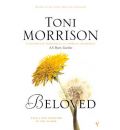 Beloved was my first Toni Morrison novel, and golly, what a place to start. This is a powerful story, with memorable characters and a strong sense of history.
Beloved tells the story of Sethe and her 18-year-old daughter Denver, who have escaped from slavery to Ohio – a free state – after the American Civil War.
In order to keep her children safe, Sethe tries to kill Denver and her three siblings, but is is successful in killing only her eldest daughter. Her two sons run away, and Denver is just a baby at the time, but her older sister, age two, is buried with a tombstone with simply “Beloved” on it. When a strange young woman appears on their new front porch, saying nothing about who she is but claiming her name is Beloved, Sethe believes that she is her murdered daughter. She falls over backwards to spoil Beloved, offering her the best of everything, including food, to the detriment of her own health. While Sethe wastes away, Beloved grows larger; she becomes very demanding and throws toddler-like tantrums when she doesn’t get her way.
While Sethe’s actions towards her children seem abhorrent on the surface, one of her redeeming features is her intense devotion to her children; her attempts at murder are to keep her children protected from the horrors she experienced as a slave. I went through stages of loving and hating Sethe for her treatment of Beloved and Denver, and by the end of the story, I still had mixed feelings towards her.
Denver is a shy, intelligent girl, often portrayed as possessing a gift for communicating with ghosts. While Beloved flourishes, Denver appears to withdraw further from the outside world, but by the end of the novel, she is proven to be much stronger, more courageous and determined than I first thought. Denver is the most interesting of characters, for me, and I found her a fascinating character.
“There is a loneliness that can be rocked. Arms crossed, knees drawn up, holding, holding on, this motion, unlike a ship’s, smooths and contains the rocker. It’s an inside kind–wrapped tight like skin. Then there is the loneliness that roams. No rocking can hold it down. It is alive. On its own. A dry and spreading thing that makes the sound of one’s own feet going seem to come from a far-off place.”
The character of Beloved is also intriguing, and throughout the story, Morrison presents three different perspectives regarding who Beloved may be. She may simply be a stranger, a young woman who has been kept locked away as a slave for many years, which would account for her language and social difficulties. Sethe believes her to be her Beloved, her toddler, because of the way she acts, her outward appearance, her breath that smells like milk and her knowledge of a few facts that only one of Sethe’s children could know. In later chapters, Beloved tells stories that make Sethe and the reader wonder if she is Sethe’s mother; she shares personal traits with Sethe’s mother and recounts stories of her voyage to America from Africa.
Beloved is a great story, with a strong sense of the power the past can have over people, and how they can either overcome it, or let it haunt them forever. It is uplifting, horrifying, saddening and hopeful all at once, and I can’t recommend it highly enough.











 1001 Books to Read Before You Die